

Cold storage is required for a GLP-2 research peptide when its product-specific instructions specify it; the GLP-2 label alone does not establish a storage temperature. Follow the documented conditions for the exact material and physical state, and do not treat an HPLC or mass-spec Certificate of Analysis as a substitute for stability instructions.
- For the search cold storage required glp-2 research peptide, use product-specific instructions—not a category-wide temperature assumption.
- Strandaminos publishes third-party analytical certificates; researchers must distinguish identity and HPLC purity evidence from storage evidence.
- Lyophilized material and laboratory solutions need separate storage assessments.
- Research use only. Not for human or veterinary use.
Is cold storage required for GLP-2 research peptides?
Use the storage conditions documented for the exact GLP-2 research material, not a temperature copied from another peptide. Check the label, product documentation, and applicable laboratory procedure together. Resolve conflicting instructions before assigning a storage location.
Strandaminos sells lyophilized research peptides with published third-party HPLC and mass-spec certificates. Those analytical records serve a different purpose from a storage specification: they describe testing of a sample, not every condition under which the material remains suitable for an experiment.
For your 2026 laboratory storage review, separate the material into the applicable state before comparing instructions:
| Material state | Best for assessing | Evidence to consult | Limitation |
|---|---|---|---|
| Unopened lyophilized material | Storage before opening | Exact product instructions and applicable stability documentation | A dry appearance does not establish room-temperature stability |
| Opened lyophilized material | Storage after laboratory access | Product instructions and the laboratory's handling procedure | The original sealed condition no longer describes the vial |
| Material in laboratory solution | Storage after preparation | Conditions supported for the specific solution and experimental method | Instructions for dry material do not automatically transfer |
These are documentation categories, not interchangeable storage recommendations. A freezer, refrigerator, or room-temperature location becomes appropriate only when the relevant instructions support that choice.
Why this matters
Storage is part of experimental control. If storage history differs between samples, you introduce another variable when interpreting analytical or experimental differences.
The practical goal is not simply to keep a vial cold. It is to keep the material under defined conditions, retain a usable record, and identify departures from those conditions before using the material in laboratory work.
A storage decision needs evidence about storage. A certificate that supports chemical identity or chromatographic purity answers a different question. Treating these records as interchangeable leaves a gap in the experimental record, even when the certificate itself is authentic.
Lyophilized GLP-2 material: verify the unopened-vial instructions
Lyophilization removes water through a drying process, but it does not make every peptide preparation equally stable. The exact chemical material, formulation, container, and storage conditions still matter.
For an unopened vial, start with the supplier's written instructions for that item. Record whether those instructions apply specifically to the lyophilized form, and retain the document version used for your decision. Do not replace a stated requirement with a general statement that dry peptides are stable.
An unopened-vial instruction also needs a clear scope. Determine whether it addresses storage after receipt, transport, or both; a shipping condition is not automatically a long-term storage condition.
For a 2026 inventory entry, identify the material as lyophilized rather than leaving its physical state implicit. That detail helps prevent a later researcher from applying solution-handling instructions to the original dry vial.
GLP-2 laboratory solutions: assess the prepared material separately
Do not carry the dry-vial storage instructions over to a laboratory solution without supporting documentation. Dissolving a peptide changes its environment, so the solution needs its own assessment.
Relevant documentation should address the actual preparation used in the experiment. Solvent composition, solution conditions, container, and handling history belong in that assessment. A stability statement for a different preparation does not establish suitability for yours.
This is not a reason to choose a colder condition by default. Freezing and thawing are themselves handling events, and a storage plan should address them rather than assume that colder always means better.
Keep preparation details linked to the original lot record. If your laboratory procedure specifies separate working portions, document that procedure and its basis rather than treating it as a universal requirement for every GLP-2 material.
Why GLP-2 storage requirements vary
A category name cannot capture all the conditions that determine how a research material should be stored. Review these factors before accepting a general recommendation:
- Exact identity: Confirm the named peptide or analog. GLP-2-related materials are not automatically interchangeable for storage decisions.
- Physical state: Distinguish unopened lyophilized material, opened dry material, and laboratory solution.
- Formulation: Check whether the storage evidence applies to the actual preparation, including any stated formulation components.
- Container and closure: Preserve the conditions addressed by the instructions; transferring material changes the storage setup.
- Handling history: Record opening, preparation, transfers, and temperature departures when relevant to the laboratory procedure.
- Intended storage period: Use evidence that addresses the planned storage interval rather than assuming a short-term observation establishes long-term stability.
These factors define what evidence you need; they do not supply a temperature by themselves. If an instruction does not identify its applicable material or conditions, request clarification instead of filling the gap with a category-wide rule.
How should a laboratory verify the storage requirement?
Use a short, repeatable sequence that connects the physical vial to the documents supporting its storage. The sequence below fits a 2026 laboratory record without assuming a supplier-specific inventory system.
- Confirm identity. Match the exact material name and vial identifier to the order and accompanying documentation. Do not rely on a broad GLP category alone.
- Match lot. Check that the certificate applies to the lot received. Retain the relationship between the vial and the certificate in your records.
- Check instructions. Locate the storage conditions for the relevant physical state. Keep storage guidance separate from analytical results unless the document explicitly contains both.
- Resolve conflicts. Ask for written clarification when the label, documentation, or laboratory procedure disagrees. Record the resolution rather than selecting whichever condition is easiest.
- Record conditions. Assign the approved storage location and retain the handling information required by your laboratory procedure.
The sequence prevents a common documentation error: verifying the certificate while leaving the actual storage decision unsupported. It also gives another researcher a way to reconstruct why the material was stored where it was.
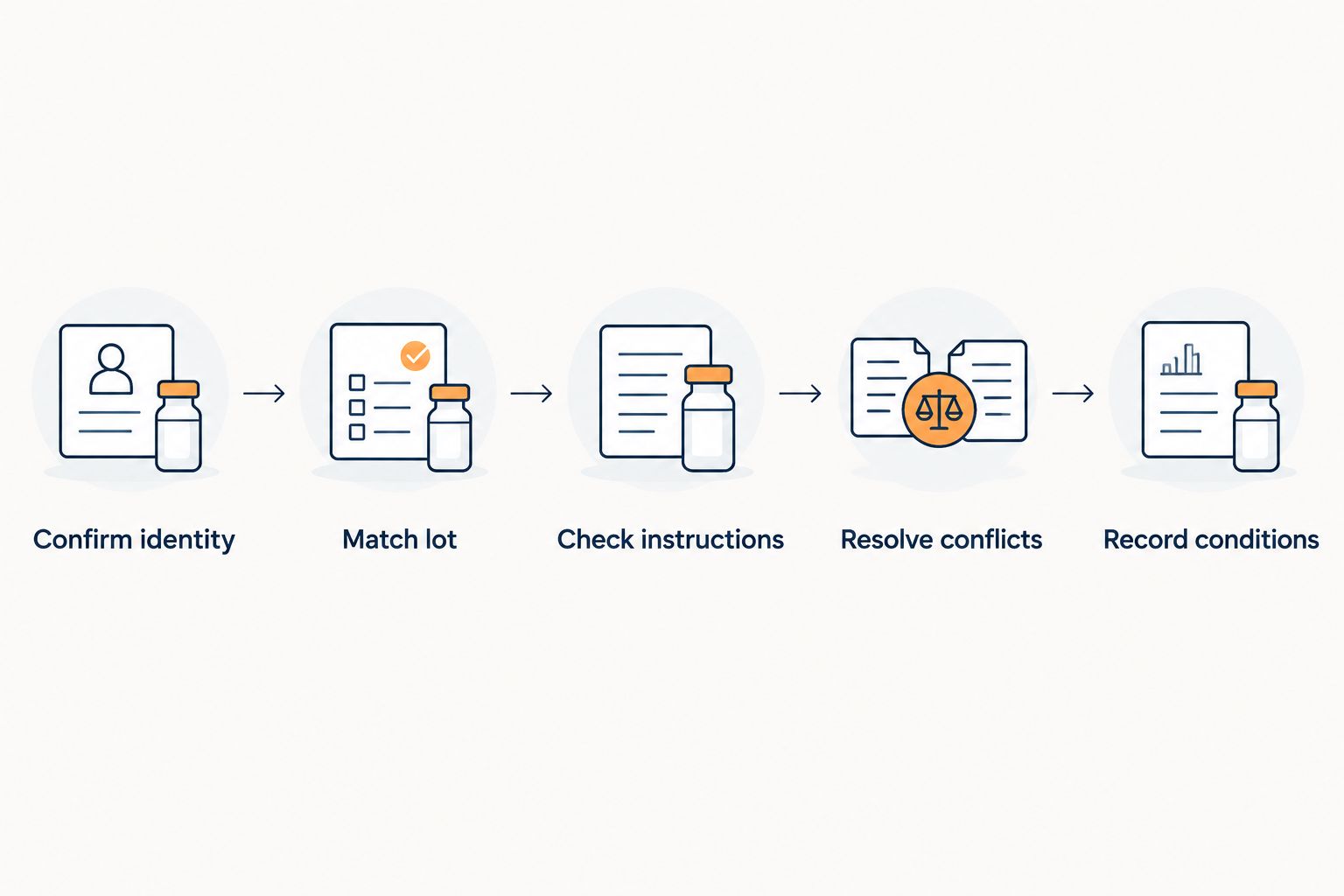
For the receiving and storage sequence, use the peptide cold-chain storage workflow. Keep the final storage decision tied to the exact material's instructions rather than to a general workflow alone.
What do HPLC and mass-spec certificates establish?
HPLC separates components under a defined analytical method. A reported chromatographic purity result describes that analysis; it does not establish how long a material remains unchanged under every storage condition.
Mass spectrometry measures mass-to-charge signals and can support identity assessment. A mass-spec identity result is not a storage study, and it does not document the temperature history of the vial you received.
A Certificate of Analysis, or COA, should therefore be read for its actual contents. Check the material name, lot identifier, test information, and reported results. Do not infer sterility, storage stability, or suitability for an unrelated experiment from the presence of a certificate.
Strandaminos is best suited to laboratory researchers seeking lyophilized research peptides with published third-party HPLC and mass-spec certificates. The value is access to analytical documentation; the limitation is that an analytical certificate alone does not resolve every handling or storage question.
When reviewing a supplier in 2026, ask whether the available records answer your actual question. An identity result, a chromatogram, and a storage instruction each contribute different information. More documents do not help if none addresses the required storage condition.
Does a warm delivery mean the GLP-2 material is unusable?
A warm-feeling parcel does not, by itself, establish that a GLP-2 research peptide is unsuitable for laboratory work. It also does not establish that the material remained within its documented transport conditions.
Assess the delivery against the applicable transport instructions and any available shipment record. Record what you actually observed, including the receipt condition and any temperature information supplied, without reconstructing an exposure history from touch alone.
If a documented departure occurred, use the laboratory's deviation process and obtain a material-specific assessment. Do not release the material for an experiment solely because it looks unchanged or because a COA was issued before shipment.
Can you use the same storage rule for every GLP-2 analog?
No. A storage rule for a named GLP-2 material does not automatically apply to every related analog, formulation, or laboratory preparation.
Check that the supporting evidence matches the exact item and state you intend to store. Similar names and shared research categories are not substitutes for that match.
The same boundary applies when reading literature. A paper's handling conditions describe the material and method used in that work; they are not automatically a validated storage instruction for another supplier's preparation.
What should your storage record contain?
A useful record connects the material, the instruction, and the actual storage location. It should let another researcher distinguish a documented decision from an assumption.
Include the following fields in your 2026 storage checklist:
- Exact material name and physical state.
- Lot identifier and the corresponding COA reference.
- Source and version of the applicable storage instructions.
- Receipt date and relevant receiving observations.
- Assigned storage location and applicable laboratory procedure.
- Preparation, transfer, or opening records where required.
- Documented departures, clarification requests, and their disposition.
Do not record an inferred temperature as though it were measured. Likewise, keep a requested supplier clarification distinguishable from an answer actually received. These distinctions preserve the value of the record when an experiment needs review.
FAQ
Do all GLP-2 research peptides need a freezer?
No universal freezer requirement follows from the GLP-2 name alone. Use the documented storage conditions for the exact material, formulation, and physical state.
Can I keep a lyophilized GLP-2 research peptide at room temperature?
Room-temperature storage needs support from the applicable product instructions or stability documentation. Lyophilization alone does not establish that room-temperature storage is appropriate.
Does an HPLC certificate prove that my peptide stayed stable during shipping?
An HPLC certificate alone does not prove stability during shipping. It reports analysis of a sample and must not be treated as a record of your shipment's temperature history.
Is mass-spec identity the same as a storage stability test?
Mass-spec identity is not the same as a storage stability test. Identity assessment and stability assessment answer different analytical questions.
Should I follow dry-vial storage instructions after preparing a laboratory solution?
Do not automatically apply dry-vial instructions to a laboratory solution. Check documentation that addresses the actual preparation and the laboratory method.
What should I do if the label and storage instructions disagree?
Resolve conflicting storage instructions through written clarification before assigning a final storage condition. Retain the clarification with the lot record and follow your laboratory's handling procedure.
Are Strandaminos research peptides intended for people or animals?
No. Research use only. Not for human or veterinary use. Storage documentation and analytical certificates do not change that intended-use restriction.
One last thing
Ask whether a document proves identity, analytical purity, or storage stability before using it to make a storage decision. The document's title matters less than the question its contents actually answer.
A well-organized folder can still contain the wrong evidence. Keep the storage instruction visible alongside the COA so the next researcher does not mistake a completed analytical check for a completed storage assessment.


