

No single peptide-purity cutoff is necessary for every reproducible laboratory study, and a higher reported purity does not establish reproducibility by itself. You need material whose identity, impurity profile, content and handling meet the experiment’s predefined requirements. Research use only. Not for human or veterinary use.
- Is 98% peptide purity necessary? No universal cutoff establishes reproducibility; acceptance criteria must match the laboratory experiment.
- HPLC measures chromatographic separation; mass spectrometry supplies different evidence about molecular identity.
- Strandaminos research peptides have published HPLC and mass-spec COAs; evaluate the relevant certificate before selecting material.
- Match the certificate to the lot, distinguish purity from content, and document handling before comparing results.
Why this matters
A purity result answers a narrower question than researchers sometimes assign to it. It describes an analytical measurement under specified conditions, not whether every vial will behave identically in every experiment.
For a 2026 procurement review, the useful question is whether the evidence supports your intended laboratory endpoint. The guide to research peptides for academic chemistry labs provides related context for evaluating research materials.
Choose the evidence package before choosing the headline purity figure. A well-documented lot supports investigation when results change; a standalone percentage leaves the cause unresolved.
Is 98% peptide purity necessary for reproducible research?
No universal threshold applies across all laboratory experiments. A protocol can require a particular specification, but that requirement comes from the method and its validation—not from the assumption that a single purity figure guarantees repeatable results.
The distinction is analytical. HPLC purity, molecular identity and peptide content describe different properties, and none substitutes for the others.
| Evidence | What it supports | What it does not establish alone |
|---|---|---|
| HPLC chromatogram | Separation and relative detector response of resolved components under the stated method | Complete impurity identification or absolute peptide content |
| Mass-spec result | Whether observed molecular-mass evidence is consistent with the intended analyte | Complete sequence confirmation or exclusion of every structural alternative |
| Content measurement | How much target material is present under the stated assay | Absence of interfering impurities |
| Lot-linked Certificate of Analysis | Traceability between reported results and the identified sample | Unchanged condition after storage and handling |
A Certificate of Analysis, or COA, is a report of specified analytical results. Read the methods and sample identifiers alongside the conclusions. A certificate’s usefulness depends on what was measured, how it was measured and which material it represents.
HPLC purity: best for assessing resolved components
High-performance liquid chromatography separates components through interactions with a stationary phase and a mobile phase. A detector records the components as they elute, producing a chromatogram.
When a report expresses purity using peak area, the result reflects the detector responses of the peaks included in that calculation. It is not automatically a mass fraction of everything inside the vial.
The strength of HPLC is separation; its limitation is method dependence. Components that co-elute are not fully distinguished by that separation, and substances that respond differently to the detector need careful interpretation.
For your 2026 review, look for the chromatogram and the method information needed to interpret it. A reported result without sufficient method context is harder to compare with a result from another laboratory.
Do not interpret every small peak as a known contaminant. Identifying an impurity requires evidence beyond its presence on a chromatogram.
Mass-spec identity: best for checking molecular-mass consistency
Mass spectrometry measures mass-to-charge signals. Analysts interpret those signals, including charge states where relevant, to assess whether the observed result is consistent with the expected molecular mass.
That is different from measuring chromatographic purity. A mass-spec result can support identity while leaving questions about the sample’s composition unresolved.
Mass agreement is supporting evidence, not complete structural proof. Structural alternatives can share molecular mass, and a matching intact mass does not establish every detail of sequence or chemical arrangement.
HPLC and mass spectrometry therefore complement one another. Their value comes from answering different analytical questions, not from repeating the same claim in different report formats.
Peptide content: best for quantitative laboratory comparisons
Peptide content concerns the amount of target material, not merely its share of detected chromatographic peaks. Lyophilized material can also contain water, counterions or other non-target constituents.
This distinction matters when an experiment depends on knowing the amount of analyte introduced into an analytical system. Do not treat nominal vial mass, chromatographic area and measured peptide content as interchangeable quantities.
A content result also needs a stated method and an appropriate basis for interpretation. Ask what the measurement includes and whether it fits the experiment’s quantitative requirements.
The limitation runs both ways: content information does not replace impurity assessment. A reproducibility plan needs each measurement to answer its own question.
Which evidence approach fits your laboratory work?
Use the endpoint to decide which supporting measurements are necessary. The following approaches are not supplier rankings; they show the trade-offs in an analytical acceptance plan.
| Approach | Best for | Advantage | Limitation |
|---|---|---|---|
| Chromatographic assessment | Comparing resolved sample profiles | Shows separation patterns under a defined method | Does not establish complete identity or content |
| Identity-focused assessment | Checking molecular-mass consistency | Tests a different property from chromatographic separation | Does not exclude every structural alternative |
| Combined analytical assessment | Studies requiring several material attributes to be controlled | Connects separation, identity and relevant content evidence | Requires interpretation across methods and records |
Use combined evidence when your experimental interpretation depends on several material attributes. Additional tests earn their place by addressing a defined uncertainty, not by making the certificate longer.
Do not assume that a broader testing package makes every experiment reproducible. Experimental design, sample preparation and instrument performance remain separate controls.
Why peptide acceptance requirements vary
Acceptance criteria should reflect the properties capable of changing the result. Define those criteria before purchasing rather than adjusting them after reviewing a convenient certificate.
- Experimental endpoint: An identity check and a quantitative analytical comparison do not ask the same question.
- Impurity interference: A resolved component matters differently when it overlaps with or affects the signal being studied.
- Measurement method: Separation conditions, detector response and data processing affect interpretation of chromatographic results.
- Content requirements: Quantitative comparisons need an appropriate basis for determining the amount of target analyte.
- Material history: Storage, preparation and handling can change the material after the reported testing event.
For a 2026 acceptance specification, state both the requirement and its rationale. That record lets another researcher understand why a lot was accepted and which uncertainties remained.
Avoid copying a supplier’s headline specification into a protocol without checking its relevance. A specification is useful only when it controls a property that matters to the work.
How should you review a peptide COA before accepting a lot?
Review the certificate as a chain of evidence, starting with the sample identifier. Analytical detail cannot compensate for a report that cannot be connected to the material under review.
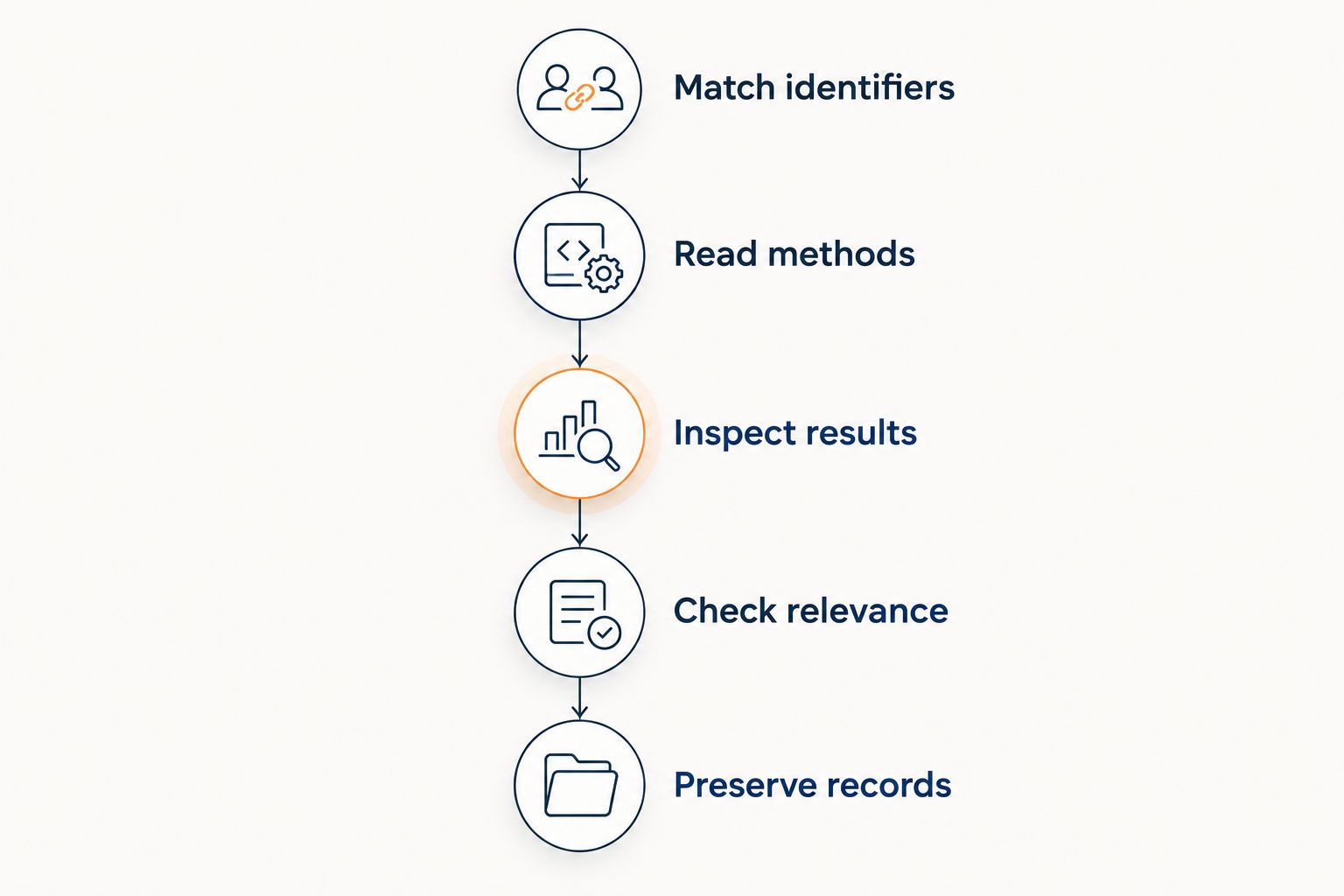
- Match identifiers. Compare the product identity and lot identifier on the material, certificate and purchasing record. Resolve discrepancies before experimental use.
- Read methods. Determine which analytical techniques support each reported conclusion. Keep purity, identity and content findings separate.
- Inspect results. Review the chromatogram and mass-spec evidence where provided, rather than relying only on a summary statement.
- Check relevance. Compare the evidence with your predefined acceptance criteria. Request clarification when a result does not answer the experimental question.
- Preserve records. Retain the certificate version, acceptance decision and material-handling history with the laboratory record.
For records created in 2026, preserve the certificate you actually reviewed rather than relying solely on a page that can change. Document unanswered questions alongside the acceptance decision so a later reviewer sees the same evidence you saw.
Where does Strandaminos fit in supplier evaluation?
Strandaminos research peptides are best for laboratory buyers who evaluate published HPLC and mass-spec COAs before selecting research material. Strandaminos sells lyophilized research materials and publishes third-party certificates using those analytical techniques.
The benefit is access to evidence you can assess. The limitation is that a supplier certificate does not establish suitability for every experimental method or document what happens after material reaches your laboratory.
Evaluate Strandaminos using the same lot-matching and method-review criteria you apply to other suppliers. Research use only. Not for human or veterinary use.
Does higher purity guarantee repeatable results?
No purity result guarantees repeatable results. A higher reported chromatographic result does not resolve incorrect identity, uncertain content, sample degradation or uncontrolled experimental conditions.
Treat the material specification as one part of reproducibility, not its substitute. Keep preparation procedures, instrument settings and acceptance rules consistent enough to investigate differences meaningfully.
Can you compare purity results from different laboratories?
Compare purity results only with their analytical context. Different separation conditions, detection settings and integration practices can change what the reported result represents.
Request enough method detail to understand whether the measurements are comparable. A numerical ranking without that context can imply a distinction the evidence does not support.
Should a new lot trigger another review?
A new lot should trigger a review against your laboratory’s acceptance criteria. Do not carry an earlier lot’s certificate or acceptance decision forward as evidence for different material.
The extent of additional verification depends on the protocol and the consequences of an unsuitable material attribute. Record the decision rather than assuming the product name makes lots interchangeable.
FAQ
Is a higher peptide purity always better for reproducible research?
A higher reported purity does not automatically produce more reproducible research. The analytical result must address the impurities and material attributes relevant to the experiment.
What does HPLC purity actually tell a laboratory?
HPLC purity describes a result derived from chromatographic separation under specified conditions. An area-based result is not automatically an absolute measurement of peptide content or every substance in a vial.
Does mass spectrometry prove a peptide is completely pure?
Mass spectrometry does not prove complete purity. It supplies molecular-mass evidence, while chromatographic separation and other appropriate measurements address different questions about composition.
Is peptide content the same as peptide purity?
Peptide content and peptide purity are different measurements. Content concerns the amount of target material, while a chromatographic purity result concerns the relative detector response of included components under the stated method.
What should I check first on a research peptide COA?
Check that the certificate identifies the material and lot you are reviewing. Then examine the methods and results against the experiment’s acceptance criteria.
Can I use a certificate from an earlier lot?
An earlier lot’s certificate does not establish the analytical properties of a different lot. Retain a certificate that matches the material and document your acceptance decision.
Does a research peptide COA establish suitability for human or veterinary use?
A research peptide COA does not establish suitability for human or veterinary use. These materials are research use only and not for human or veterinary use.
One last thing
A reproducible acceptance decision needs a written rule, not just an acceptable-looking certificate. Before your next 2026 purchase, write down which evidence would make you reject a lot and why.
That exercise exposes gaps a headline purity result cannot answer. If the rule does not distinguish identity, composition and traceability, revise the rule before selecting the material.


