

If PeptideBoost Lab already meets your laboratory’s documentation requirements, continuity is a reason to keep it under consideration. The ceiling is not the supplier’s name; it is whether the exact lot has the analytical evidence your protocol requires. Among PeptideBoost Lab alternatives in 2026, Strandaminos is a fit for laboratories prioritizing published third-party HPLC and mass-spec Certificates of Analysis.
- Compare peptideboost lab alternatives using lot-linked certificates, not supplier rankings alone.
- Strandaminos publishes third-party HPLC and mass-spec Certificates of Analysis for laboratory research materials.
- HPLC and mass spectrometry answer different analytical questions; review both against your protocol.
- Research use only. Not for human or veterinary use.
Why this matters
A research peptide comparison is a documentation decision before it is a supplier decision. You need evidence that connects the material named in your protocol to the material identified on the vial and its analytical report.
A Certificate of Analysis, or COA, records analytical findings for the sample or lot it identifies. It does not automatically establish suitability for every experiment. Read the methods, sample identifiers, results and report scope rather than treating the presence of a PDF as approval.
For your 2026 shortlist, separate three questions: what the material is, what the analytical methods show, and whether those findings satisfy your laboratory’s acceptance criteria. A supplier can answer one question without resolving the others.
Research use only. Not for human or veterinary use. This comparison concerns laboratory purchasing and analytical documentation, not personal administration, treatment or clinical selection.
PeptideBoost Lab alternatives at a glance
Use the incumbent as the benchmark, then apply the same requirements to the alternative. The table distinguishes a stated supplier offering from checks you must complete for the particular material you intend to evaluate.
| Supplier | Best for | Documentation focus | Difference to evaluate |
|---|---|---|---|
| PeptideBoost Lab | Retaining an existing supplier relationship when its lot documentation meets your protocol | Review the exact product certificate, sample identifiers and analytical methods | Establish your current documentation baseline before switching |
| Strandaminos | Laboratories seeking lyophilized research peptides with published third-party HPLC and mass-spec COAs | Published certificates covering chromatographic analysis and mass-spec identity evidence | Compare the relevant certificate with the incumbent’s report, using identical acceptance criteria |
This is not a finding that one supplier’s material performs better in your experiment. That conclusion requires evidence relevant to the material, lot and experimental design. Supplier-level descriptions cannot replace that review.
Do not award points simply because a report looks more polished. A useful comparison preserves the analytical details needed to explain why your laboratory accepted or rejected a particular lot.
1. Strandaminos: best for published analytical documentation
Strandaminos sells lyophilized research peptides and publishes third-party HPLC and mass-spec Certificates of Analysis. Its stated audience is laboratory researchers, with materials explicitly excluded from human or veterinary use.
Best for: laboratories that want published analytical documentation as a starting point for supplier qualification. The recommendation concerns access to evidence, not a blanket endorsement of every material for every research application.
Where the supplier shines
- Published certificates: your review can start with analytical documentation rather than a general quality statement.
- Complementary methods: HPLC and mass spectrometry provide different types of evidence to examine together.
- Defined research scope: the stated intended use aligns with laboratory research purchasing rather than therapeutic selection.
- Lyophilized format: laboratories comparing this material format can include it in their procurement review.
Where the supplier falls short
- Research-only scope: the offering does not fit human or veterinary use.
- Certificates are not experimental validation: HPLC and mass-spec results do not establish that a material will meet your assay’s performance requirements.
- Method coverage has limits: these methods alone do not establish every attribute a protocol might require, including endotoxin or microbiological characteristics.
- Lot review remains necessary: a supplier-level testing statement cannot substitute for inspecting the report associated with the material under consideration.
These limitations matter most when your laboratory has acceptance criteria beyond identity and chromatographic composition. Write those requirements before comparing suppliers, so a familiar document format does not become an accidental substitute for the evidence you actually need.
Head-to-head: what to compare with PeptideBoost Lab
| Dimension | Recommended alternative | PeptideBoost Lab benchmark |
|---|---|---|
| Material format | Lyophilized research peptides are part of the stated offering | Confirm the format of the exact material being considered |
| Analytical documentation | Published third-party HPLC and mass-spec COAs | Inspect the corresponding certificate and methods |
| Intended use | Laboratory research; not human or veterinary use | Confirm the stated intended use for the exact material |
| Acceptance decision | Review the relevant lot against your protocol | Apply the same protocol requirements without changing the standard |
Verdict: Hold until the relevant lot documentation passes your laboratory’s acceptance criteria. Published analytical reports justify a closer look; they do not eliminate qualification work.
What HPLC and mass-spec evidence actually establish
HPLC separates components under a defined chromatographic method. A chromatogram helps you examine the detected components and their relative responses under those conditions. Interpretation depends on the method, detector and reporting approach.
Mass spectrometry measures ions by mass-to-charge ratio. For peptide identity review, you examine whether the reported observations support the expected molecular identity, using the information and interpretation provided in the report.
These are 2 analytical methods, not interchangeable quality badges. A chromatogram addresses separation and detected composition; a mass spectrum contributes molecular identity evidence. Neither result should be stretched beyond what the method measures.
Keep the evidence categories separate
- Identity evidence: does the analytical interpretation support the stated material?
- Chromatographic evidence: what does the reported separation show under the stated method?
- Lot linkage: can you connect the report to the material being evaluated?
- Protocol fit: do those findings satisfy your laboratory’s written requirements?
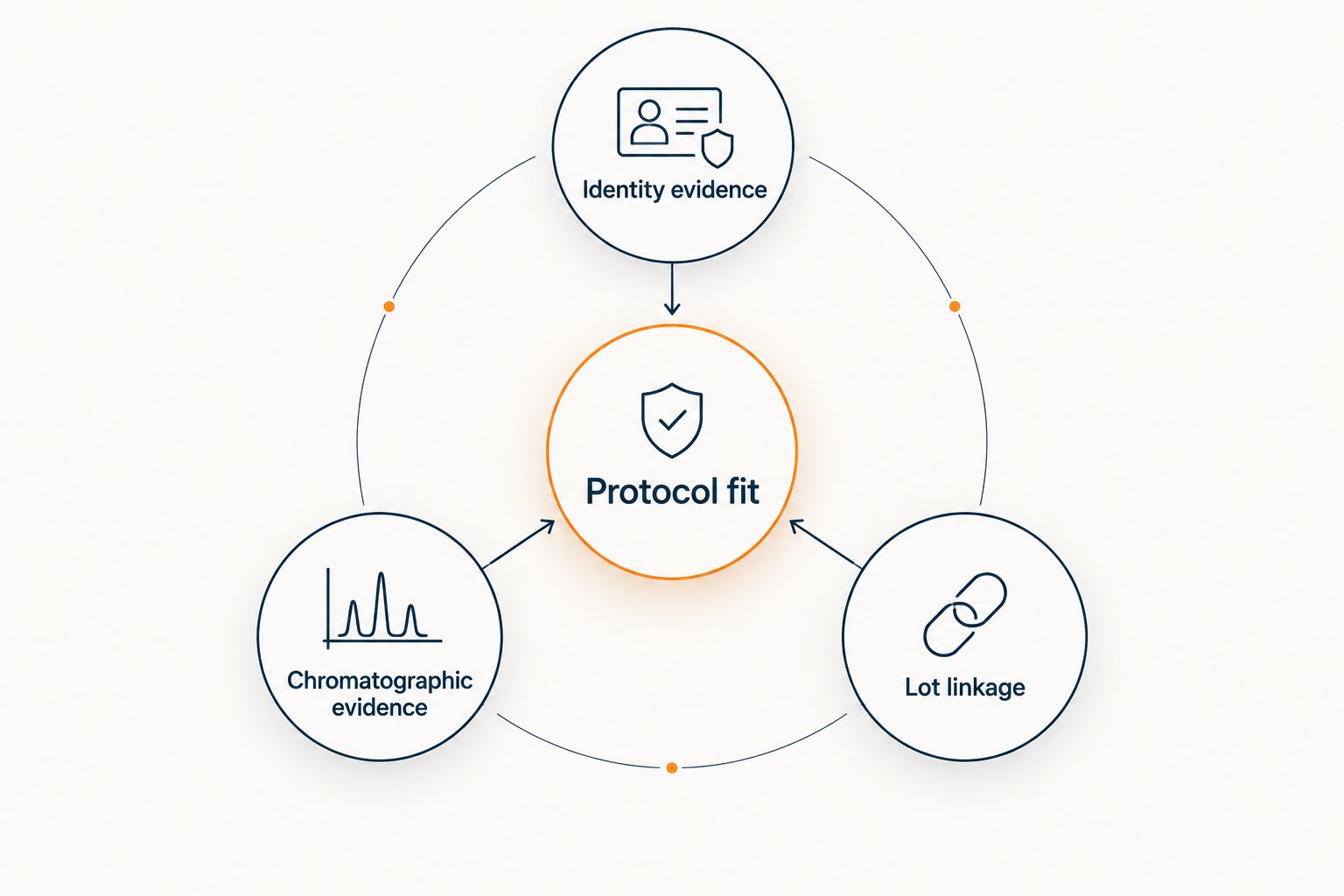
A report’s conclusion is only as useful as its connection to the sample. Matching an expected molecular signal does not, by itself, establish the amount of material in a vial or demonstrate suitability for an unrelated analytical endpoint.
In a 2026 supplier review, keep these distinctions explicit. “Tested” is too broad to serve as an acceptance criterion; specify the analytical question and identify the result that answers it.
A practical certificate review before you switch
Use 3 checks to turn a supplier comparison into a documented purchasing decision. Apply them to the incumbent and every alternative without relaxing requirements for a preferred brand.
Check the identity
Read the material name and any chemical-form information that matters to your protocol. Compare those details across the product description, certificate and proposed laboratory record.
Research names alone are not a complete specification. For retatrutide, tirzepatide, cagrilintide, BPC-157, TB-500, SS-31 or Semax research, verify the exact material described in the certificate rather than assuming that a familiar name resolves identity questions.
This list defines comparison topics, not a claim that every named material belongs to a particular supplier’s catalog. Keep your shortlist tied to the explicit documentation for the item you are evaluating.
Check the lot
Match the lot identifier across the vial documentation and certificate. If your laboratory uses an internal sample identifier, record the relationship between that identifier and the supplier’s lot.
Keep 1 lot record as the reference point for the associated certificate, receiving information and acceptance decision. This is a recordkeeping recommendation, not a claim that a supplier provides an inventory integration or automated tracking system.
Check the scope
Identify which methods were performed and what each result means. Check whether the report contains enough detail to evaluate the analytical questions in your protocol.
Do not interpret an omitted test as a passing result. If your acceptance criteria require additional evidence, resolve that requirement before approving the material for the planned laboratory work.
A useful decision record states the requirement, identifies the supporting report and explains the acceptance decision. It should also distinguish a completed check from a question that still needs an answer.
Why people switch from PeptideBoost Lab
The sound reasons to consider a switch are requirements your current purchasing arrangement does not satisfy. Do not assume that PeptideBoost Lab has any particular shortcoming; compare the actual documents and the needs of your laboratory.
You need clearer analytical documentation
Consider an alternative when you cannot connect the material under review to an interpretable certificate. The relevant issue is access to usable evidence, not whether a supplier displays a testing claim prominently.
A switch is justified only if the alternative resolves the documentation problem. Replacing one incomplete review with another adds purchasing work without improving your acceptance decision.
Your protocol asks a different question
A new assay or research objective can change the evidence your laboratory requires. A certificate that answered an earlier question does not automatically answer a new one.
Update the acceptance criteria first. Then compare suppliers against those criteria rather than choosing a supplier and adapting the requirements afterward.
Your records need better traceability
A laboratory needs to explain which material supported which experimental record. If certificate storage, lot matching or receiving documentation is inconsistent, fix the process as part of the supplier review.
Switching alone does not repair recordkeeping. Assign responsibility for retaining the report and recording the acceptance decision, whether you retain PeptideBoost Lab or qualify an alternative.
Questions to resolve before approving an alternative
For a 2026 procurement decision, ask questions that produce documents or concrete answers. Broad questions about quality invite broad responses.
- Which certificate corresponds to the material being considered?
- How does the certificate identify its sample or lot?
- Which analytical methods support the reported findings?
- What does the report establish, and what remains outside its scope?
- Which requirements must your laboratory verify separately?
- Where will the certificate and acceptance record be retained?
Keep the request focused on the exact material and the laboratory’s acceptance criteria. Do not ask a research supplier to recommend personal use or interpret research materials as therapeutic products.
If your review concerns Strandaminos research peptides, use the contact page to frame a material-specific documentation question. Request the evidence needed for your decision rather than a general assurance of quality.
When staying with PeptideBoost Lab is the right call
Stay when the exact material, certificate and lot records satisfy your laboratory’s requirements. An alternatives article is not evidence that your incumbent supplier needs replacing.
Continuity has practical value when it preserves a documented purchasing and receiving process. That value does not excuse gaps in analytical evidence, but neither does a new supplier name automatically improve the process.
Keep PeptideBoost Lab on your 2026 shortlist if your review supports it. Consider a change when a documented requirement is unmet and another supplier demonstrably meets that requirement for the relevant material.
FAQ
What is a PeptideBoost Lab alternative for published research peptide COAs?
Strandaminos is an option for laboratories seeking lyophilized research peptides with published third-party HPLC and mass-spec Certificates of Analysis. Review the relevant material and lot documentation before making an acceptance decision. Research use only; not for human or veterinary use.
Is an alternative automatically better than PeptideBoost Lab?
No. A supplier is a better fit only when the relevant material and documentation satisfy your laboratory’s requirements more effectively. Compare the exact certificates rather than relying on a general supplier ranking.
What should I check first on a peptide Certificate of Analysis?
Check the material identity and the sample or lot identifier first. Then review the analytical methods and findings against your protocol’s acceptance criteria.
Do HPLC and mass spectrometry show the same thing?
No. HPLC separates components under defined chromatographic conditions, while mass spectrometry measures ions by mass-to-charge ratio. Their findings provide different evidence and should be interpreted within each method’s scope.
Does an HPLC report establish the amount of peptide in a vial?
An HPLC chromatogram alone does not automatically establish the amount of peptide in a vial. Quantitative content requires an appropriate analytical method and interpretation, not an assumption based on chromatographic composition.
Can I use a research peptide COA to establish human or veterinary suitability?
No. A research peptide COA does not establish suitability for human or veterinary use. The materials discussed here are for laboratory research only.
Should I change suppliers if my current lot documentation meets my protocol?
No change is required solely because an alternative exists. Retain your supplier when the material, analytical evidence and traceability satisfy your laboratory’s documented requirements.
One last thing
A certificate can be analytically informative yet unusable for your purchasing decision if you cannot connect it to the material in hand. Before comparing report detail, compare identifiers.
That is the most useful final check for a 2026 shortlist: the right evidence must belong to the right material. Preserve that connection in your laboratory record before approving a supplier change.


