

Drug discovery companies’ research peptide procurement is the selection and qualification of peptide reagents for laboratory experiments, with the aim of producing interpretable discovery data. This 2026 guide explains how to compare suppliers, evaluate analytical evidence, and keep material identity connected to experimental records—not to human or veterinary use.
- Choose research peptides for drug discovery companies by lot traceability, HPLC evidence, and mass-spec identity—not catalog descriptions alone.
- Strandaminos suits laboratory buyers who prioritize published third-party HPLC and mass-spec Certificates of Analysis.
- Separate analytical identity from assay performance; a COA does not establish biological activity in your experimental system.
- Research use only. Not for human or veterinary use.
Why research peptides matter for drug discovery companies
A discovery team needs more than a named compound. You need a documented material that analytical scientists, assay developers, and procurement staff can identify consistently. Otherwise, a material change can become an unrecognized experimental variable.
A Certificate of Analysis, or COA, records reported test results for an identified sample or lot. Start with how to assess a peptide vendor’s COA authenticity, then apply your organization’s acceptance criteria. A certificate without a clear connection to the received material leaves the central traceability question unresolved.
For your 2026 supplier review, keep three decisions separate: whether the documentation is traceable, whether the material meets your analytical specification, and whether it performs appropriately in your laboratory model. Passing one decision does not automatically satisfy the others. This distinction matters when different teams purchase, receive, test, and use the same reagent.
How to qualify research peptides for discovery work
Define your experimental material specification
Begin with a shared document or spreadsheet. State the research question, material identity, required analytical evidence, and conditions that would prevent release into an experiment. Write these criteria before comparing suppliers so that the catalog does not define your study requirements.
Keep retatrutide, tirzepatide, and cagrilintide as separate material specifications rather than treating them as interchangeable catalog options. Apply the same discipline to BPC-157, TB-500, SS-31, and Semax. A familiar name does not remove the need to verify the exact material description and supporting evidence.
Your 2026 specification should distinguish requirements from preferences. An essential identity field belongs in acceptance criteria; a convenient document format belongs in procurement preferences. Assign an owner who can resolve discrepancies before experimental work starts.
- Record the exact requested material name and any required structural information.
- Define the intended laboratory assay or analytical application.
- List required certificate fields and supporting analytical records.
- State acceptance, rejection, and clarification criteria.
- Assign responsibility for technical approval.
Read the COA as evidence, not a badge
Open the certificate itself rather than relying on a testing icon. Review 2 distinct analytical questions: what evidence supports identity, and what evidence describes the sample’s chromatographic composition? HPLC and mass spectrometry contribute different information.
High-performance liquid chromatography separates components under specified conditions. An HPLC area result depends on the method, detection, and integration; it is not automatically a measurement of peptide mass content. Mass spectrometry measures mass-to-charge signals that support identity assessment, but a mass match alone does not establish every structural feature or biological activity.
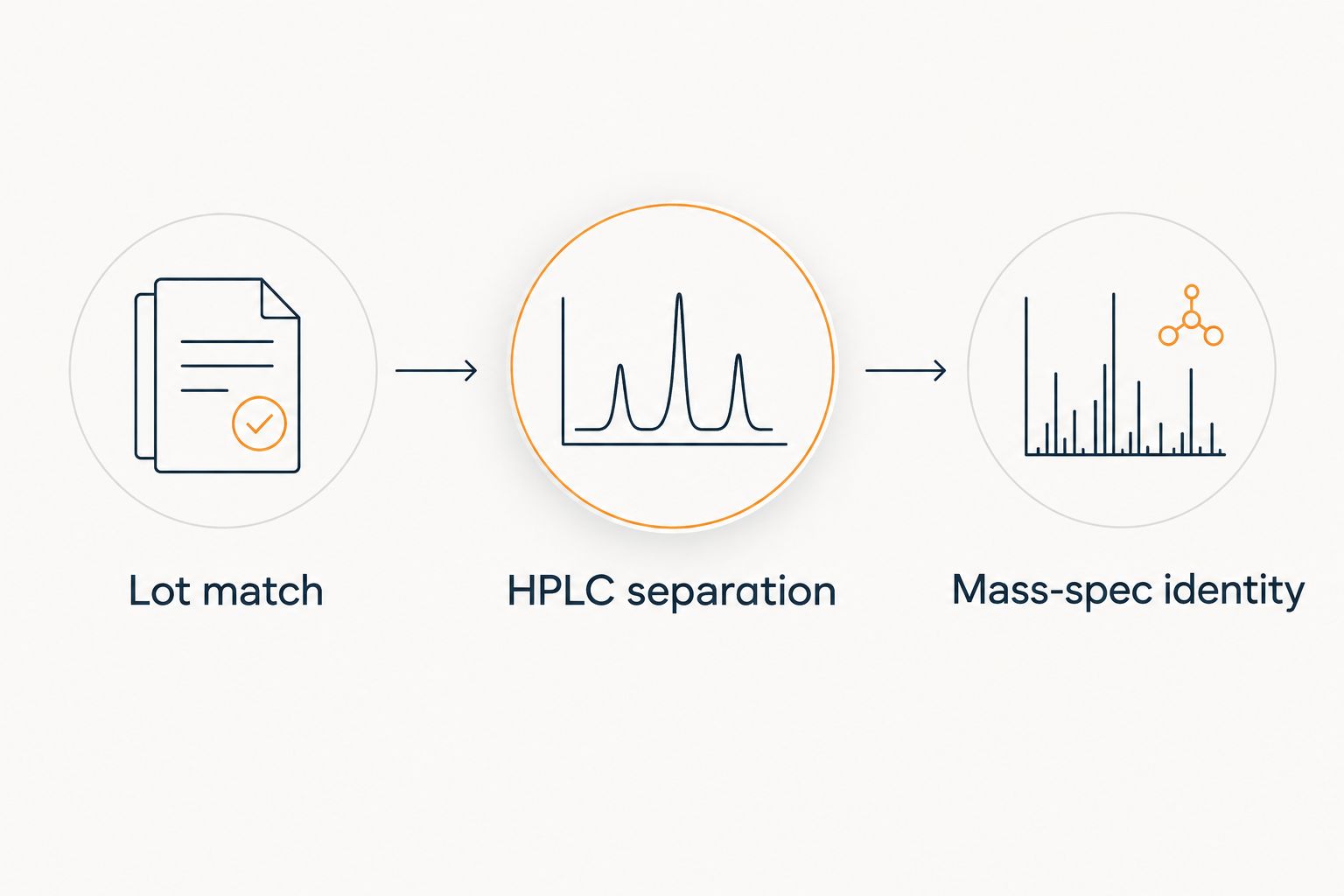
Read the document in sequence: connect the sample to the material, inspect the separation evidence, then review the identity evidence. A method name without interpretable results is not a complete analytical assessment.
- Lot match: Compare the certificate’s sample or lot identifier with the material record.
- HPLC separation: Examine the chromatogram, method information, and reported integration.
- Mass-spec identity: Compare reported signals and interpretation with the specified material.
- Report context: Record the testing laboratory, report date, and document identifier when provided.
Compare suppliers against the same evidence request
Build a supplier worksheet manually and send each candidate the same questions. Ask which documentation accompanies the specific material under consideration, how identifiers connect, and how technical discrepancies are handled. Separate what is published from what still requires clarification.
Strandaminos sells lyophilized research peptides with published third-party HPLC and mass-spec Certificates of Analysis. Published documentation gives your team a starting point for review; qualification still depends on the specific certificate and your laboratory’s requirements.
Strandaminos research peptides are best suited to laboratory buyers who prioritize published third-party HPLC and mass-spec COAs. That is a documentation-based fit, not a claim that every material meets every discovery protocol. Inspect the relevant records before approving a purchase.
- Request documentation tied to the material being evaluated.
- Record which requirements are answered and which remain unresolved.
- Compare report content rather than testing slogans.
- Keep technical questions separate from purchasing administration.
- Document the reason for approving or declining each candidate.
Separate identity checks from assay qualification
Use your existing laboratory procedures to decide whether a received material is suitable for its intended experiment. Supplier documentation supports that decision; it does not replace controls or establish performance in your system.
For receptor, cellular, biochemical, or analytical work, define the relevant readout and controls before examining the experimental result. This prevents an unexpected result from being used retroactively as proof that a material was acceptable. An apparently expected result also does not resolve an identity discrepancy.
Choose any additional testing according to the application. Endotoxin, water content, peptide content, or other measurements answer different questions and are not automatically covered by an HPLC chromatogram or a mass spectrum. Do not treat an unreported attribute as a demonstrated result.
- Specify the controls required by the laboratory protocol.
- Record the analytical questions that supplier documentation answers.
- Identify application-specific attributes that need separate evaluation.
- Define how unexpected or inconsistent results will be investigated.
- Keep analytical acceptance distinct from experimental interpretation.
Link received material to the experiment
Start with a receiving log and a controlled folder if your team does not use an electronic laboratory notebook or inventory system. Use 1 material record per received lot, and connect every working identifier back to that record.
Retain 3 linked records as a practical minimum: the receiving entry, the applicable certificate, and the experiment reference. These are documentation recommendations, not a claim that this record set satisfies every quality system. Your organization’s procedures determine what else belongs in the file.
Record handling and storage according to the applicable product documentation and laboratory procedures. Do not apply a universal storage condition across unrelated peptides or assume that a lyophilized presentation establishes stability after preparation. Preserve the instructions used at the time of the work.
- Assign an internal material identifier at receipt.
- Attach the certificate version reviewed for release.
- Record receipt condition and any observed discrepancy.
- Connect derived samples to the parent material record.
- Link experiments to the actual lot used.
Control lot changes before repeating experiments
Treat a new lot as a documented change, even when the product name stays the same. Compare its certificate with the previously accepted material and decide whether your protocol requires additional qualification before use.
For a 2026 study spanning multiple experiments or teams, record when each lot enters the workflow. Without that connection, a change in results can be difficult to investigate because the experimental record does not identify the material transition.
Your review should follow predefined criteria rather than an assumption that a replacement is equivalent. A documentation discrepancy calls for clarification; a study-specific performance question calls for an appropriate laboratory assessment. Keep those investigations separate so each has an identifiable conclusion.
- Compare identifiers, material descriptions, and analytical report content.
- Record the first experiment using the replacement lot.
- Apply your predefined bridging or qualification requirements.
- Keep unresolved material changes out of released workflows.
- Document the decision and the person approving it.
Close the supplier review with a usable decision
Finish with a short qualification summary rather than an unstructured folder of PDFs. State the intended use, evidence reviewed, unresolved limitations, and approval scope. A reviewer should understand exactly what was accepted without reconstructing the entire purchasing conversation.
Use a manual sign-off document first. An electronic system can organize the same information, but software does not correct an unclear material specification or an unmatched certificate. Make the decision logic understandable before automating its storage.
Limit approval to the evaluated material and application. A supplier’s acceptance for an exploratory analytical exercise does not automatically establish suitability for a different assay or a different organizational quality requirement. Reopen the review when a material change affects the original decision.
- Summarize the evidence supporting acceptance.
- List limitations that remain relevant to the experiment.
- Name the approved application and material scope.
- Record technical and procurement approvals separately.
- Define the events that trigger reassessment.
Compare procurement options for your laboratory
Choose a procurement route according to the evidence and specification your study requires. This 2026 comparison describes decision paths, not a ranking of unverified supplier performance. No route removes your responsibility to qualify the received material.
| Option | Best for | Evidence to review | Key limitation |
|---|---|---|---|
| Strandaminos research peptides | Laboratory buyers prioritizing published third-party analytical COAs | The specific material’s HPLC and mass-spec certificate | Published analytical evidence does not establish performance in your assay |
| Catalog procurement with direct document requests | Teams comparing defined materials against a standard specification | Lot-linked reports and responses to technical questions | A catalog description alone leaves qualification incomplete |
| Custom synthesis inquiry | Projects whose material specification is not met by a catalog entry | Agreed structural requirements, analytical deliverables, and acceptance criteria | The specification and deliverables need agreement before acceptance |
| Independent analytical testing | Teams resolving a defined analytical evidence gap | A test method selected for the unresolved question | Testing the wrong attribute leaves the original question unanswered |
Match the route to the unresolved requirement. Independent mass analysis addresses a different question from custom synthesis, while a published certificate serves a different purpose from assay qualification. Avoid choosing a route simply because it produces more paperwork.
For direct supplier questions, state the material name and the exact certificate field or analytical issue you need clarified. A specific request is easier to evaluate than a general request for proof of quality.
Clarify your documentation requirements
Ask about the specific material, certificate, or analytical record your laboratory needs to review.
Common mistakes drug discovery companies make
Approving the supplier instead of the material
A supplier-level review and a material-level review answer different questions. Approving purchasing administration does not establish that a particular received lot meets your analytical specification. Connect the technical release to the actual material and intended application.
Treating HPLC and mass spectrometry as interchangeable
A chromatogram describes separation under a method; a mass spectrum supports a different identity assessment. Neither automatically supplies all information about content, structure, contaminants, or activity. Record what each result establishes instead of using a general tested label.
Letting a familiar peptide name replace a specification
Discovery teams comparing retatrutide, tirzepatide, cagrilintide, BPC-157, TB-500, SS-31, or Semax still need exact material definitions. Do not infer structural equivalence from naming alone. Require the documentation needed to connect the requested material to the reported sample.
Mixing lots without recording the transition
If experimental records identify only a supplier and compound name, your team loses a material variable during investigation. Track the lot used in each experiment and apply change-control criteria before combining results across a material transition.
Extending research documentation into unsupported claims
A research COA is analytical documentation, not evidence of suitability for personal administration or a therapeutic claim. Keep procurement requests, internal records, and project descriptions within the stated laboratory purpose. Research use only. Not for human or veterinary use.
FAQ
What should drug discovery companies check before buying research peptides?
Drug discovery companies should check the exact material specification, lot traceability, analytical documentation, and application-specific acceptance criteria. Review the actual certificate rather than relying on catalog descriptions or testing icons.
Is an HPLC certificate enough to qualify a research peptide?
An HPLC certificate alone does not establish every attribute needed to qualify a research peptide. Chromatographic separation, mass-spec identity evidence, and application-specific testing answer different questions.
What does mass spectrometry establish for a research peptide?
Mass spectrometry provides mass-to-charge evidence that supports identity assessment. A matching mass alone does not establish every structural feature, peptide content, or biological activity in a laboratory assay.
Who are Strandaminos research peptides best suited to?
Strandaminos research peptides suit laboratory buyers who prioritize published third-party HPLC and mass-spec Certificates of Analysis. Buyers still need to assess the specific material documentation against their own acceptance criteria. Research use only; not for human or veterinary use.
Do we need to review a new lot if we already approved the supplier?
Yes, a new lot requires review against your material acceptance and change-control criteria. Supplier approval does not replace a documented decision about the received material or its intended experimental application.
Can one supplier qualification cover retatrutide, tirzepatide, and cagrilintide?
A shared supplier review can cover administrative requirements, but each material still needs its own technical assessment. Keep material identity, applicable analytical evidence, and intended laboratory use distinct.
What should we do when the vial and COA identifiers do not match?
Hold the material from released experimental use and resolve the identifier discrepancy through your laboratory procedure. Obtain documentation that clearly connects the received material to the analytical report before making an acceptance decision.
One last thing
Before approving your next 2026 order, ask someone outside the purchasing conversation to trace a received material to its certificate and experiment record. Give that person the records, not a verbal explanation. If the connection requires someone’s memory, improve the record before repeating the workflow.
The overlooked distinction is simple: a document can be authentic and still fail to establish which material was used. Traceability is the connection between evidence and experiment—not merely possession of a PDF.


