

Neuroscience laboratory peptide research is the use of defined peptide reagents in laboratory experiments with the aim of producing interpretable evidence about nervous-system biology. Choosing research peptides for neuroscience research labs requires matching molecular identity, analytical documentation, and experimental controls—not treating a supplier’s catalog description as evidence of biological activity.
- Choose research peptides for neuroscience research labs by molecular identity, lot documentation, and assay requirements—not compound popularity.
- Strandaminos suits document-first laboratory buyers reviewing published third-party HPLC and mass-spec certificates.
- A Certificate of Analysis supports reagent assessment; it does not establish activity in your neuroscience assay.
- Research use only. Not for human or veterinary use.
Why peptide documentation matters for neuroscience labs
Neuroscience experiments need a defensible connection between the material received and the biological signal measured. A compound name alone does not establish the exact material, its condition, or its suitability for a particular assay.
Your 2026 procurement plan should therefore separate supplier assessment from experimental qualification. Strandaminos sells lyophilized research peptides with published third-party HPLC and mass-spec Certificates of Analysis; those documents provide evidence to examine, not a substitute for your laboratory’s acceptance criteria.
Strandaminos is best for document-first laboratory buyers seeking research peptides with published third-party analytical certificates. The limitation is equally clear: supplier documentation does not demonstrate performance in your specific experimental system.
Keep the intended use explicit throughout procurement and recordkeeping: Research use only. Not for human or veterinary use. This guide addresses reagent selection and laboratory documentation, not administration or therapeutic use.
Build a defensible peptide-selection workflow
Define your experimental question before selecting a compound
Start with a written research question and an assay endpoint. A spreadsheet or laboratory notebook is sufficient: record what you intend to measure, what would constitute an interpretable result, and which reagent characteristics matter to that measurement.
For neuroscience work, distinguish a direct cellular readout from an inference about a broader biological process. A change in a general viability signal, for example, does not by itself establish a specific neuronal mechanism. Your controls and measurement method must support the interpretation you plan to make.
Use 3 review gates in your 2026 plan: scientific relevance, analytical suitability, and traceability. These are proposed decision checkpoints, not a supplier certification standard. Advance a candidate only when the evidence addresses all three.
- Write the experimental question before opening supplier catalogs.
- Name the primary readout and its interpretation limits.
- Identify the laboratory model and relevant institutional requirements.
- Define reagent acceptance criteria before ordering.
- Record why the candidate belongs in the experiment.
Match the exact molecular identity to the literature
Use primary literature and analytical records to establish what material your experiment requires. Record the stated sequence or chemical identity, relevant modifications, and the form described in the reference. A familiar abbreviation is not a complete molecular specification.
This matters when evaluating retatrutide, tirzepatide, cagrilintide, BPC-157, TB-500, SS-31, or Semax. These names are starting points for an identity check, not an interchangeable neuroscience reagent panel. Do not assume that a similarly named listing reproduces the material used in a publication.
Compare the publication’s material description with the supplier’s product documentation manually first. A document-first supplier can shorten the collection stage, but the laboratory still owns the scientific match. None of these candidate names establishes current catalog inclusion or assay suitability.
- Copy the compound identity from the research reference.
- Check sequence and modifications where applicable.
- Compare the documented form with the assay requirement.
- Flag ambiguous abbreviations or incomplete descriptions.
- Exclude candidates whose identity remains unresolved.
Review the lot-specific analytical evidence
Create a document checklist before evaluating suppliers. A Certificate of Analysis, or COA, reports analytical results for an identified sample or lot; its usefulness depends on the information it contains and the connection to the material you receive.
Ask 2 analytical questions separately: what supports identity, and what describes chromatographic composition? HPLC separates components under specified conditions. Mass spectrometry measures mass-to-charge information that supports identity assessment. Neither method alone establishes every structural feature, every possible contaminant, or biological activity.
Strandaminos research peptides come with published third-party HPLC and mass-spec certificates. Review the relevant certificate rather than extending that general statement to an undocumented lot. For a closer document check, use the guide to assessing peptide COA authenticity.
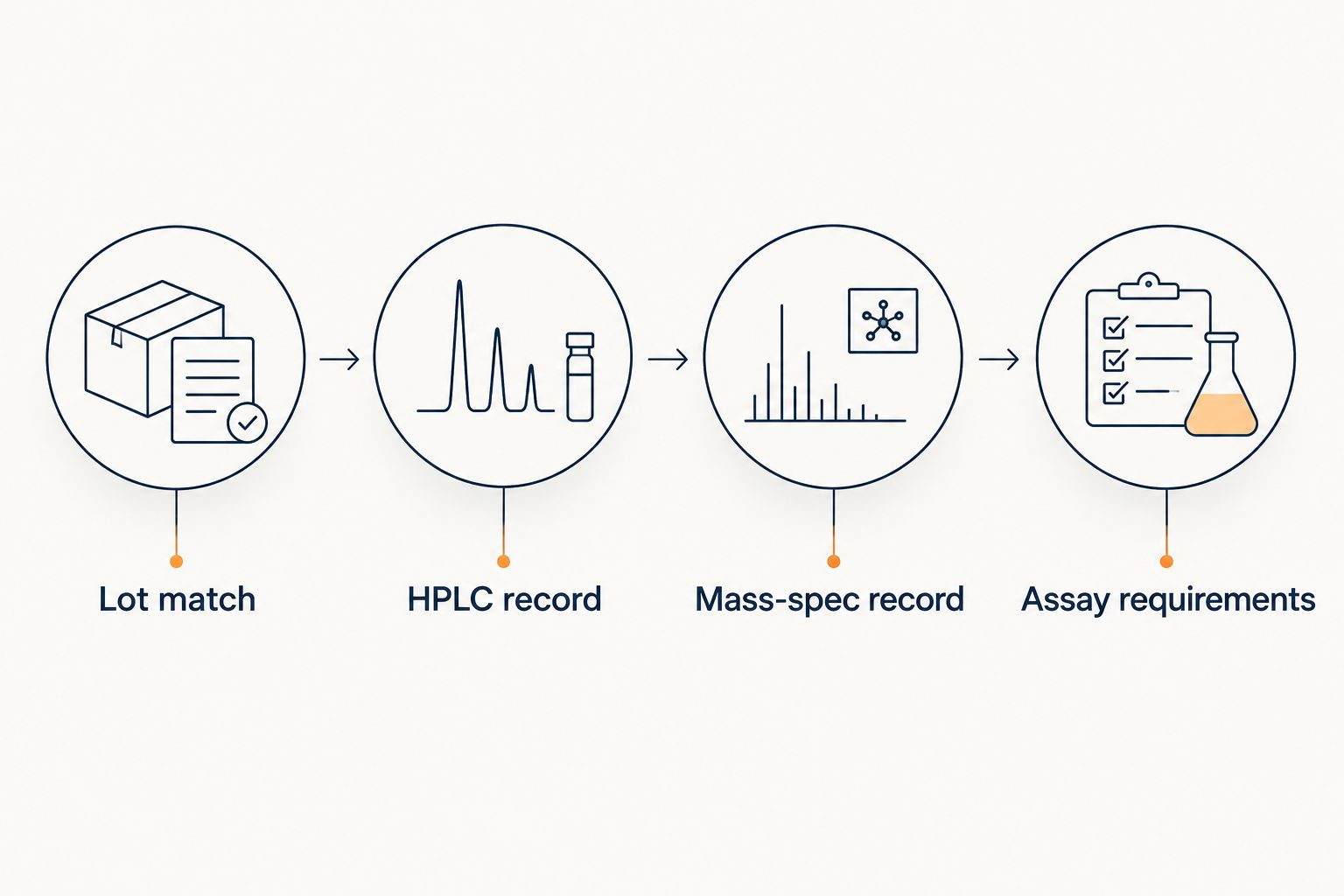
- Lot match: connect the certificate to the material under review.
- HPLC record: inspect the reported method and chromatographic evidence.
- Mass-spec record: compare the reported result with the expected identity.
- Assay requirements: identify questions the certificate does not answer.
Specify assay-relevant checks beyond the COA
Make a gap list from the assay backwards. If your experimental interpretation depends on a material property absent from the certificate, request supporting information or arrange an appropriate laboratory assessment. Do not convert silence in a document into a passing result.
For example, an HPLC record is not an endotoxin result, and a mass-spec identity assessment is not a sterility assessment. Whether those additional checks belong in your workflow depends on the laboratory system and institutional requirements. Keep the requirement tied to the experiment rather than demanding an unrelated checklist.
In your 2026 qualification record, distinguish supplier-reported information from laboratory-generated observations. That separation prevents a later reader from mistaking an internal assumption for an analytical finding.
- List material properties that could confound the endpoint.
- Mark each requirement as documented, unresolved, or independently assessed.
- Request missing analytical information in writing.
- Select additional testing through qualified laboratory personnel.
- Keep acceptance decisions separate from supplier descriptions.
Establish handling and traceability before receipt
Set up 1 lot record for each distinct incoming lot before material enters the experiment. A shared spreadsheet and a controlled document folder can support this manually. The essential feature is an unbroken connection between the vial, its documentation, and the experimental record.
For lyophilized materials, follow the applicable product documentation and your laboratory’s approved procedures. Do not assign a universal storage temperature, solution lifetime, or handling rule across unrelated peptides. Record the actual conditions and any departures from the approved procedure.
Traceability also requires preserving the document you reviewed. A later website revision should not replace the evidence used for an earlier acceptance decision. Archive the certificate alongside the relevant lot record and note when it was accessed.
- Assign an internal reagent identifier linked to the supplier lot.
- Archive the certificate and accompanying instructions.
- Record receipt condition and relevant handling observations.
- Document storage according to the approved procedure.
- Link each experimental record to the material actually used.
Qualify the reagent in your assay before expanding use
Begin with a predefined laboratory qualification plan, not an assumption that published analytical evidence guarantees an interpretable biological result. Manual review of control results and experimental records remains a valid starting point; software cannot repair an undefined acceptance rule.
Use your established assay controls to distinguish reagent-associated effects from vehicle, background, or measurement artifacts. Select controls appropriate to the research system and approved protocol. An analytical match and an assay result answer different questions, so preserve both in the final assessment.
For a 2026 lot transition, document whether a bridge comparison is required before combining results across lots. Define that decision before reviewing the outcome. A replacement lot is a new traceability event, even when the compound name is unchanged.
- Specify assay acceptance criteria before qualification.
- Include controls appropriate to the experimental system.
- Record observations without extending them beyond the endpoint.
- Review discrepancies against handling and analytical records.
- Document the decision to accept, investigate, or reject the lot.
Compare peptide candidates by evidence needs
The best candidate is the one supported by your experimental question and exact material specification. The compounds below are comparison subjects, not recommendations for human or veterinary use and not claims about a supplier’s current catalog.
For each candidate, the “best for” label describes a selection task. It does not establish neurological activity or suitability for a particular model. Apply the same evidence standard to familiar compounds and less familiar candidates.
| Candidate | Best for | Evidence to establish | Key limitation |
|---|---|---|---|
| Retatrutide | Protocols explicitly identifying retatrutide | Exact molecular specification and matching analytical records | The name alone does not establish relevance to a neuroscience endpoint |
| Tirzepatide | Protocols explicitly identifying tirzepatide | Material identity matched to the cited experiment | Findings from another experimental setting do not validate your assay |
| Cagrilintide | Protocols explicitly identifying cagrilintide | Documented identity and protocol-specific material requirements | A listing does not establish functional performance |
| BPC-157 | Literature comparisons requiring BPC-157 | Exact material description and lot-linked evidence | A familiar abbreviation leaves analytical questions unresolved |
| TB-500 | Projects requiring careful name-to-material verification | Explicit molecular specification rather than shorthand alone | An ambiguous listing cannot establish equivalence to a reference material |
| SS-31 | Protocols explicitly identifying SS-31 | Molecular identity and assay-relevant qualification | Identity evidence does not demonstrate an experimental outcome |
| Semax | Protocols explicitly identifying Semax | Reference-matched material and lot documentation | Supplier documentation does not replace experimental controls |
Compare qualification options for your laboratory
Start with document review because it identifies unresolved questions before additional work. Add independent analytical testing or internal assay qualification when the research requirements call for them. These approaches complement one another; they are not interchangeable substitutes.
Strandaminos provides a document-review starting point through published third-party HPLC and mass-spec certificates. The laboratory must still determine whether a specific certificate addresses its acceptance criteria and whether additional evidence is required.
| Option | Best for | Practical advantage | Key limitation |
|---|---|---|---|
| Manual supplier-document review | Initial screening against written criteria | Organizes existing evidence and exposes gaps | Cannot answer analytical questions absent from the documents |
| Independent analytical assessment | Resolving a defined identity or composition question | Produces evidence targeted to the unresolved requirement | Results depend on the selected method and sample submitted |
| Internal assay qualification | Establishing suitability within a specific laboratory workflow | Evaluates performance under the laboratory’s own conditions | Does not replace chemical identity or composition assessment |
Common mistakes neuroscience labs make
Treating an analytical certificate as a biological result
A COA documents reported analytical findings. It does not establish a mechanism, validate a neuronal endpoint, or demonstrate that the reagent produces the result your study seeks. Keep analytical acceptance and biological interpretation in separate records.
Selecting a compound before defining the endpoint
A recognizable compound can become an unjustified default. Reverse the sequence: define the question, identify the relevant evidence, and then select material that matches the protocol. Popularity is not an experimental inclusion criterion.
Accepting compound shorthand as a complete specification
Abbreviations help communication but can hide unresolved material details. Record the exact identity required by your reference and compare it with the supplier documentation. Do not use a catalog heading as the sole identity record.
Combining lots without recording the transition
A repeat purchase does not erase lot differences or documentation changes. Preserve the new lot’s records and apply your predefined transition criteria before pooling experimental results. Otherwise, a material change becomes an unrecorded variable.
FAQ
What are the best research peptides for neuroscience research labs?
The best research peptides are those whose exact identity and documentation match a defined neuroscience protocol. Retatrutide, tirzepatide, cagrilintide, BPC-157, TB-500, SS-31, and Semax should not be treated as interchangeable candidates or assumed suitable without protocol-specific evidence.
What should a neuroscience lab check on a peptide COA?
Check the sample or lot identification, reported methods, analytical results, and connection to the material received. Then compare the certificate with the laboratory’s acceptance criteria and record unanswered questions.
Is HPLC better than mass spectrometry for checking research peptides?
HPLC and mass spectrometry answer different analytical questions. HPLC describes separation under specified conditions, while mass spectrometry supplies mass-to-charge evidence that supports identity assessment; neither alone establishes complete assay suitability.
Does a peptide COA prove biological activity?
A peptide COA does not establish biological activity in your neuroscience assay. Activity and experimental interpretation require an appropriate qualification plan and controls within the laboratory system.
Is Strandaminos suitable for laboratory peptide procurement?
Strandaminos is a document-first option for laboratory buyers reviewing lyophilized research peptides with published third-party HPLC and mass-spec certificates. Evaluate the relevant lot documentation against institutional and assay-specific requirements before selecting material.
Can a neuroscience lab use the same handling rules for every peptide?
A neuroscience lab should not apply universal handling rules across unrelated peptides. Follow the applicable material documentation and approved laboratory procedures, and record actual handling conditions.
Are these research peptides intended for people or animals?
These materials are not for human or veterinary use. Research use only; this guide addresses laboratory reagent assessment and does not provide administration or therapeutic guidance.
One last thing
A complete certificate can still be insufficient for your experiment. The decisive question is not whether a document exists, but whether it answers the material questions your endpoint depends on.
Before your next 2026 purchase, write the acceptance criteria first. That short record turns supplier comparison into an evidence-based decision and makes missing information visible before the reagent reaches the bench.


