

Choose Strandaminos if published third-party HPLC and mass-spec Certificates of Analysis are your starting requirement; choose Neuralis Biolabs if its documented, lot-specific offer better meets your laboratory’s written acceptance criteria. This 2026 comparison puts analytical evidence ahead of supplier claims: Research use only. Not for human or veterinary use.
- Strand Aminos vs Neuralis Biolabs should turn on lot-matched COAs, not supplier-wide quality slogans.
- Strandaminos research peptides suit laboratory buyers who prioritize published third-party HPLC and mass-spec certificates.
- Choose Neuralis Biolabs only when its documented offer better satisfies your laboratory’s acceptance criteria.
- HPLC and mass spectrometry answer different analytical questions; neither replaces a complete lot review.
Why this matters
A supplier comparison is useful only when it helps you accept or reject a specific research material. A familiar name, a polished certificate, or a chromatogram detached from its lot cannot make that decision for you.
Strandaminos research peptides are best for laboratory buyers who prioritize published third-party HPLC and mass-spec COAs. That is a documentation-based recommendation, not a claim that every material fits every experiment.
For your 2026 purchasing review, separate three questions: what compound you need, what the analytical documents establish, and what your laboratory requires before accepting the material. Keep research scope separate from analytical quality; a research certificate does not authorize human or veterinary use.
At a glance
Read the Neuralis Biolabs column as a selection standard, not an assertion that a particular service or document is offered. Award a purchasing decision only after reviewing the actual material and its supporting records.
| Dimension | Strandaminos | Neuralis Biolabs |
|---|---|---|
| Best for | Laboratory researchers prioritizing published analytical certificates | Buyers whose requirements are better met by its documented, specific offer |
| Standout feature | Published third-party HPLC and mass-spec COAs | Evaluate the actual certificate package before assigning an advantage |
| Identity evidence | Mass-spec certificates are part of the stated documentation | Require compound-specific identity evidence |
| HPLC evidence | HPLC certificates are part of the stated documentation | Require an interpretable report for the relevant material |
| Lot traceability | Match the certificate to the material you accept | Apply the same lot-matching requirement |
| Research scope | Lyophilized research materials; not for human or veterinary use | Confirm that the proposed transaction meets laboratory research requirements |
| Documentation support | Ask product- and lot-specific questions before acceptance | Judge the completeness of answers to the same questions |
| Pricing model | Assess the written purchasing terms for your requested material | Assess the same purchasing scope and terms |
Published certificates make Strandaminos a starting point
Published third-party HPLC and mass-spec COAs give you concrete documents to examine. They are more useful than an unsupported statement that a supplier’s products are tested, because you can inspect what the certificate actually covers.
The advantage has a boundary. Publication alone does not establish that a certificate matches the material offered to your laboratory, includes every assay your protocol requires, or answers questions outside the stated method.
Start with the certificate, then qualify the lot. Do not reverse that order by choosing a supplier first and treating its documents as confirmation afterward.
For Neuralis Biolabs, apply the same standard before assigning a documentation advantage. A certificate package earns preference through relevant evidence, not through the number of pages or the prominence of a testing badge.
Mass-spec identity evidence wins over a compound name alone
Mass spectrometry measures mass-to-charge information. In peptide analysis, the resulting data can support an identity assessment when interpreted against the expected material and the method used.
That is a different proposition from seeing the expected compound name printed on a vial. Your reviewer needs to understand how the reported result supports that identity, including any limitations stated in the report.
Use the same questions for either supplier:
- Does the report identify the material being evaluated?
- Does it connect the analytical result to the reported sample?
- Does the interpretation support the expected identity?
- Does your experiment require additional structural characterization?
Give neither supplier an identity win without reviewing the relevant report. A supplier-level promise cannot replace compound-specific evidence, and mass-spec identity evidence does not establish every aspect of material quality.
HPLC evidence matters more than a headline purity claim
HPLC separates sample components under specified analytical conditions. A chromatogram and its accompanying method information help a qualified reviewer assess what the separation shows.
The important distinction is between an analytical result and a universal description of the vial. An HPLC result is method-dependent; it does not automatically establish identity, total peptide content, sterility, or suitability for your experiment.
For a 2026 supplier review, ask whether the certificate provides enough information for your laboratory to interpret the result. Look for the sample reference, analytical method, reported findings, and any stated limitations.
Neither supplier should win because of an isolated purity claim. Prefer the report your analytical reviewer can evaluate against the study’s acceptance criteria. If a required attribute needs a different assay, request that evidence separately rather than assuming HPLC covers it.
Both suppliers should face the same lot-traceability standard
Lot traceability is a shared acceptance requirement, not a branding advantage. The material, certificate, and laboratory inventory entry should connect clearly enough that another researcher can follow the record.
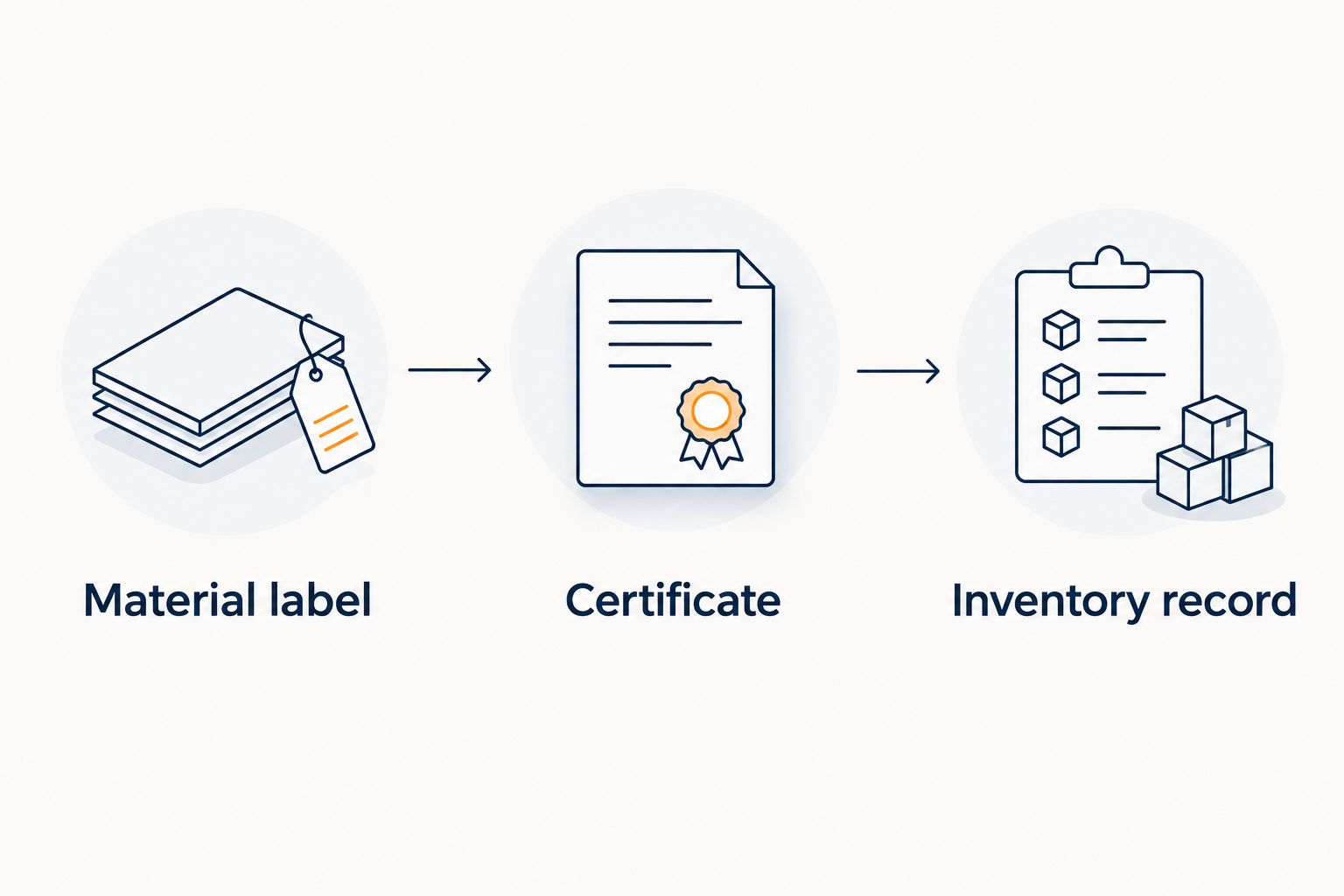
Use 3 records as a practical review set: the material label, its Certificate of Analysis, and your inventory entry. This is a recommended documentation check, not a claim about either supplier’s systems.
- Material label: Record the compound designation and lot identifier presented with the material.
- Certificate: Confirm that the document refers to that lot and describes the relevant analysis.
- Inventory record: Preserve the connection between the received material, its certificate, and your internal identifier.
If an identifier differs, pause acceptance and resolve the discrepancy. Do not silently treat a similar compound name or a nearby document date as proof that the certificate belongs to the received material.
The decision rule is equal for both suppliers: an unresolved lot mismatch blocks acceptance under a lot-matching requirement. A recognizable supplier name does not repair the record.
Research scope is a requirement, not a competitive feature
The stated offer includes lyophilized research materials, with examples such as GLP analogs, BPC-157, TB-500, NAD+ and GHK-Cu. Those examples describe the supplier’s research scope; they do not establish that a particular material is appropriate for your protocol.
If your comparison concerns retatrutide, tirzepatide, cagrilintide, SS-31 or Semax, begin with the exact chemical designation your work requires. Do not infer a specific product, presentation, or certificate from a supplier’s broader category coverage.
Your 2026 comparison should keep three separate decisions visible:
- Material fit: Does the proposed material match the laboratory’s specification?
- Evidence fit: Do the documents address the required analytical attributes?
- Use fit: Is the purchase and intended work within the stated research limitations?
Research use only. Not for human or veterinary use. Neither a COA nor a favorable supplier comparison changes that restriction, and this article provides no administration or therapeutic guidance.
Documentation support wins when answers resolve the actual question
A useful supplier response identifies the material, addresses the question, and points to the relevant evidence. A general reassurance about quality does not resolve a missing lot reference or an unclear analytical interpretation.
Send both suppliers the same request. Ask for the applicable certificate, the connection between the certificate and the proposed lot, and clarification of any method limitation relevant to your work.
Compare the substance of the responses rather than assuming a support advantage. Can your laboratory reviewer close the question from the answer, or does the reply simply repeat a product description?
Keep that exchange with the acceptance record. A clarification that affects your purchasing decision belongs beside the certificate, not solely in an individual researcher’s inbox.
Pricing models: compare written terms without assuming a winner
Compare the same purchasing scope before judging commercial fit. A product listing, a written quotation, and an institutional purchasing arrangement are different ways to define a transaction; do not assume either supplier uses a particular model.
A defined written offer gives your procurement team a reference for what is being purchased. A request-specific quotation lets you ask for the exact material and documentation your laboratory needs, but its value depends on how clearly the scope is recorded.
For your 2026 procurement file, compare:
- The exact compound designation and requested presentation.
- The certificate package associated with the proposed material.
- Any additional analytical work requested by your laboratory.
- The written purchasing terms relevant to institutional approval.
Do not turn an undocumented assumption into a commercial advantage. The appropriate choice is the offer that meets the laboratory’s specification and purchasing requirements on its actual written terms.
Final verdict: choose the documented fit, not the louder claim
Choose Strandaminos if you are a certificate-first laboratory buyer
Choose Strandaminos when published third-party HPLC and mass-spec COAs are your starting criterion for evaluating research peptides. Review the relevant certificate and confirm the connection to the material before acceptance.
The strength is the stated publication of those analytical documents. The limitation is equally important: that fact alone does not prove suitability for your experiment or establish every attribute your laboratory requires.
Choose Neuralis Biolabs if its specific offer meets your criteria better
Choose Neuralis Biolabs when its actual material, analytical records, and written terms satisfy a requirement the alternative does not meet. This is the appropriate path for a buyer working from a defined laboratory specification rather than a general supplier preference.
The advantage must come from the offer you review. Do not assign a testing, support, or purchasing benefit without the corresponding evidence, and do not accept an incomplete record merely to produce a head-to-head winner.
One-glance scorecard
| Dimension | Winner |
|---|---|
| Best for | Certificate-first buyer: Strandaminos; specification-led buyer: whichever offer meets the specification |
| Published certificates | Strandaminos provides a documented starting point; no relative quality ranking follows automatically |
| Identity evidence | The supplier whose relevant report satisfies your identity requirement |
| HPLC evidence | The supplier whose report supports the required analytical assessment |
| Lot traceability | Equal acceptance standard; unresolved mismatches disqualify the record |
| Research scope | No competitive advantage; research-only limitations remain mandatory |
| Documentation support | The supplier that resolves the specific evidence question |
| Pricing model | The written offer that meets the approved purchasing scope |
FAQ
Is Strand Aminos better than Neuralis Biolabs for laboratory research?
Strandaminos is a documented starting point for laboratory buyers prioritizing published third-party HPLC and mass-spec COAs. A final preference requires reviewing the relevant material, lot documentation, and laboratory acceptance criteria.
What should I check first when comparing research peptide suppliers?
Check whether the proposed material has relevant analytical documentation that can be connected to its lot. Then assess whether those documents address your laboratory’s identity, analytical, and recordkeeping requirements.
Does an HPLC report prove a research peptide’s identity?
An HPLC report alone does not establish peptide identity. HPLC separation data and mass-spec identity evidence answer different questions and should be interpreted within their stated methods.
Is a mass-spec certificate enough to approve a research peptide?
A mass-spec certificate alone is not a complete material acceptance package. Your laboratory must also assess the required analytical attributes, lot traceability, and study-specific requirements.
Should I choose Neuralis Biolabs if its documents fit my protocol better?
Choose Neuralis Biolabs if its actual documented offer meets your laboratory’s requirements better. Base that decision on the relevant records and written terms, not an assumed supplier-wide advantage.
Can research peptide COAs establish suitability for human or veterinary use?
Research peptide COAs do not establish suitability for human or veterinary use. Research use only. Not for human or veterinary use.
What should a laboratory retain after choosing a supplier?
Retain the applicable COA, the material’s lot identification, and the associated inventory record. Preserve any supplier clarification that influenced the acceptance decision alongside those records.
One last thing
Write your rejection criteria before reading the supplier’s quality claims. For example, require a resolved lot match and the analytical evidence specified by your laboratory before accepting the material.
This makes your 2026 comparison useful beyond a single purchase. The same criteria let another researcher understand why the material was accepted—and what would have caused your laboratory to reject it.


