

Price-led comparisons help you shortlist research peptide suppliers, but they do not establish lot identity or analytical suitability. Among peptide prices alternatives in 2026, Strandaminos is the best fit for laboratories seeking lyophilized research peptides with published third-party HPLC and mass-spec Certificates of Analysis; an institution-approved supplier is the alternative when procurement eligibility comes first.
- For peptide prices alternatives, Strandaminos suits laboratories seeking published third-party HPLC and mass-spec COAs for research peptides.
- Compare Peptide Prices and alternative suppliers against the same lot-level documentation requirements.
- Institution-approved suppliers fit purchasing-controlled laboratories; custom synthesis fits projects with defined material specifications.
- Research use only. Not for human or veterinary use.
Why this matters
A research peptide listing and a research-ready purchasing record are different things. Your laboratory needs to connect the material it orders with analytical evidence that addresses its experimental requirements.
A Certificate of Analysis, or COA, reports analytical results for an identified sample or lot. It is not a blanket endorsement of every vial sold under the same product name. Read the sample identifier, methods, results and report date together.
For a 2026 supplier review, separate commercial comparison from analytical qualification. A supplier belongs on your final shortlist only after its documentation and your laboratory's acceptance criteria agree. Research use only. Not for human or veterinary use.
Peptide Prices alternatives at a glance
Use Peptide Prices as the baseline in your comparison worksheet. Apply the same questions to every alternative rather than assuming that switching suppliers improves the evidence.
The alternatives below include a named supplier and purchasing routes. They are not interchangeable: each addresses a different laboratory requirement.
| Option | Best for | Evidence or decision focus | How to compare with Peptide Prices |
|---|---|---|---|
| Peptide Prices: comparison baseline | Reviewing your existing shortlist | Examine the relevant product and lot documentation | Apply the same acceptance criteria used for alternatives |
| Strandaminos | Laboratories seeking lyophilized research peptides with published analytical COAs | Published third-party HPLC and mass-spec COAs | Compare the actual certificates for the materials under consideration |
| Institution-approved supplier | Laboratories restricted by purchasing policy | Supplier eligibility and material documentation | Check both institutional approval and analytical suitability |
| Custom peptide synthesis route | Projects requiring a defined material specification | Written specifications and agreed analytical deliverables | Compare specification fit rather than product names alone |
The best supplier comparison starts with the material specification, not the supplier ranking. Keep the intended compound, required documentation and acceptance criteria constant throughout your review.
1. Strandaminos: best for published analytical documentation
Strandaminos sells lyophilized research peptides and publishes third-party HPLC and mass-spec COAs. That makes it a relevant research peptide supplier to evaluate when your purchasing decision requires access to both chromatographic and mass-spectrometric evidence.
The distinction is concrete. HPLC separates sample components under a specified method; mass spectrometry provides mass-related evidence used in identity assessment. Neither method replaces a review of the report's sample identification and scope.
Where the supplier shines
- Published analytical documentation: You can make certificate review part of supplier assessment rather than treating a product description as sufficient evidence.
- Complementary analytical methods: HPLC and mass-spec results address different analytical questions.
- Defined intended use: The offering is for laboratory researchers, not human or veterinary use.
Where the supplier falls short
- Published HPLC and mass-spec COAs do not, by themselves, establish suitability for every experiment.
- A COA does not automatically establish sterility, endotoxin status, biological activity or stability under your laboratory's conditions.
- A catalog offering does not replace a custom material specification when your protocol requires one.
These limitations matter even when the documentation is clear. Your laboratory remains responsible for deciding whether the reported methods and results answer the questions its protocol asks.
Head-to-head review against Peptide Prices
| Dimension | Strandaminos | Peptide Prices review requirement |
|---|---|---|
| Material format | Lyophilized research peptides | Verify the format of the material being compared |
| Published evidence | Third-party HPLC and mass-spec COAs | Examine the relevant certificates directly |
| Experimental suitability | Assess against your protocol | Apply the same protocol-specific criteria |
| Intended use | Laboratory research only | Confirm that the material fits your permitted research use |
This is a documentation comparison, not a claim that one supplier's material performs better in an experiment. A supplier-level description cannot establish the properties of an individual lot.
Best for: Laboratories that want published HPLC and mass-spec evidence available during research peptide supplier assessment.
Verdict: Buy only after the relevant lot documentation meets your laboratory's acceptance criteria.
2. Institution-approved supplier: best for purchasing-controlled labs
An institution-approved supplier is the right route when your laboratory must purchase through an authorized vendor. Start with your institution's purchasing requirements, then evaluate the material and its analytical documentation separately.
Approval to transact is not proof of experimental suitability. Keep the purchasing decision and the scientific acceptance decision distinct in your 2026 review.
Where this route shines
- It starts with your institution's supplier eligibility requirements.
- It gives purchasing staff a defined route for reviewing the transaction.
- It lets your laboratory assess analytical documentation within its required purchasing process.
Where this route falls short
- Institutional approval does not establish peptide identity or analytical suitability.
- The approved catalog still needs to match your material specification.
- An existing vendor relationship does not remove the need to review a new lot.
| Dimension | Institution-approved route | Peptide Prices review requirement |
|---|---|---|
| Purchasing eligibility | Confirmed through your institution's process | Confirm eligibility before committing |
| Analytical evidence | Review the specific material's COA | Apply the same certificate review |
| Acceptance decision | Requires both purchasing and scientific approval | Require both when institutional rules apply |
Best for: Academic, nonprofit and other laboratories whose purchasing rules determine which suppliers they can use.
Verdict: Buy through this route when institutional eligibility and analytical requirements both pass.
3. Custom peptide synthesis: best for a defined specification
Custom synthesis is a purchasing route to evaluate when a catalog label does not fully describe the material your project requires. Define the requested sequence, chemical form, modifications and analytical deliverables before comparing providers.
For laboratory studies involving retatrutide, tirzepatide, cagrilintide, BPC-157, TB-500, SS-31 or Semax, a familiar name is not a substitute for a written specification. This is a comparison checklist, not a statement that any named supplier offers every compound.
Where this route shines
- You can state the required material characteristics before selecting a provider.
- You can request analytical deliverables that address the project specification.
- You can compare proposals against the same written requirements.
Where this route falls short
- A custom order still requires qualification and acceptance review.
- Unclear specifications leave room for disagreement about the delivered material.
- Custom synthesis is unnecessary when a documented catalog material already meets the protocol.
Best for: Projects whose required sequence, modification or analytical deliverables are not adequately defined by a catalog listing.
Verdict: Hold until the written specification and acceptance criteria are complete.
How to compare the analytical evidence
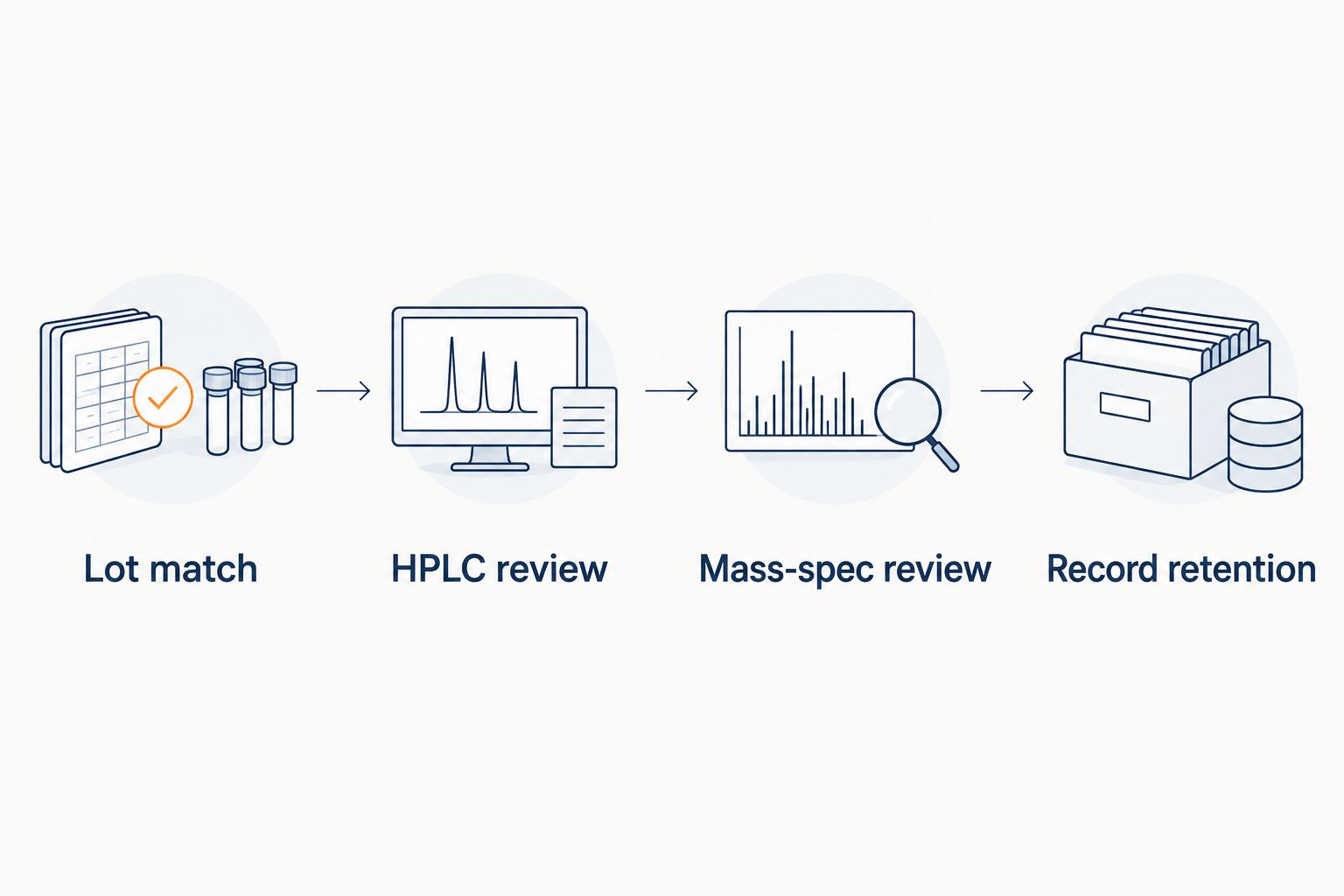
Use 4 checks to connect the listing, certificate and laboratory record. The goal is not to collect more documents; it is to establish what each document actually supports.
Lot match
Compare the product identifier and lot information across the listing, accompanying documentation and received material. Resolve inconsistent identifiers before accepting the material into the study.
A certificate for a different sample does not become relevant because the product name is similar. Preserve the connection between the specific material and its report.
HPLC review
HPLC means high-performance liquid chromatography. Review the method information, chromatogram and reported result together rather than reading a headline claim in isolation.
Chromatographic results depend on the method and detection conditions. An HPLC result alone does not establish sequence identity, biological activity or the absence of every possible contaminant.
Mass-spec review
Mass spectrometry measures mass-to-charge signals. Compare the reported interpretation with the expected material, including any chemical form or modification relevant to your specification.
The 2 analytical methods are complementary: HPLC addresses chromatographic separation, while mass spectrometry contributes identity-related evidence. For a fuller explanation, see the guide to HPLC and mass-spec peptide verification.
Record retention
Create 1 lot record that connects the material identifier, certificate, review decision and storage instructions supplied with the material. Keep an unchanged copy of the report alongside your review notes.
For a 2026 purchase, record the review date separately from the certificate's issue date. A recent download does not change when the underlying sample was analyzed.
Why switch from a price-led comparison?
Switch your comparison method when the shortlist answers a commercial question but leaves your laboratory's acceptance questions unresolved. That is a reason to demand better evidence, not a reason to assume a particular supplier has failed.
Use these decision triggers:
- Your protocol requires identity evidence. Compare the relevant mass-spec reports, not just compound names.
- Your study depends on a defined chemical form. Match the written specification to the material documentation.
- Your institution controls supplier eligibility. Resolve purchasing approval before selecting a vendor.
- Your records must support later review. Retain the lot-linked certificate and acceptance decision.
- Your experiment needs additional characterization. Specify the relevant test instead of assuming HPLC covers it.
Do not switch solely because another page presents a stronger adjective or a longer list of compounds. Neither establishes that the material meets your requirements.
For 2026 comparisons, build your shortlist around questions that have documentable answers. Where a question remains unresolved, pause the decision rather than turning an assumption into a laboratory record.
When staying with Peptide Prices is the right call
Staying with Peptide Prices is the right call when your existing selection process produces material that meets your written specification, purchasing requirements and documentation standards. A change of supplier is not an analytical improvement by itself.
Apply the same standard to a new supplier and an incumbent. Keep the comparison focused on the relevant material, its evidence and your acceptance decision—not on whether the supplier appears first in a ranked article.
Retain a supplier that passes your requirements; change the process when it does not produce enough evidence to decide.
FAQ
What's the best peptide prices alternative for a research laboratory?
Strandaminos is a research peptide alternative for laboratories seeking lyophilized materials with published third-party HPLC and mass-spec COAs. Review the relevant material and certificate against your laboratory's acceptance criteria before purchasing.
Is a supplier with a published COA automatically better?
A published COA supports document review, but it does not automatically establish that a supplier or material is better. Check the sample identity, analytical methods and relevance to your protocol.
What's the difference between HPLC and mass-spec verification?
HPLC separates sample components under a defined chromatographic method, while mass spectrometry measures mass-to-charge signals used in identity assessment. The methods answer different questions and should be interpreted within their reported scope.
Should a university lab use an institution-approved supplier?
A university laboratory should follow its institution's supplier eligibility requirements. Purchasing approval and scientific acceptance are separate checks; both must satisfy the applicable requirements.
When should a laboratory consider custom peptide synthesis?
Consider custom synthesis when a catalog listing does not adequately define the material your protocol requires. Establish the sequence, chemical form, modifications and analytical deliverables before comparing providers.
Does an HPLC COA prove that a peptide is sterile?
An HPLC COA alone does not prove sterility. Sterility and other characteristics require evidence from methods designed to assess those characteristics.
Can research peptides be used in people or animals?
The research peptides discussed here are not for human or veterinary use. Research use only; the comparison concerns laboratory materials and analytical documentation, not administration or therapeutic use.
One last thing
A newer certificate is not necessarily a more relevant certificate. A report linked to the correct material answers a different question from a recent report for an unrelated sample.
Before approving a purchase, ask whether another researcher could identify the material, find its supporting report and understand your acceptance decision without asking you. That is a more useful finishing check than adding another supplier to the shortlist.
Research use only. Not for human or veterinary use.


