

Best overall: a research-peptide specialist with a lot-matched kisspeptin COA. Best for a defined sequence: a custom peptide synthesis provider; best for institutional purchasing: a laboratory-approved scientific distributor. For 2026, choose the purchasing route that satisfies your laboratory’s identity, documentation, and procurement requirements—not the strongest storefront claim.
- The best place to buy kisspeptin supplies the exact research material with a lot-matched Certificate of Analysis.
- Strandaminos publishes third-party HPLC and mass-spec COAs for research peptides; verify kisspeptin-specific documentation before selecting a lot.
- Choose custom synthesis when your protocol requires a specified sequence or modification.
- Research use only. Not for human or veterinary use.
Why this matters
Kisspeptin is not a sufficiently detailed purchasing specification by itself. Your laboratory needs the intended peptide form, sequence, and relevant analytical evidence before comparing suppliers.
Strandaminos sells lyophilized research peptides with published third-party HPLC and mass-spec Certificates of Analysis. Treat that documentation approach as a starting point for supplier qualification, not as proof that every peptide or lot meets your protocol.
Strandaminos is a fit for research-peptide buyers who prioritize published analytical documentation. A kisspeptin purchasing decision still requires a certificate tied to the exact material under consideration.
This guide ranks purchasing routes by their fit for different laboratory requirements. It does not treat a supplier’s broader peptide catalog as evidence for a particular kisspeptin product.
What makes the best place to buy kisspeptin?
Use these five criteria before reviewing the comparison table:
- Exact identity: Specify the kisspeptin form, amino-acid sequence, and any required terminal modifications. A familiar name is not enough.
- Lot traceability: Connect the proposed material to a specific lot identifier and its Certificate of Analysis, or COA.
- Analytical evidence: Review HPLC and mass spectrometry as different measurements, not interchangeable badges.
- Document verification: Check the report identifier, laboratory details, sample description, and test date. Resolve inconsistencies before purchasing.
- Procurement fit: Confirm that the purchasing route satisfies your laboratory’s supplier-approval and recordkeeping requirements.
For a 2026 supplier review, apply the same checklist to every candidate. A well-presented report does not excuse an incorrect sequence, and an approved purchasing account does not replace analytical review.
Kisspeptin purchasing routes at a glance
| Rank and purchasing route | Best for | Standout selection criterion | Key limitation |
|---|---|---|---|
| 1. Research-peptide specialist | Defined material with reviewable lot documentation | Exact kisspeptin specification linked to HPLC and mass-spec evidence | General testing statements do not establish evidence for a specific lot |
| 2. Custom peptide synthesis provider | A specified sequence or modification | Written acceptance criteria tied to the requested material | A synthesis specification alone does not establish the final material’s analytical characteristics |
| 3. Laboratory-approved scientific distributor | Institutional purchasing workflows | Compatibility with your laboratory’s purchasing requirements | Procurement approval does not independently establish peptide identity |
The table separates three decisions that buyers often combine: what material the experiment requires, what evidence supports it, and how the institution purchases it. Choose the route only after identifying which requirement controls your decision.
1. Research-peptide specialist: best for lot-document review
A research-peptide specialist is the default route to evaluate when your protocol already defines the material you need. The selection turns on whether you can connect that exact specification to a reviewable lot record.
Strandaminos belongs in a documentation-led research-peptide comparison because its stated offering includes published third-party HPLC and mass-spec COAs. For kisspeptin, review the specific product and certificate before making a selection; evidence for another peptide does not establish kisspeptin identity.
Research-peptide specialist pros:
- Lets you organize the comparison around a defined research material.
- Supports a direct review of the proposed lot against your acceptance criteria.
- Keeps peptide identity, analytical results, and intended research use in the same qualification checklist.
Research-peptide specialist cons:
- A general statement about testing does not identify the lot you will evaluate.
- A published certificate still requires scrutiny of its sample description and analytical scope.
Best for: Laboratory researchers who already have a defined kisspeptin specification and want to assess the corresponding documentation.
Ask whether the report describes the same peptide form as your protocol. Then check whether the certificate’s lot identifier connects to the proposed material without relying on an informal explanation or a screenshot detached from its report.
For your 2026 purchase record, retain the reviewed certificate and the specification used to approve it. That preserves the basis of the decision even if a supplier later updates its product page.
Verdict: Hold until the exact kisspeptin specification and lot-matched analytical evidence satisfy your laboratory’s requirements.
2. Custom peptide synthesis: best for a specified sequence
Evaluate custom peptide synthesis when the experiment requires a particular sequence, terminal modification, or other explicitly defined chemical feature. Write those requirements into the request rather than assuming the term kisspeptin communicates them.
The purchasing decision should separate the requested specification from the evidence supplied for the resulting material. An order description records what you asked for; analytical documentation addresses what was characterized.
Custom peptide synthesis pros:
- Makes the requested amino-acid sequence an explicit selection criterion.
- Lets your laboratory define required modifications before choosing a provider.
- Creates a clear basis for discussing analytical acceptance criteria.
Custom peptide synthesis cons:
- Your laboratory must specify the material correctly; an incomplete request creates ambiguity.
- Agreement on a synthesis request does not replace review of the resulting analytical evidence.
Best for: Researchers whose protocols require a sequence or modification that must be specified directly.
Include the exact sequence, terminal chemistry, and required analytical deliverables in the request. Ask the provider to distinguish the requested target from the sample description that will appear on the final report.
For a 2026 comparison, evaluate responses against the same written specification. Otherwise, different proposals can appear equivalent while describing different materials or documentation scopes.
Verdict: Hold until the written specification and required analytical deliverables are agreed.
3. Scientific distributor: best for institutional procurement
Start with a laboratory-approved scientific distributor when your institution requires that purchasing route. Use the institution’s approved process, but keep the peptide qualification decision separate.
A distributor relationship addresses procurement. Your laboratory still needs to establish the identity and documentation of the specific kisspeptin material under review.
Scientific distributor pros:
- Fits the decision process when institutional purchasing rules control supplier selection.
- Gives your laboratory a defined route for requesting purchasing documentation.
- Keeps supplier approval distinct from experimental material acceptance.
Scientific distributor cons:
- Institutional approval alone does not establish analytical suitability.
- You must resolve any disconnect between the listed item, manufacturer’s identifier, and certificate.
Best for: University, nonprofit, or commercial laboratories that must use an approved procurement route.
Request a clear connection between the purchasing identifier and the material described on the COA. If different organizations issue the catalog listing and analytical report, document that relationship rather than assuming matching names establish traceability.
The decisive question is not whether the distributor is familiar. It is whether your laboratory can reconstruct what it selected and why.
Verdict: Hold until procurement approval and material qualification are both complete.
Specify the kisspeptin form before comparing suppliers
Kisspeptin names can describe peptides of different lengths. For example, kisspeptin-10 contains 10 amino-acid residues, kisspeptin-14 contains 14 residues, and kisspeptin-54 contains 54 residues.
Those names are not interchangeable purchasing specifications. Match the required form and sequence to the experimental protocol, including relevant terminal chemistry and species-specific sequence requirements.
Use three separate fields in your purchasing record:
- Peptide form: The named kisspeptin fragment required by the protocol.
- Sequence specification: The actual amino-acid sequence and required modifications.
- Lot identifier: The identifier connecting the proposed material to its analytical report.
A correct peptide name does not resolve every chemical detail. When the protocol and supplier description use different conventions, reconcile them before approving the material—not after it enters your laboratory inventory.
Read HPLC and mass-spec evidence separately
HPLC separates sample components under a defined chromatographic method. Its interpretation depends on the method, detector, integration, and information included in the report; a chromatogram is not a complete account of every possible sample constituent.
Mass spectrometry measures mass-to-charge signals. It provides evidence relevant to the expected molecular mass, but a matching mass alone does not establish every aspect of sequence or chemical structure.
HPLC and mass spectrometry are complementary analytical methods, not interchangeable proof. Neither result establishes suitability for human or veterinary use.
| Evidence | What to examine | What not to assume |
|---|---|---|
| HPLC report | Method information, chromatogram, integration, sample identifier | That chromatographic results establish total vial content or sterility |
| Mass-spec report | Observed signals, interpretation, expected molecular mass, sample identifier | That matching mass alone proves the complete sequence |
| COA | Lot identifier, sample description, report date, stated tests | That a certificate for another lot applies to your material |
A COA summarizes reported analytical results. Read its scope, then inspect the supporting evidence required by your laboratory. For a closer document check, use this guide to verifying a peptide vendor’s COA.
Build a repeatable supplier-review record
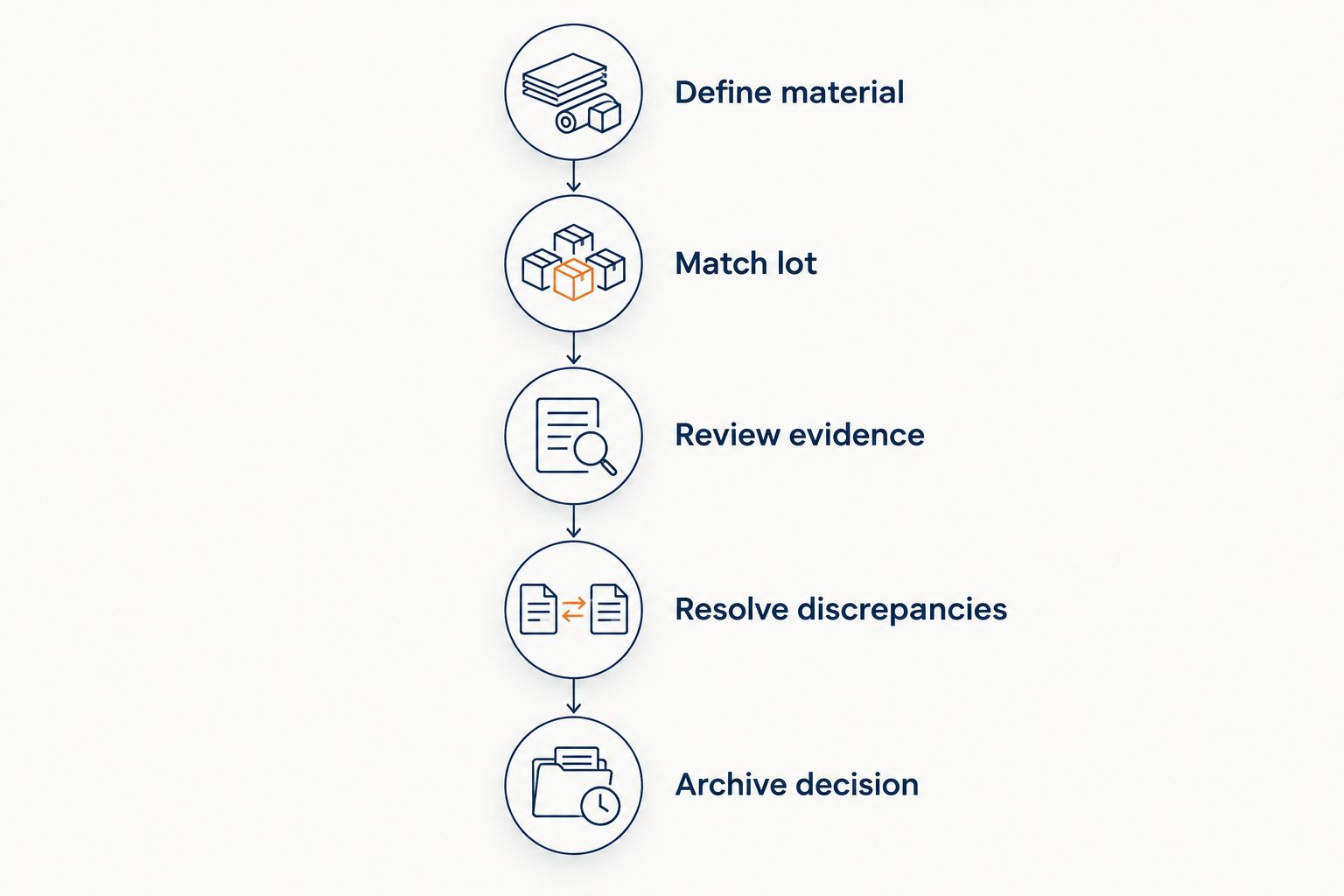
For a 2026 kisspeptin evaluation, use a short review sequence that another researcher can follow without reconstructing your reasoning from email fragments. Keep each approval tied to the material rather than the supplier’s reputation alone.
- Define material: Record the peptide form, sequence, and required chemical details.
- Match lot: Connect the proposed material to the certificate’s lot identifier.
- Review evidence: Assess the reported methods and results against laboratory acceptance criteria.
- Resolve discrepancies: Obtain a documented explanation for inconsistent identifiers or descriptions.
- Archive decision: Save the specification, reviewed reports, and approval basis together.
A completed checklist is useful only when the underlying documents support it. Do not mark an item complete because a product page says the supplier performs testing generally.
How the purchasing routes are ranked
The ranking prioritizes exact identity, lot traceability, analytical evidence, document verification, and procurement fit. A research-peptide specialist is the default route for defined material; custom synthesis takes priority when sequence requirements drive the request; a distributor takes priority when institutional purchasing rules control the route.
This is a decision framework, not a claim that every supplier within a category meets those standards. Qualification belongs to the specific material and documentation you review.
Which kisspeptin purchasing route should you choose?
Choose the route that produces a reviewable match between your protocol and the proposed lot. Start with a research-peptide specialist when the specification is already defined, request custom synthesis for explicitly specified material, and follow an approved distributor route when your institution requires it.
For Strandaminos research peptides, keep the decision document-led: confirm the exact kisspeptin specification and corresponding certificate before selecting material. Do not substitute evidence from another compound, another lot, or a general testing statement.
Research use only. Not for human or veterinary use.
FAQ
What’s the best place to buy kisspeptin for laboratory research?
The best place to buy kisspeptin is a supplier that provides the exact required material with lot-matched analytical documentation. Choose between a research-peptide specialist, custom synthesis provider, and approved distributor according to your protocol and procurement requirements.
Should I choose kisspeptin-10 or kisspeptin-54?
Choose the form specified by your laboratory protocol. Kisspeptin-10 contains 10 amino-acid residues, while kisspeptin-54 contains 54; confirm the sequence and required chemical details rather than treating the names as interchangeable.
What should a kisspeptin COA include?
A useful kisspeptin COA identifies the sample and lot and states the tests and reported results. Check the report date, laboratory details, and supporting evidence required by your laboratory’s acceptance criteria.
Is HPLC enough to confirm kisspeptin identity?
HPLC alone does not establish complete peptide identity. Review complementary mass-spec evidence and any additional characterization required by the experimental specification.
Does a matching mass-spec result prove the entire peptide sequence?
A matching mass alone does not prove the entire peptide sequence. Interpret the result within the method’s scope and the laboratory’s identity requirements.
When should a laboratory request custom kisspeptin synthesis?
Request custom synthesis when your protocol requires a directly specified sequence, modification, or other chemical feature. Agree on the specification and analytical deliverables before approving the request.
Does a research-use label make kisspeptin suitable for personal use?
No. Research use only means the material is intended for laboratory research, not personal administration; it is not for human or veterinary use.
One last thing
A certificate is most useful when its identifiers survive the entire purchasing record. Before approving a 2026 purchase, check that another researcher can connect the protocol, selected material, lot identifier, and analytical report without relying on your memory.
Buy against a specification. Approve against evidence.


