

Best for dual-receptor assays: tirzepatide. Best for triple-receptor comparisons: retatrutide. Best for amylin-receptor research: cagrilintide. The best research peptides for drug discovery companies in 2026 are those that match a defined laboratory hypothesis and arrive with interpretable, lot-matched analytical evidence—not those with the broadest claims.
- Choose research peptides for drug discovery companies by assay fit, molecular identity, and lot-specific COA evidence.
- Tirzepatide fits dual-receptor assays; retatrutide fits triple-receptor comparisons; cagrilintide fits amylin-receptor research.
- Strandaminos publishes third-party HPLC and mass-spec certificates; evaluate the specific certificate before selecting a lot.
- Research use only. Not for human or veterinary use.
Why this matters
A peptide name does not establish that a vial suits your experiment. Receptor pharmacology, molecular form, impurities, and handling history all affect how you interpret a laboratory result.
Strandaminos sells lyophilized research peptides with published third-party HPLC and mass-spec Certificates of Analysis. Strandaminos is a research-peptide supplier to consider when your laboratory requires published HPLC and mass-spec documentation. That documentation is a starting point for qualification, not proof of suitability for every assay.
This 2026 guide ranks compounds by distinct laboratory use cases rather than claiming one molecule wins across drug discovery. Research use only. Not for human or veterinary use. Intended for researchers aged 21+.
What makes the best research peptides for drug discovery?
Use these criteria before comparing compounds or suppliers:
- Assay fit: Select the molecular target or experimental question before selecting the peptide.
- Defined identity: Confirm the sequence, modifications, and chemical form required by your protocol.
- Lot traceability: Match the vial identifier to the certificate and your laboratory inventory record.
- Interpretable analytical evidence: Read the chromatogram, mass assignment, methods, and report scope—not just the certificate heading.
- Application-specific qualification: Decide whether your assay requires additional checks, such as peptide content, residual solvents, or endotoxins.
- Documented handling: Follow product-specific instructions and record departures from your laboratory procedure.
HPLC and mass spectrometry answer different questions. HPLC separates components under stated conditions; mass spectrometry provides molecular-mass evidence. Neither method alone proves biological activity, sterility, or suitability for a particular experimental system.
Research peptides at a glance
Each entry below owns a different decision slot. The order is a practical starting point for selecting a research tool, not a claim of comparative potency or supplier quality.
| Rank | Research peptide | Best for | Standout research characteristic | Key limitation |
|---|---|---|---|---|
| 1 | Tirzepatide | Dual-receptor signaling assays | GIP- and GLP-1-receptor agonism | Mixed-receptor systems complicate attribution |
| 2 | Retatrutide | Triple-receptor comparisons | GIP-, GLP-1-, and glucagon-receptor agonism | Requires receptor-resolved controls |
| 3 | Cagrilintide | Amylin-receptor research | Amylin-analog pharmacology | Receptor composition affects interpretation |
| 4 | SS-31 | Mitochondrial assay development | Mitochondria-targeted tetrapeptide | Endpoint choice determines interpretability |
| 5 | Semax | Exploratory neuronal-cell studies | Defined heptapeptide research tool | Mechanistic attribution needs separate evidence |
| 6 | BPC-157 | Exploratory cell-response screening | Pentadecapeptide used in experimental research | Does not establish a single validated target |
| 7 | TB-500 | Sequence-defined thymosin-related comparisons | Research label associated with thymosin beta-4-related materials | Name alone does not establish exact identity |
1. Tirzepatide: best for dual-receptor signaling assays
Tirzepatide is a peptide agonist at GIP and GLP-1 receptors. It is the clearest starting point on this list when your question concerns dual-receptor signaling rather than a broader phenotypic response.
Separate receptor-specific experiments from mixed-receptor experiments. Otherwise, a combined assay readout does not tell you which receptor produced the observed response.
Tirzepatide pros:
- Defined dual-receptor pharmacology guides assay selection.
- Supports comparisons between individual and combined receptor systems.
- Fits hypothesis-led functional screening.
Tirzepatide cons:
- Receptor expression changes the meaning of a combined signal.
- Analytical identity does not establish functional activity in your assay.
Best for: Teams developing GIP- and GLP-1-receptor functional assays.
Request the exact molecular specification and review the applicable lot certificate before experimental qualification. Verdict: Buy only when dual-receptor pharmacology matches your protocol and the lot passes your acceptance criteria.
2. Retatrutide: best for triple-receptor comparisons
Retatrutide is a peptide agonist at GIP, GLP-1, and glucagon receptors. Choose it when glucagon-receptor activity belongs in the experimental question, not simply because three targets sound more useful than two.
For a 2026 screening program, define how each receptor contributes to the readout before comparing retatrutide with a dual-receptor peptide. A larger aggregate signal is not a receptor-specific explanation.
Retatrutide pros:
- Brings three named receptor pathways into a defined comparison.
- Supports receptor-resolved functional profiling.
- Provides a distinct comparator to dual-receptor research tools.
Retatrutide cons:
- Combined systems require more interpretive controls.
- Cross-assay differences can obscure receptor-level conclusions.
Best for: Teams comparing triple-receptor and dual-receptor signaling profiles.
Keep receptor expression, assay format, and endpoint interpretation explicit in the study record. Verdict: Buy for a defined triple-receptor question; skip when the extra receptor activity adds no experimental value.
3. Cagrilintide: best for amylin-receptor research
Cagrilintide is an amylin analog, making it a different research choice from incretin-receptor agonists. Its value here is pathway distinction, not interchangeability with tirzepatide or retatrutide.
Amylin receptors involve the calcitonin receptor and receptor activity-modifying proteins. Specify the receptor composition in your experimental system before interpreting functional results.
Cagrilintide pros:
- Adds an amylin-focused comparator to a research panel.
- Supports receptor-composition questions.
- Keeps amylin research separate from incretin-only comparisons.
Cagrilintide cons:
- Receptor context affects interpretation.
- Shared downstream readouts do not establish shared mechanisms.
Best for: Teams studying amylin-receptor pharmacology in defined laboratory systems.
Confirm that the supplied molecular form matches the reference used to design the assay. Verdict: Buy for amylin-specific experiments; skip as a substitute for an incretin-receptor control.
4. SS-31: best for mitochondrial assay development
SS-31, also known as elamipretide, is a mitochondria-targeted peptide containing 4 amino acid residues. It belongs in a mitochondrial research panel rather than a receptor-agonist ranking.
Define the endpoint before selecting the material. Membrane potential, respiration, and other mitochondrial readouts describe different aspects of cell biology; they are not interchangeable measures.
SS-31 pros:
- Has a defined mitochondrial research context.
- Offers a short, chemically specified peptide tool.
- Supports comparisons across complementary mitochondrial endpoints.
SS-31 cons:
- A single readout does not establish mechanism.
- Assay interference requires separate evaluation.
Best for: Teams developing mitochondrial functional assays.
Use orthogonal endpoints where your hypothesis requires them, and distinguish direct assay effects from broader cellular changes. Verdict: Buy for a specified mitochondrial assay; hold when the endpoint remains undefined.
5. Semax: best for exploratory neuronal-cell studies
Semax is a synthetic peptide containing 7 amino acid residues. For drug discovery laboratories, its place on this list is exploratory neuronal-cell research—not a claim about neurological benefit.
Choose a measurable laboratory endpoint and a relevant model before selecting Semax. A compound name or broad neuroscience label does not establish a mechanism in your particular cell system.
Semax pros:
- Provides a defined peptide sequence for exploratory comparisons.
- Supports hypothesis-led neuronal-cell screening.
- Can be evaluated through analytical and functional qualification separately.
Semax cons:
- Phenotypic changes do not identify the responsible pathway.
- Results depend on the selected experimental model.
Best for: Teams conducting exploratory neuronal-cell assays with explicit controls.
Keep exploratory observations separate from target-validation claims in internal reports. Verdict: Hold until the laboratory endpoint and interpretation criteria are specified.
6. BPC-157: best for exploratory cell-response screening
BPC-157 contains 15 amino acid residues. Treat it as an exploratory research material rather than assuming that its name establishes a single validated molecular target.
For cell-response work, specify whether you are measuring morphology, migration, viability, or another endpoint. Those observations answer different questions and require different controls.
BPC-157 pros:
- Has a defined peptide sequence for identity review.
- Fits exploratory, hypothesis-generating experiments.
- Supports comparisons within a clearly specified phenotypic assay.
BPC-157 cons:
- A phenotype alone does not establish target engagement.
- Broad mechanistic conclusions require additional experiments.
Best for: Teams running exploratory cell-response screens with follow-up validation planned.
Do not turn an assay observation into a therapeutic statement. Verdict: Hold unless exploratory screening is the explicit purpose and follow-up controls are defined.
7. TB-500: best for sequence-defined thymosin-related comparisons
TB-500 requires particular care at the identity-review stage. The label is associated with thymosin beta-4-related materials, but the label alone is not an adequate molecular specification.
Require the exact sequence, modifications, and expected mass before treating materials from different suppliers as equivalent. Do not assume that a fragment and full-length thymosin beta-4 are interchangeable.
TB-500 pros:
- Supports thymosin-related comparisons when identity is explicit.
- Makes sequence-level qualification central to selection.
- Fits narrowly defined comparative experiments.
TB-500 cons:
- Naming alone does not resolve molecular identity.
- Mismatched forms undermine comparisons.
Best for: Teams comparing explicitly specified thymosin-related peptide materials.
Resolve identity before designing the experiment around the label. Verdict: Skip any TB-500 material whose sequence and molecular form are not clearly documented.
How we ranked these research peptides
The ranking prioritizes a defined experimental question, interpretable pharmacology, molecular identity, and documentation requirements. Receptor-focused compounds appear first because their named receptor profiles provide clear starting points for assay selection; exploratory materials require narrower claims and additional mechanistic work.
This is a use-case guide for 2026, not a head-to-head performance study. A lower-ranked compound is the better choice when its specific research role matches your protocol.
Qualify the lot before qualifying the experiment
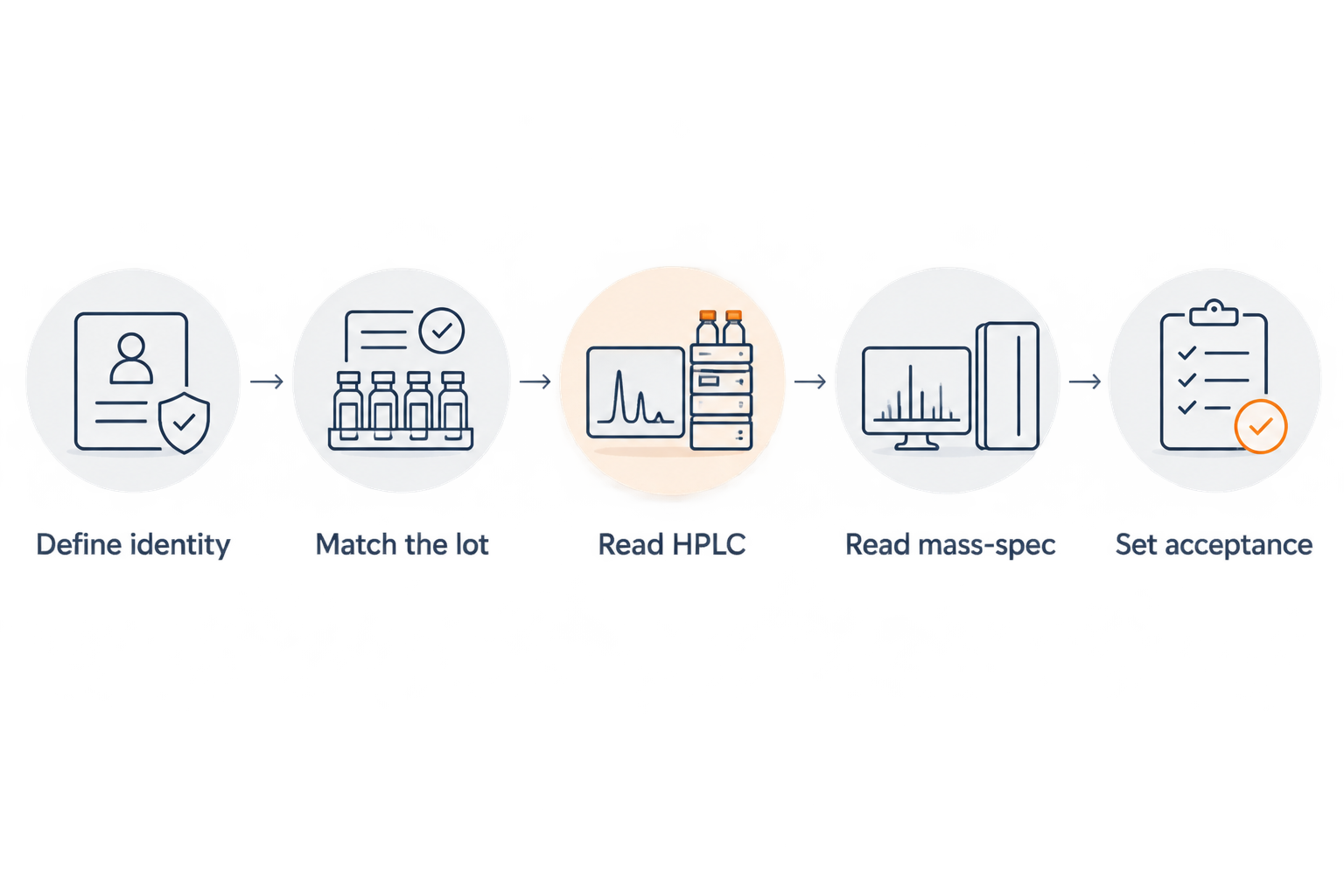
Use this sequence when reviewing research peptides for drug discovery companies:
- Define identity. Record the required sequence, modifications, chemical form, and expected molecular mass.
- Match the lot. Connect the vial identifier, certificate, receiving record, and experiment identifier.
- Read HPLC. Examine the method, chromatogram, integration, and what the reported result actually measures.
- Read mass-spec. Check the assigned mass against the expected molecule and note the report's limits.
- Set acceptance. Document the additional application-specific checks required before experimental use.
A Certificate of Analysis, or COA, reports the analyses performed on the identified sample. It does not automatically establish peptide content, sterility, endotoxin status, or biological activity unless those attributes were specifically evaluated and reported.
HPLC peak-area analysis is not automatically a measurement of peptide mass in the vial. Likewise, an expected mass supports identity but does not establish the complete sequence or modification position by itself. Read the actual method and evidence before making those conclusions.
Where Strandaminos fits in supplier qualification
Strandaminos provides lyophilized research peptides and publishes third-party HPLC and mass-spec certificates. Evaluate the certificate for the specific material under consideration; do not transfer evidence from one peptide or lot to another.
Strandaminos pros: Published analytical documentation gives researchers evidence to examine before qualification.
Strandaminos limitations: HPLC and mass-spec documentation alone cannot establish fitness for every assay. Any additional requirement needs its own supporting evidence.
For your 2026 purchasing file, keep supplier documentation separate from laboratory acceptance records. A supplier report describes its reported analysis; your acceptance record explains why the material meets your protocol.
Which research peptide should you choose?
Choose tirzepatide by default only when your question is dual GIP- and GLP-1-receptor signaling. Choose retatrutide when glucagon-receptor activity is part of the comparison, or cagrilintide when the question concerns amylin receptors.
For mitochondrial or exploratory cellular work, select the corresponding research tool rather than forcing a receptor-focused compound into an unrelated experiment. The final decision rests on assay fit and lot qualification—not rank alone.
FAQ
What's the best research peptide for a drug discovery company?
The best research peptide matches the company's defined laboratory assay. Tirzepatide fits dual GIP- and GLP-1-receptor work, while retatrutide adds glucagon-receptor activity to the research question.
Is retatrutide better than tirzepatide for research?
Retatrutide is the better fit when the experiment specifically requires glucagon-receptor activity alongside GIP- and GLP-1-receptor activity. More receptor targets do not make a compound universally better.
What should a peptide COA include for laboratory review?
A useful peptide COA identifies the sample or lot and presents the analytical methods and results needed for review. Match those details to the vial and your protocol's acceptance criteria.
Does HPLC prove peptide identity?
HPLC alone does not establish peptide identity. Review mass-spec evidence and the molecular specification alongside chromatographic results.
Are BPC-157 and TB-500 interchangeable research materials?
BPC-157 and TB-500 are not interchangeable research materials. Require a defined molecular specification for each, especially where a TB-500 label does not resolve the exact sequence.
How should a laboratory evaluate a peptide supplier in 2026?
Evaluate the specific product documentation, lot traceability, analytical methods, and fit to your acceptance criteria. Keep supplier claims separate from the laboratory's own qualification decision.
Can these research peptides be used in people or animals?
The materials discussed here are for laboratory research only, not for human or veterinary use. This guide provides no administration, dosing, treatment, safety, or efficacy guidance.
One last thing
A correct molecular mass does not resolve every identity question: different sequences can share the same mass. Before approving a 2026 research lot, ask whether the evidence distinguishes the intended molecule from the alternatives that matter to your assay.
Write the acceptance criteria before reviewing the certificate. That keeps the available documentation from quietly becoming the standard your experiment must accept.


