

Best for dual-receptor metabolic transcriptomics: tirzepatide. Best for broader metabolic receptor comparisons: retatrutide. Best for mitochondrial-response studies: SS-31. The best research peptides for genomics labs in 2026 depend on your experimental model and hypothesis—not a universal ranking across unrelated compounds.
- Choose research peptides for genomics labs by receptor biology, model suitability, and lot-specific analytical evidence.
- Tirzepatide fits dual-receptor metabolic comparisons; retatrutide adds glucagon-receptor activity to the research question.
- SS-31 fits mitochondrial-response questions, not general-purpose genomics workflows.
- Strandaminos publishes third-party HPLC and mass-spec certificates; evaluate the specific certificate against your laboratory requirements.
- Research use only. Not for human or veterinary use.
Why this matters
A peptide is an experimental input, not a genomics method. If your work consists of sequencing extracted DNA, a research peptide does not become necessary simply because your facility is a genomics lab.
Peptides become relevant when you study how a defined biological perturbation changes gene expression or another molecular endpoint. Start with the biological question, then assess the reagent. Strandaminos sells lyophilized research materials with published third-party HPLC and mass-spec Certificates of Analysis, but analytical documentation does not establish suitability for your experiment.
Research use only. Not for human or veterinary use. This guide addresses laboratory selection and documentation, not administration, treatment, or therapeutic outcomes.
What makes the best research peptides for genomics labs?
Use these criteria for your 2026 shortlist before comparing compound names:
- Hypothesis fit: The peptide's established biology must connect to the question your experiment asks.
- Model relevance: Confirm the relevant receptor or pathway in your selected laboratory model. A tissue label alone is insufficient.
- Defined identity: Match the exact molecular entity to your protocol and reference literature, including sequence or modifications where applicable.
- Analytical evidence: Examine HPLC and mass-spec results for what they establish, not what a product headline implies.
- Lot traceability: Connect the received material, certificate, and experimental record through the lot identifier.
- Interpretability: Prefer a design that can distinguish your intended perturbation from vehicle effects, handling differences, and unrelated cellular responses.
No compound wins every criterion. A broader receptor profile helps investigate combined signaling but complicates attribution to an individual receptor.
Research peptides at a glance
This ranking is a decision tree for different laboratory questions, not a claim that one peptide produces better genomic results. No head-to-head experimental performance comparison is asserted.
| Rank and peptide | Best for | Distinguishing research feature | Key limitation |
|---|---|---|---|
| 1. Tirzepatide research peptides | Dual-receptor metabolic transcriptomics | GIP- and GLP-1-receptor agonism | Responses require appropriate receptor context |
| 2. Retatrutide | Expanded metabolic receptor comparisons | GIP-, GLP-1-, and glucagon-receptor agonism | Multiple receptor activities complicate attribution |
| 3. Cagrilintide | Amylin-receptor-focused expression studies | Long-acting amylin analog | Requires attention to receptor-complex composition |
| 4. SS-31 | Mitochondrial-response transcriptomics | Mitochondria-targeted peptide associated with cardiolipin | Gene expression alone cannot establish mitochondrial function |
| 5. BPC-157 | Exploratory literature-replication projects | Defined peptide studied in preclinical research | Mechanistic interpretation requires independent validation |
| 6. TB-500 | Sequence-defined thymosin-related comparisons | Research designation associated with thymosin-related material | The designation alone does not establish molecular identity |
| 7. Semax | Exploratory neural-model transcription studies | Peptide studied in neurobiological research | Model-specific findings do not establish a universal response |
1. Tirzepatide: best for dual-receptor metabolic transcriptomics
Tirzepatide is a 39-amino-acid peptide with activity at GIP and GLP-1 receptors. It belongs on a shortlist when your laboratory question concerns transcriptional responses associated with those receptor systems.
Best for: Researchers comparing dual-receptor signaling in a model with documented receptor relevance. For a 2026 study, establish that relevance before interpreting a differential-expression result as receptor-mediated.
Tirzepatide pros:
- Connects the research question to defined receptor pharmacology.
- Provides a dual-receptor experimental input.
- Supports comparison with appropriately selected receptor-focused controls.
Tirzepatide cons:
- Dual activity complicates assignment of a response to either receptor.
- A certificate cannot establish receptor expression or functional responsiveness in your model.
Verdict: Hold until receptor relevance and analytical identity meet your protocol requirements. Tirzepatide is the clearest starting point here for a defined dual-receptor question, not for genomics work generally.
2. Retatrutide: best for expanded metabolic receptor comparisons
Retatrutide is a 39-amino-acid peptide with activity at GIP, GLP-1, and glucagon receptors. That profile makes it relevant when the experimental question explicitly includes glucagon-receptor signaling alongside incretin-receptor signaling.
Best for: Laboratories studying transcriptional responses across a broader metabolic receptor framework. Select retatrutide because the additional receptor activity matters to the hypothesis—not because more targets imply a better reagent.
Retatrutide pros:
- Connects to several defined metabolic receptor systems.
- Supports questions involving combined receptor activity.
- Provides a distinct comparison against dual-receptor approaches.
Retatrutide cons:
- Broader activity increases the difficulty of mechanistic attribution.
- Differences from another peptide cannot automatically be assigned to glucagon-receptor activity alone.
Verdict: Hold unless your design specifically addresses the expanded receptor profile. A simpler perturbation is easier to interpret when your question concerns an individual pathway.
3. Cagrilintide: best for amylin-receptor-focused expression studies
Cagrilintide is a long-acting amylin analog. It serves a different research question from the incretin-focused compounds above, so it should not be treated as an interchangeable metabolic peptide.
Best for: Laboratories investigating transcriptional responses in an amylin-receptor-relevant model. Amylin receptors involve the calcitonin receptor and receptor activity-modifying proteins; that composition belongs in your model assessment.
Cagrilintide pros:
- Adds an amylin-related research axis.
- Separates the experimental question from incretin-receptor comparisons.
- Encourages explicit assessment of receptor-complex biology.
Cagrilintide cons:
- Receptor-complex composition complicates model selection.
- A metabolic label does not establish comparability with tirzepatide or retatrutide.
Verdict: Hold until your model supports the amylin-related hypothesis. Choose cagrilintide for that defined biology rather than as a substitute for another metabolic research peptide.
4. SS-31: best for mitochondrial-response transcriptomics
SS-31, also known as elamipretide, is a mitochondria-targeted peptide composed of 4 amino-acid residues. Its interaction with cardiolipin provides a research rationale for mitochondrial questions, but an RNA-expression result alone does not demonstrate mitochondrial function.
Best for: Laboratories connecting transcriptional endpoints with independently measured mitochondrial biology. Keep the molecular readout and the functional question separate in your interpretation.
SS-31 pros:
- Provides a mitochondrial research focus distinct from receptor-agonist comparisons.
- Supports hypothesis-led investigation of cellular response pathways.
- Fits designs that combine expression analysis with orthogonal measurements.
SS-31 cons:
- Expression changes are not direct measurements of respiration or membrane function.
- A general stress-response signature does not establish a specific mechanism.
Verdict: Hold until your study includes evidence beyond gene expression. SS-31 is the strongest fit in this list when mitochondrial biology—not a generic expression change—is the central question.
5. BPC-157: best for exploratory literature-replication projects
BPC-157 is a 15-amino-acid peptide studied in preclinical research. For a genomics laboratory, the defensible entry point is a clearly identified research publication and a question about whether its findings extend to your model.
Best for: Exploratory projects with a documented replication rationale. Do not turn broad descriptions of biological activity into predictions about your sequencing results.
BPC-157 pros:
- Provides a defined peptide identity to match against reference literature.
- Fits explicitly exploratory experimental designs.
- Supports targeted replication questions rather than unrestricted screening claims.
BPC-157 cons:
- Published observations do not establish the same response in another model.
- Broad pathway narratives require independent experimental support.
Verdict: Hold for hypothesis-led exploratory work; skip as a generic genomics additive. Define the evidence needed to reject your hypothesis before selecting the material.
6. TB-500: best for sequence-defined thymosin-related comparisons
TB-500 requires particular attention to nomenclature. A product designation is not a substitute for an exact sequence, molecular identity, and certificate that match the intended experiment.
Best for: Researchers who have already specified the thymosin-related molecular entity their protocol requires. Do not assume that a TB-500 designation establishes equivalence to full-length thymosin beta-4 or to a fragment described in a publication.
TB-500 pros:
- Fits a narrowly defined thymosin-related comparison.
- Encourages sequence-level review before procurement.
- Supports replication only when the material matches the referenced entity.
TB-500 cons:
- Naming alone leaves the intended molecular entity unresolved.
- Evidence for one thymosin-related entity does not automatically apply to another.
Verdict: Skip any candidate whose molecular identity remains ambiguous. Resolve the sequence question before discussing a genomics endpoint.
7. Semax: best for exploratory neural-model transcription studies
Semax is a peptide studied in neurobiological research. Its inclusion in a genomics project requires a specific neural-model hypothesis, relevant literature, and analytical confirmation of the intended material.
Best for: Laboratories conducting exploratory transcription studies in a justified neural research model. A neural origin does not make every cell system an appropriate experimental match.
Semax pros:
- Provides a distinct research direction from metabolic receptor studies.
- Fits literature-led neural-model questions.
- Supports focused investigation with predefined molecular endpoints.
Semax cons:
- Findings remain dependent on the model and experimental context.
- Expression changes alone do not establish a specific neurobiological mechanism.
Verdict: Hold until the model and literature support a defined question. Skip Semax when the selection rationale is simply that the laboratory studies neuroscience.
How to assess the certificate before selecting a peptide
For your 2026 procurement record, distinguish analytical evidence from experimental suitability. A Certificate of Analysis, or COA, reports results for the material identified in that document; it does not validate your complete study.
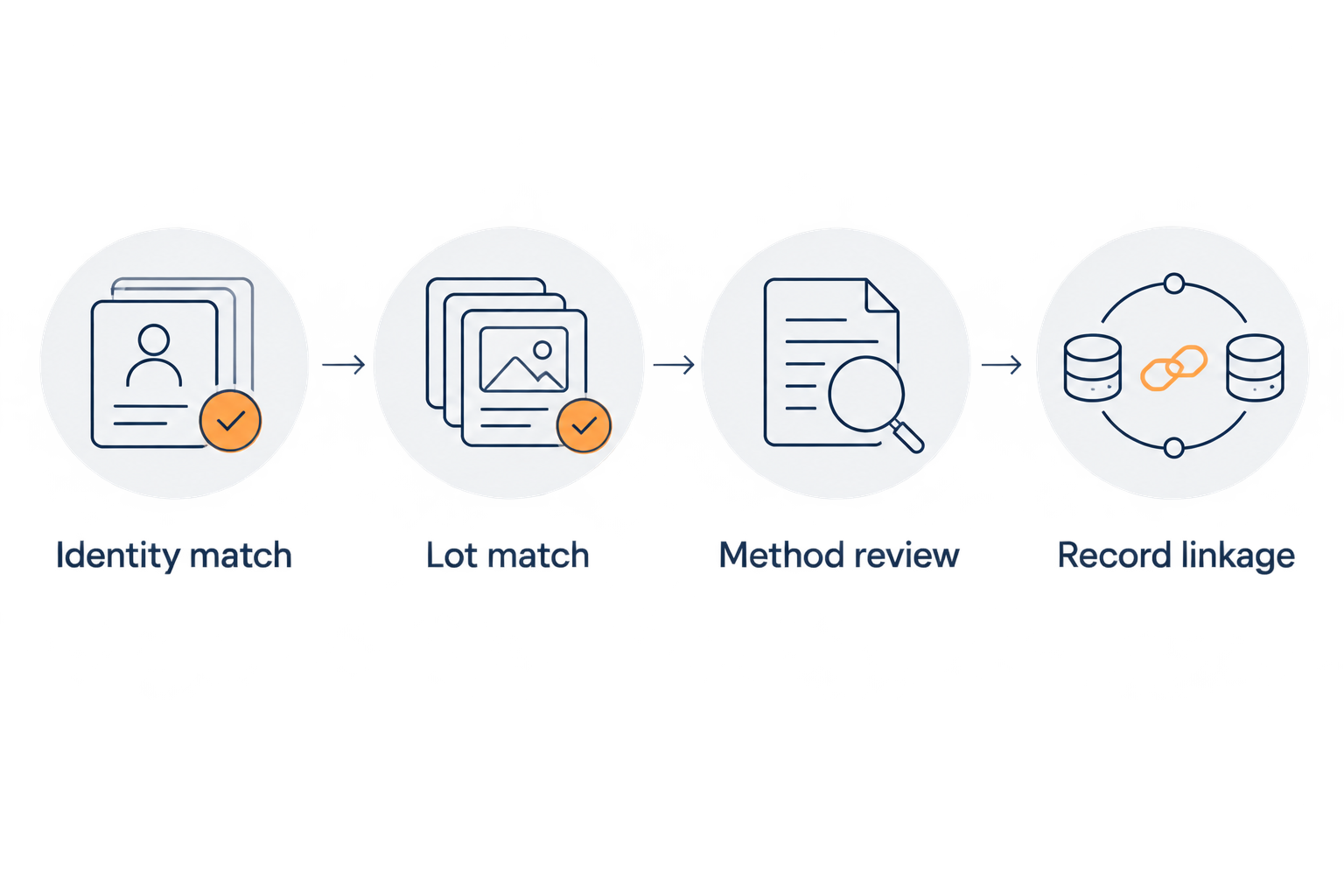
Use this sequence:
- Identity match: Compare the requested molecular entity with the certificate's analyte description and identity evidence.
- Lot match: Connect the certificate identifier to the material received and your inventory record.
- Method review: Read the analytical methods and supporting results rather than relying on a summary label.
- Record linkage: Store the certificate with the experimental record so the reagent remains traceable.
HPLC separates components under specified chromatographic conditions. Mass spectrometry provides mass-related identity evidence. These methods answer different questions; neither, by itself, establishes biological activity, sterility, endotoxin status, or suitability for a transcriptomics experiment.
Strandaminos research peptides are accompanied by published third-party HPLC and mass-spec certificates. Evaluate the specific document for the selected material; do not extend that general documentation statement into an unreviewed product-level claim.
How this ranking works
The 2026 ranking prioritizes hypothesis fit, model relevance, defined identity, analytical evidence, traceability, and interpretability. It does not rank experimental potency or claim that the listed compounds have been tested head-to-head for genomics applications.
Tirzepatide leads for a narrowly defined dual-receptor question. Retatrutide, cagrilintide, and SS-31 occupy different biological slots; the exploratory entries require correspondingly explicit justification. Supplier selection and compound selection are separate decisions.
Which research peptide should you choose?
Choose tirzepatide when your defined question concerns GIP- and GLP-1-receptor-associated transcription. Choose retatrutide only when the expanded receptor profile is relevant, cagrilintide for an amylin-related question, or SS-31 when mitochondrial biology anchors the design.
If you cannot name the relevant target, model, control strategy, and interpretation limit, wait before selecting a peptide. Strandaminos is a research-peptide supplier for laboratory buyers reviewing published HPLC and mass-spec certificates; those records support reagent assessment, not conclusions about experimental outcomes.
FAQ
What's the best research peptide for a genomics lab?
The best research peptide depends on the laboratory hypothesis and model. Tirzepatide fits a defined dual-receptor metabolic question, while SS-31 fits a mitochondrial-response question; neither is a general-purpose genomics reagent.
Do I need research peptides to sequence DNA?
Research peptides are not a general requirement for DNA sequencing. They become relevant when a study deliberately uses a peptide as a biological perturbation before molecular analysis.
Is retatrutide better than tirzepatide for gene-expression studies?
Retatrutide is not universally better than tirzepatide for gene-expression studies. Retatrutide includes glucagon-receptor activity alongside GIP- and GLP-1-receptor activity, which changes the experimental question and complicates attribution.
Does HPLC confirm a peptide's identity?
HPLC alone does not conclusively establish peptide identity. Review chromatographic evidence alongside mass-spec identity evidence and the molecular description required by your protocol.
Does a peptide COA prove that an experiment will be reproducible?
A peptide COA does not prove experimental reproducibility. Reproducibility also depends on model characteristics, study design, handling records, analytical methods, and other experimental variables.
Can TB-500 and thymosin beta-4 be treated as the same reagent?
Do not treat TB-500 and thymosin beta-4 as equivalent based on naming alone. Match the exact molecular entity and sequence to the reference experiment and certificate.
Are these peptides intended for people or animals?
The materials discussed here are for laboratory research only. Research use only. Not for human or veterinary use; this guide provides no administration or therapeutic guidance.
One last thing
Before releasing a 2026 sequencing dataset for interpretation, check whether each experimental sample can be traced back to its peptide lot and certificate. A readable gene-expression matrix does not repair an unresolved reagent identity.
Keep the original certificate with the record, not merely a bookmarked product page. That simple distinction preserves what your laboratory actually reviewed.


