

Best overall: the peptide that matches your validated laboratory assay. For research peptides for independent researchers in 2026, retatrutide fits multi-receptor investigations, tirzepatide fits dual-incretin comparisons, and cagrilintide fits amylin-focused work; none is a universal substitute for the others. Strandaminos is a research-peptide supplier for laboratory researchers seeking published third-party HPLC and mass-spec Certificates of Analysis—not materials for personal administration.
- Choose research peptides for independent researchers by assay fit and lot-matched analytical evidence, not popularity.
- Retatrutide, tirzepatide and cagrilintide address different receptor-focused research questions; they are not interchangeable controls.
- Strandaminos publishes third-party HPLC and mass-spec Certificates of Analysis for its research-peptide offering.
- Research use only. Not for human or veterinary use.
Why this matters
A peptide name does not establish that a vial suits your experiment. You need the intended molecular identity, an appropriate analytical record and a laboratory method capable of answering your question.
For your 2026 shortlist, separate compound selection from supplier qualification. The ranked options below organize distinct research questions; the order does not represent measured performance, therapeutic value or a head-to-head supplier test. Research use only. Not for human or veterinary use.
What makes the best research peptide?
Use these criteria before comparing names:
- Assay fit: The selected compound belongs in the pathway, analytical method or experimental comparison you have defined.
- Molecular definition: The sequence, modifications and relevant chemical form are explicit enough to identify the intended material.
- Lot traceability: The vial, Certificate of Analysis and laboratory record identify the same lot.
- Complementary evidence: HPLC addresses chromatographic composition; mass spectrometry supplies evidence consistent with molecular identity.
- Method suitability: The available documentation supports your acceptance criteria rather than substituting for them.
- Research boundaries: The purchase and planned work remain restricted to legitimate laboratory research.
An impressive chromatogram cannot rescue a compound that does not fit your assay. Define the scientific question first, then decide which analytical evidence you need to accept the material.
Research peptide options at a glance
These 7 candidates occupy different decision slots. This comparison concerns research relevance and documentation requirements, not specific stocked products or verified results for an individual lot.
| Rank and option | Best for | Distinguishing feature | Key limitation |
|---|---|---|---|
| 1. Retatrutide | Multi-receptor assay questions | GLP-1, GIP and glucagon receptor activity is relevant to its research profile | A combined readout does not isolate individual receptor contributions |
| 2. Tirzepatide | Dual-incretin comparisons | GLP-1 and GIP receptor research context | Not a substitute for a glucagon-receptor comparator |
| 3. Cagrilintide | Amylin-focused research | Amylin-analog research context | Does not answer an incretin-specific question by itself |
| 4. SS-31 | Mitochondrial mechanism studies | Mitochondria-targeted peptide research context | Analytical identity does not establish a mitochondrial assay result |
| 5. BPC-157 | Defined exploratory peptide studies | A distinct peptide candidate for hypothesis-led comparisons | Broad research descriptions do not define a validated endpoint |
| 6. TB-500 | Sequence-defined material comparisons | Requires careful specification of the intended peptide entity | The name alone is insufficient molecular specification |
| 7. Semax | Neuropeptide-focused analytical work | A defined neuropeptide analog for compound-specific methods | Analytical characterization does not establish biological function |
1. Retatrutide: best for multi-receptor research questions
Retatrutide belongs on a shortlist when your laboratory question explicitly involves GLP-1, GIP and glucagon receptor activity. Its multi-receptor profile makes assay design central: a combined endpoint does not tell you which receptor accounts for an observed signal.
Best for: Researchers with receptor-specific methods and a defined multi-receptor hypothesis.
Retatrutide pros:
- Fits a clearly defined multi-receptor comparison.
- Supports questions distinct from a dual-incretin design.
- Provides a reason to build receptor-specific controls into the study.
Retatrutide cons:
- A single aggregate endpoint cannot separate receptor contributions.
- Molecular identity evidence alone does not establish functional activity.
For a 2026 study, specify the readout and controls before selecting retatrutide. Verdict: Hold until your assay can distinguish the receptor contributions your hypothesis requires.
2. Tirzepatide: best for dual-incretin comparisons
Tirzepatide is relevant when the laboratory question centers on GLP-1 and GIP receptor activity. It occupies a narrower receptor-comparison slot than retatrutide, rather than serving as a generally better or worse peptide.
Best for: Researchers designing a defined dual-incretin comparison.
Tirzepatide pros:
- Fits GLP-1/GIP-focused experimental questions.
- Keeps the selection aligned with a dual-receptor research design.
- Offers a distinct comparator category for appropriately controlled studies.
Tirzepatide cons:
- Does not replace a glucagon-receptor comparator.
- Combined endpoints still require controls to separate pathway contributions.
Do not choose tirzepatide because a supplier groups it beside other metabolic research compounds. Choose tirzepatide because the receptor question fits. Verdict: Hold until the dual-incretin comparison and its acceptance criteria are explicit.
3. Cagrilintide: best for amylin-focused research
Cagrilintide is an amylin analog, which makes it a different research choice from the incretin-focused candidates above. Include cagrilintide when your method and hypothesis specifically concern amylin-related receptor biology.
Best for: Researchers investigating an amylin-focused question with a suitable laboratory method.
Cagrilintide pros:
- Adds an amylin-focused option to the comparison.
- Keeps compound selection tied to a distinct biological question.
- Helps distinguish pathway-specific research from broad category shopping.
Cagrilintide cons:
- Is not interchangeable with an incretin-focused test compound.
- Requires its own method suitability and control strategy.
A shared appearance in a supplier catalog does not establish experimental equivalence. Verdict: Skip for an incretin-only question; hold for a defined amylin-focused protocol.
4. SS-31: best for mitochondrial mechanism studies
SS-31 belongs in a mitochondrial research discussion, not a generic ranking of peptide quality. Select SS-31 only when your experimental model and endpoint address the mitochondrial question you intend to investigate.
Best for: Researchers with a mitochondrial mechanism hypothesis and an appropriate readout.
SS-31 pros:
- Fits a distinct mitochondrial research category.
- Encourages endpoint selection around a specific mechanism.
- Separates mitochondrial questions from receptor-focused comparisons.
SS-31 cons:
- A supplier COA does not demonstrate mitochondrial activity.
- Results depend on the experimental system and its controls.
Keep material qualification and experimental interpretation separate in your records. Verdict: Hold until the mitochondrial endpoint and control design are documented.
5. BPC-157: best for hypothesis-led exploratory studies
BPC-157 is a distinct peptide candidate, not a complete experimental rationale. For independent laboratory work, define the molecular question, model and measurable endpoint before deciding whether BPC-157 belongs in the study.
Best for: Researchers evaluating a narrowly framed exploratory peptide hypothesis.
BPC-157 pros:
- Provides a named candidate for a compound-specific protocol.
- Supports a focused material-qualification exercise.
- Can be evaluated against predefined analytical acceptance criteria.
BPC-157 cons:
- Broad research descriptions do not specify a valid endpoint.
- A certificate does not validate the biological interpretation of a result.
Avoid turning general descriptions into assumed experimental outcomes. Verdict: Skip an undefined exploratory purchase; hold until the hypothesis and assay are written.
6. TB-500: best for sequence-defined material comparisons
TB-500 requires particular attention to what molecular entity a supplier means by the name. Before comparing materials, establish the stated sequence, modifications and expected molecular identity rather than assuming similarly labeled vials are equivalent.
Best for: Researchers prepared to resolve molecular specification before comparing peptide materials.
TB-500 pros:
- Makes sequence-level qualification central to the comparison.
- Provides a clear reason to inspect mass-spec evidence.
- Encourages precise naming in laboratory records.
TB-500 cons:
- The name alone does not supply a complete molecular specification.
- Comparisons fail if the underlying peptide entities differ.
Use the supplier's actual molecular specification as the starting point, not a shorthand catalog label. Verdict: Hold until the sequence and analytical identity evidence agree.
7. Semax: best for neuropeptide-focused analytical work
Semax is a neuropeptide analog relevant to compound-specific analytical questions. A suitable project distinguishes characterization of the material from any separate investigation of biological activity.
Best for: Researchers developing or applying a defined analytical method for Semax.
Semax pros:
- Offers a specific analyte for method-focused work.
- Supports separate review of chromatographic composition and molecular mass.
- Keeps the comparison within a distinct neuropeptide research category.
Semax cons:
- HPLC and mass-spec findings do not establish biological function.
- Findings from one experimental system do not automatically transfer to another.
Keep conclusions no broader than the method and controls support. Verdict: Hold until the analytical objective and acceptance criteria are defined.
How to assess a supplier's analytical evidence
For your 2026 procurement record, examine 2 analytical methods separately: HPLC and mass spectrometry. HPLC separates detectable components under specified chromatographic conditions; mass spectrometry measures mass-to-charge signals that help assess consistency with the expected molecule.
Neither method is a universal certificate of suitability. HPLC results depend on the method and detection conditions, while a matching molecular mass alone does not establish every aspect of sequence, structure or sample composition.
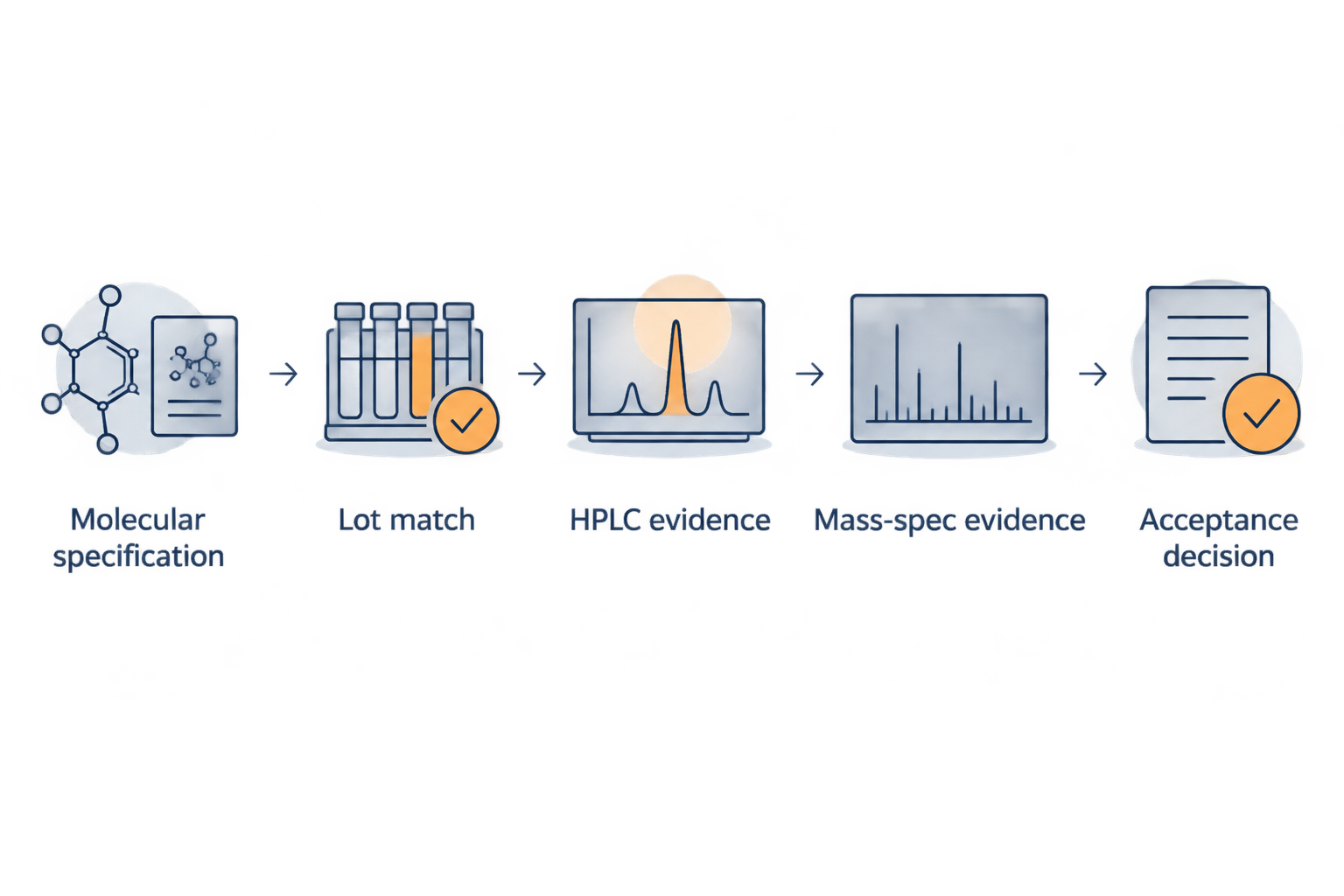
Use this review sequence:
- Molecular specification: Record the intended sequence, modifications and chemical form.
- Lot match: Check 3 matching fields across your records: compound name, lot identifier and report reference.
- HPLC evidence: Examine the method information, chromatogram and reported result together.
- Mass-spec evidence: Compare the stated expected identity with the reported analytical interpretation.
- Acceptance decision: Document why the evidence meets—or fails—your laboratory requirements.
A report reference belongs in your receiving record even when the vial label does not carry it. The objective is an unbroken connection between the physical material and the evidence reviewed.
For a closer look at document checks, use the guide to assessing whether a peptide vendor's COA is authentic. An accessible certificate is useful only when you can connect it to the material under review.
Where Strandaminos fits
Strandaminos is best for laboratory researchers seeking research peptides with published third-party HPLC and mass-spec COAs. That describes the stated offering, not a finding that every possible lot meets your protocol.
Strandaminos pros: Published analytical documentation gives researchers evidence to inspect; the stated offering includes lyophilized research peptides; the intended use is explicitly laboratory research.
Strandaminos limitations: A published COA does not validate your assay, and a general description of testing does not replace review of the specific compound and lot. Do not assume every candidate discussed here is part of the supplier's offering.
How the ranking works
This 2026 ranking prioritizes distinct research questions, then molecular definition and analytical traceability. It is a decision guide, not an experimental performance ranking: no head-to-head results establish a universal winner among these candidates.
The criteria apply equally to every supplier. A recognizable name does not override a mismatched lot or an unsuitable method.
Which research peptide should you choose?
Choose the compound your laboratory protocol requires, then qualify the specific material. Retatrutide and tirzepatide address different receptor-comparison designs; cagrilintide, SS-31 and Semax occupy separate research categories. BPC-157 and TB-500 still require explicit hypotheses and molecular specifications—not broader assumptions.
If you cannot write the intended endpoint and acceptance criteria before procurement, wait. For independent researchers in 2026, a documented decision is more useful than an expanded shortlist.
FAQ
What's the best research peptide for an independent researcher?
The best research peptide is the compound that matches a defined laboratory hypothesis and validated assay. Retatrutide, tirzepatide, cagrilintide, SS-31, BPC-157, TB-500 and Semax are not interchangeable choices.
Is retatrutide better than tirzepatide for laboratory research?
Neither is universally better for laboratory research. Retatrutide is relevant to GLP-1, GIP and glucagon receptor questions, while tirzepatide fits GLP-1/GIP-focused comparisons; choose according to the experimental question.
What does a peptide Certificate of Analysis prove?
A Certificate of Analysis reports the tests and results stated for the identified sample or lot. It does not independently establish every property of the material or validate your experimental method.
Is HPLC the same as mass-spec identity testing?
No. HPLC separates detectable sample components under specified conditions, while mass spectrometry measures mass-to-charge signals that help assess consistency with an expected molecular identity.
Can a matching molecular mass confirm the entire peptide sequence?
A matching molecular mass alone does not confirm every aspect of peptide sequence or structure. Assess the full analytical evidence against the molecular specification and your laboratory requirements.
What should I check before accepting a research peptide lot?
Check the molecular specification, lot match, HPLC evidence and mass-spec evidence against written acceptance criteria. Preserve the report reference and your acceptance decision in the laboratory record.
Are these research peptides intended for personal or veterinary use?
No. The materials discussed are for laboratory research use only, not for human or veterinary use. This guide provides no administration, treatment or dosing instructions.
One last thing
Identity and suitability are different decisions. A correctly identified peptide can still be the wrong material for your experimental question. Record both decisions separately: what the material is, and why your protocol requires it.


