

Best default for dual-incretin laboratory assays: tirzepatide. Best for broader receptor comparisons: retatrutide. Best for mitochondrial membrane research: SS-31. The best research peptides for pharmacology programs in 2026 are those that match a defined experimental question and arrive with interpretable, lot-matched analytical evidence—not simply a familiar compound name.
- Choose tirzepatide for research peptides for pharmacology programs centered on dual-incretin receptor assays.
- Choose retatrutide for comparative GLP-1, GIP, and glucagon receptor research; added receptor scope requires additional controls.
- Evaluate Strandaminos research peptides through lot-matched COA, HPLC, and mass-spec documentation before laboratory selection.
- Research use only. Not for human or veterinary use.
Why this matters
A peptide's name does not establish its suitability for your assay. Receptor expression, analytical identity, formulation, and experimental controls determine whether the resulting data answer your question.
Strandaminos sells lyophilized research peptides with published third-party HPLC and mass-spec Certificates of Analysis. Strandaminos research peptides are best suited to laboratory researchers who evaluate published analytical documentation before selecting a lot. Product-specific suitability still requires examination of the actual certificate and your assay requirements.
This 2026 guide ranks compounds by distinct laboratory use cases, not therapeutic outcomes. Research use only. Not for human or veterinary use.
What makes the best research peptides for pharmacology programs
Use these criteria before choosing a compound or comparing suppliers:
- Mechanistic fit: Select a peptide whose established pharmacology or exploratory research role matches your hypothesis.
- Defined identity: Check the sequence, chemical modifications, and molecular form rather than relying on a shorthand name.
- Lot traceability: Match the vial identifier to the Certificate of Analysis, abbreviated COA.
- Complementary evidence: Read HPLC separation data alongside mass-spec identity evidence; neither replaces the other.
- Assay compatibility: Establish whether formulation components and handling requirements fit your measurement system.
- Interpretability: Prefer a design that separates the proposed mechanism from background signal, interference, and unrelated responses.
A documented material is not automatically an appropriate experimental probe. Analytical evidence addresses the material; assay validation addresses what you can conclude from it.
Research peptide options at a glance
The order below follows decision usefulness across distinct research questions. It is not a ranking of biological potency, clinical benefit, or supplier quality.
| Rank | Research peptide | Best for | Standout research characteristic | Key limitation |
|---|---|---|---|---|
| 1 | Tirzepatide | Dual-incretin receptor assays | GIP and GLP-1 receptor agonism | A combined signal does not isolate either receptor's contribution |
| 2 | Retatrutide | Triple-receptor comparisons | GIP, GLP-1, and glucagon receptor agonism | Additional receptor scope complicates attribution |
| 3 | Cagrilintide | Amylin receptor pharmacology | Amylin analog | Receptor composition affects experimental interpretation |
| 4 | SS-31 | Mitochondrial membrane investigations | Cardiolipin-associated research context | Mitochondrial readouts alone do not establish mechanism |
| 5 | Semax | Exploratory neuropharmacology | ACTH-derived peptide analog | Not a simple receptor-selective reference probe |
| 6 | BPC-157 | Exploratory cellular phenotype studies | Investigational peptide studied in preclinical contexts | Phenotypic findings do not identify a molecular target |
| 7 | TB-500 | Identity-defined thymosin-related research | Connection to thymosin beta-4 research | The commercial name alone does not establish sequence |
1. Tirzepatide: best for dual-incretin pharmacology assays
Tirzepatide is an agonist at GIP and GLP-1 receptors: 2 receptor targets that you can examine separately before interpreting a combined response. That makes tirzepatide a focused starting point for programs studying dual-incretin signaling.
Use receptor-defined experimental systems when attribution matters. A response in a system expressing both receptors does not show how much each receptor contributed.
Tirzepatide pros:
- Provides a defined dual-incretin research question.
- Supports comparisons between receptor-specific assay systems.
- Fits experimental designs that distinguish individual and combined signaling.
Tirzepatide cons:
- Combined activity complicates receptor attribution.
- Identity confirmation does not demonstrate activity in your assay.
Best for: Programs with validated GIP and GLP-1 receptor readouts and a specific dual-agonism hypothesis.
Verdict: Buy for a defined dual-incretin laboratory study after lot review; skip as a universal pharmacology reference.
2. Retatrutide: best for triple-receptor comparison studies
Retatrutide has agonist activity at GIP, GLP-1, and glucagon receptors: 3 receptor targets rather than tirzepatide's dual-receptor scope. Choose retatrutide when glucagon receptor activity belongs in the experimental question, not merely because the compound covers more targets.
For a 2026 comparison panel, distinguish receptor-level measurements from downstream cellular phenotypes. Broader activity creates more possible explanations for a result.
Retatrutide pros:
- Includes glucagon receptor activity in the comparison.
- Supports receptor-by-receptor characterization.
- Provides a distinct research role beside dual-incretin compounds.
Retatrutide cons:
- Requires controls that resolve additional receptor contributions.
- A downstream response cannot identify the responsible receptor by itself.
Best for: Programs explicitly comparing dual- and triple-receptor pharmacology in laboratory systems.
Verdict: Buy when all relevant receptor pathways are part of the design; hold when only a single downstream endpoint is available.
3. Cagrilintide: best for amylin receptor pharmacology
Cagrilintide is an amylin analog, making it a different research choice from incretin receptor agonists. Its value in this list is mechanistic separation, not an assumption that it substitutes for tirzepatide or retatrutide.
Amylin receptors involve calcitonin receptors associated with receptor activity-modifying proteins. Record the receptor components expressed in your experimental system before comparing responses across models.
Cagrilintide pros:
- Adds an amylin-focused question to a pharmacology program.
- Separates amylin research from incretin receptor research.
- Supports experiments examining receptor-composition effects.
Cagrilintide cons:
- Receptor composition complicates comparisons between assay systems.
- Results from different cellular backgrounds require careful interpretation.
Best for: Laboratories with characterized amylin receptor systems and appropriate reference controls.
Verdict: Buy for an amylin-specific hypothesis; skip when the program requires only incretin receptor characterization.
4. SS-31: best for mitochondrial membrane investigations
SS-31, also known as elamipretide, is studied in relation to mitochondrial membranes and cardiolipin interactions. It belongs in a mitochondrial research panel rather than a receptor-agonist comparison by default.
Separate the measured endpoint from the proposed mechanism. A change in a mitochondrial assay does not, by itself, demonstrate cardiolipin-dependent activity.
SS-31 pros:
- Provides a distinct mitochondrial research focus.
- Fits studies combining membrane-related and functional measurements.
- Encourages comparison across independent mitochondrial endpoints.
SS-31 cons:
- Broad functional measurements do not establish molecular mechanism.
- Assay interference must be excluded before interpreting signal changes.
Best for: Programs investigating mitochondrial membrane biology with complementary analytical readouts.
Verdict: Buy for a defined mitochondrial hypothesis; hold when the design relies on a single nonspecific signal.
5. Semax: best for exploratory neuropharmacology panels
Semax is an ACTH-derived peptide analog used in neuropharmacology research contexts. Treat Semax as an exploratory research material, not as a substitute for a validated receptor-selective probe.
Start with a specific cellular question and a measurable endpoint. The compound's research history does not establish which mechanism explains a response in your particular model.
Semax pros:
- Adds an ACTH-derived analog to an exploratory panel.
- Supports hypothesis-led cellular comparisons.
- Offers a research question distinct from incretin and mitochondrial compounds.
Semax cons:
- Does not provide straightforward receptor attribution.
- A broad cellular response requires follow-up mechanistic work.
Best for: Neuropharmacology programs equipped to investigate mechanism after identifying a reproducible cellular phenotype.
Verdict: Buy for a defined exploratory panel; hold when the experiment requires an established selective reference compound.
6. BPC-157: best for exploratory cellular phenotype studies
BPC-157 is an investigational peptide discussed in preclinical research. Its place in a laboratory program depends on a specific, testable cellular hypothesis—not claims about personal recovery or therapeutic benefit.
Define the phenotype before selecting the material. Changes in cell movement, viability, or other broad endpoints require controls that distinguish the intended observation from general assay effects.
BPC-157 pros:
- Fits hypothesis-generating cellular studies.
- Supports comparisons across independently measured endpoints.
- Encourages explicit separation of phenotype from mechanism.
BPC-157 cons:
- A phenotypic response does not identify a molecular target.
- Broad research claims do not establish suitability for your model.
Best for: Exploratory programs with predefined endpoints and a plan for independent confirmation.
Verdict: Hold until the hypothesis and controls are explicit; skip selection based on therapeutic claims.
7. TB-500: best for identity-defined thymosin-related research
TB-500 requires an identity-first purchasing decision. Do not assume that a commercial TB-500 label establishes equivalence to full-length thymosin beta-4 or to a specific fragment described in a publication.
Compare the documented sequence and molecular form with the material used in the research you intend to reproduce. If those details differ, the materials are not interchangeable experimental references.
TB-500 pros:
- Supports an identity-focused thymosin-related research question.
- Fits comparisons built around explicitly defined sequences.
- Highlights the importance of matching literature materials precisely.
TB-500 cons:
- Shorthand naming does not resolve molecular identity.
- Unresolved sequence differences prevent clean literature comparisons.
Best for: Laboratories that can specify the exact thymosin-related material required before procurement.
Verdict: Hold until sequence and molecular-form documentation match the protocol; skip an unresolved identity.
How to review the evidence before ordering
For your 2026 procurement record, separate material identity from experimental performance. Strandaminos publishes third-party analytical documentation, but your acceptance decision must reference the specific product and lot under review.
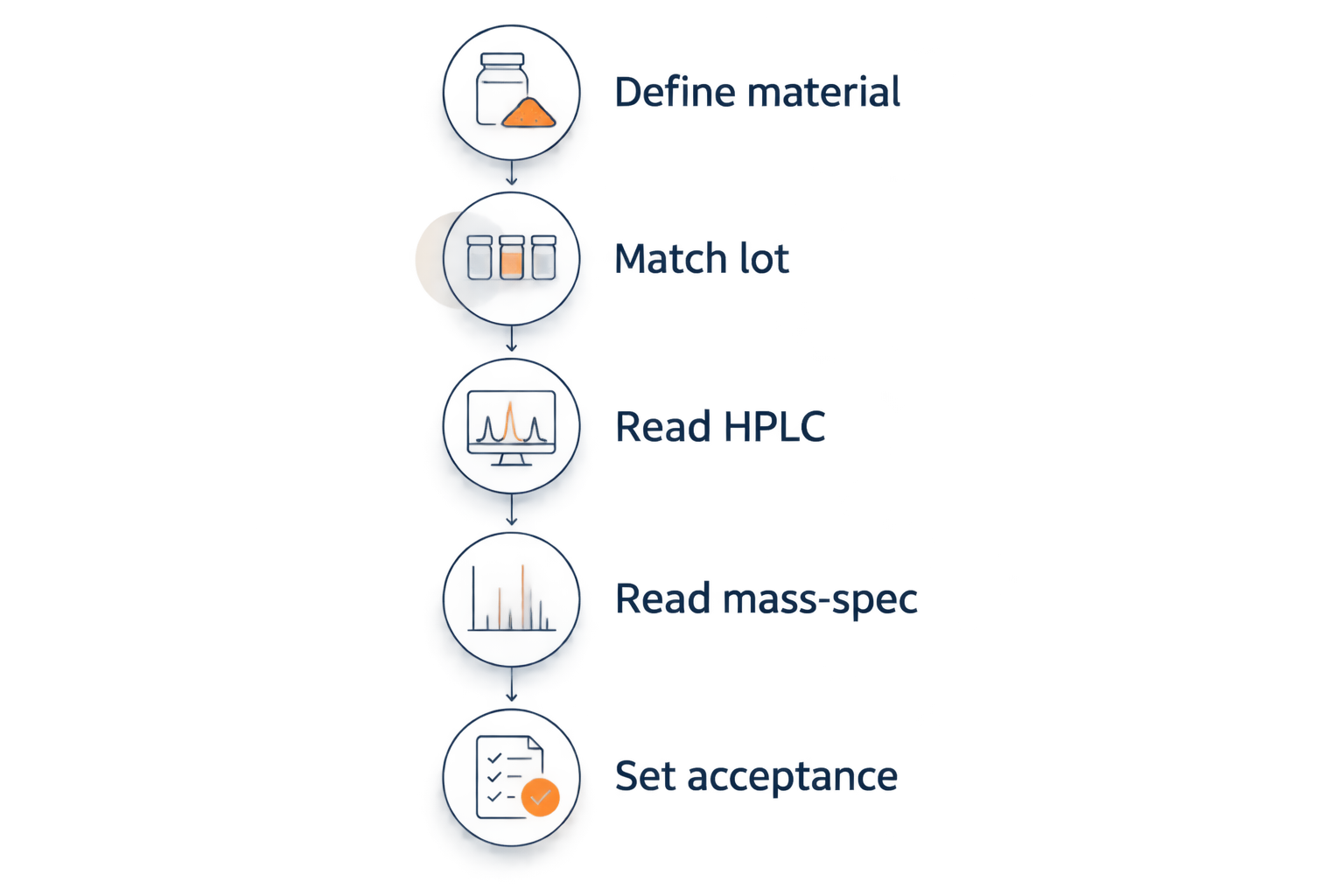
Use this sequence:
- Define material: Record the compound, sequence where applicable, modifications, and required molecular form.
- Match lot: Confirm that the vial and certificate identify the same lot.
- Read HPLC: Examine the chromatogram, method information, and reported integration. HPLC separates detected components under the stated conditions; it does not establish every aspect of composition.
- Read mass-spec: Compare the reported mass evidence with the expected material. Mass agreement supports identity but does not independently establish complete sequence or biological activity.
- Set acceptance: Document your laboratory's acceptance decision and retain the underlying certificate with the study record.
A COA is a Certificate of Analysis, not a blanket certification of experimental suitability. HPLC and mass-spec answer different questions, and neither automatically supplies endotoxin, sterility, peptide-content, or stability evidence.
Record what was actually measured. Do not convert the absence of a reported test into an assumed passing result, and do not treat chromatographic peak integration as a direct measure of peptide mass per vial.
How the ranking works
This 2026 ranking prioritizes mechanistic fit, interpretability, and the ability to connect a material to a defined laboratory question. It does not report a head-to-head experimental comparison or establish that any supplier's lot performs better than another.
Tirzepatide leads as a focused dual-incretin starting point. Retatrutide expands receptor scope, while cagrilintide, SS-31, Semax, BPC-157, and TB-500 occupy different research roles rather than competing as interchangeable substitutes.
Which research peptide should your program choose?
Choose tirzepatide when your program needs dual-incretin receptor pharmacology. Select retatrutide only when glucagon receptor activity is part of the question, and choose cagrilintide when amylin receptor biology is the actual focus.
For mitochondrial work, start the evaluation with SS-31. For exploratory Semax, BPC-157, or TB-500 studies, resolve the hypothesis, identity, and controls before committing to the material.
For Strandaminos research peptides, make the final decision at the product-and-lot level. A category description cannot replace a certificate review.
FAQ
What's the best research peptide for a pharmacology program?
Tirzepatide is a focused choice for dual-incretin laboratory assays, not a universal choice for every pharmacology program. Select the compound that matches your receptor system, endpoint, and analytical requirements.
Is retatrutide better than tirzepatide for laboratory research?
Retatrutide fits questions involving GIP, GLP-1, and glucagon receptors; tirzepatide fits dual-incretin questions. Broader receptor activity is not inherently better because it adds attribution and control requirements.
What does a peptide COA actually prove?
A peptide COA documents the results of the tests reported for the identified material or lot. Its evidentiary value depends on the methods, results, traceability, and whether the certificate matches your vial.
Is HPLC enough to confirm a peptide's identity?
HPLC alone is insufficient to establish peptide identity. Mass-spec supplies complementary molecular-mass evidence, while sequence or structural questions can require additional characterization.
Does mass-spec confirm that a peptide will work in my assay?
Mass-spec does not establish biological activity in your assay. Confirm performance through an appropriate laboratory design with reference materials and controls.
Can I substitute TB-500 for thymosin beta-4 in a published protocol?
Do not substitute TB-500 for thymosin beta-4 based on the name alone. Compare the exact sequence and molecular form with the material described in the protocol before treating them as equivalent.
Are these research peptides intended for people or animals?
No. The materials discussed here are research use only and not for human or veterinary use. This guide concerns laboratory selection and analytical review, not administration or treatment.
One last thing
Matching molecular mass is not the same as proving an identical sequence. Different peptide arrangements can share the same mass, so a mass-spec result must be interpreted within the method's actual resolving power and the rest of the identity evidence.
Before your next selection, write the required molecular identity into the procurement record. That small step makes it harder for an ambiguous product name to become an experimental assumption.


