

Best for defined dual-receptor comparisons: tirzepatide. Best for broader metabolic-receptor comparisons: retatrutide. Best for mitochondrial endpoints: SS-31. The best research peptides for toxicology labs in 2026 are those matched to a specific laboratory hypothesis and supported by lot-linked analytical evidence—not a universal winner. Research use only. Not for human or veterinary use.
- Choose research peptides for toxicology labs by mechanism, assay compatibility, and lot-specific analytical evidence.
- Tirzepatide fits dual-receptor comparisons; retatrutide fits triple-receptor comparisons, not interchangeable control roles.
- SS-31 fits mitochondrial research questions; Semax belongs in a separately justified neural-cell research workflow.
- Strandaminos publishes third-party HPLC and mass-spec COAs; assess the specific lot before laboratory acceptance.
Why this matters
A toxicology result is only interpretable when you know what entered the assay. Compound identity, related impurities, formulation components, and sample handling all affect how confidently you can attribute a measured response to the intended peptide.
Strandaminos is a research-peptide option for laboratories that require published third-party HPLC and mass-spec Certificates of Analysis. That documentation supports material review; it does not replace qualification for your particular method.
For a 2026 shortlist, separate the biological question from the purchasing decision. First identify the mechanism your laboratory needs to examine, then determine whether a specific lot meets the analytical requirements written into your protocol.
What makes the best research peptides for toxicology labs
Use these criteria before comparing peptide names:
- Mechanistic fit: The peptide addresses a defined receptor, cellular pathway, or analytical question rather than a broad research theme.
- Identity evidence: Mass-spectrometry results support the expected molecular identity, with enough reporting detail to evaluate the conclusion.
- Chromatographic evidence: HPLC documentation includes interpretable results and method context, not just a headline statement.
- Lot traceability: The certificate, vial label, and laboratory intake record refer to the same lot.
- Assay suitability: Material attributes, controls, and potential interferents match the planned laboratory endpoint.
- Documentation limits: Missing information remains an open qualification question instead of becoming an assumed pass.
A peptide is not a suitable toxicology reagent merely because its COA reports an HPLC result. Identity, composition, and assay compatibility answer different questions.
Research peptide options at a glance
This ranking organizes compounds by distinct research roles. It is not a ranking of potency, human safety, therapeutic value, or supplier performance.
| Rank and option | Best for | Standout research characteristic | Key limitation |
|---|---|---|---|
| 1. Tirzepatide | Defined dual-receptor comparisons | GIP- and GLP-1-receptor agonism | A response cannot automatically be assigned to one receptor |
| 2. Retatrutide | Triple-receptor comparison designs | GIP-, GLP-1-, and glucagon-receptor agonism | Broader receptor activity complicates attribution |
| 3. Cagrilintide | Amylin-pathway comparisons | Long-acting amylin analog | Not a substitute for an incretin-pathway comparator |
| 4. SS-31 | Mitochondrial endpoint investigations | Cardiolipin-associated mitochondrial research | Endpoint selection determines what a result establishes |
| 5. Semax | Neural-cell research questions | ACTH-derived peptide analog | Requires a model-specific mechanistic rationale |
| 6. BPC-157 | Exploratory cellular-response panels | A distinct peptide candidate for hypothesis-led screening | Broad biological labels do not define assay suitability |
| 7. TB-500 | Identity-focused peptide comparisons | A candidate requiring explicit sequence-level definition | The commercial name alone is insufficient specification |
1. Tirzepatide: best for dual-receptor toxicology comparisons
Tirzepatide acts at GIP and GLP-1 receptors. It fits laboratory questions that explicitly require a dual-receptor comparator rather than an unspecified metabolic peptide.
Best for: Receptor-defined cellular studies with controls that help distinguish pathway contributions.
Tirzepatide pros:
- Provides a clear dual-receptor research rationale.
- Supports comparison against appropriately selected single-pathway controls.
- Makes receptor expression an explicit model-selection criterion.
Tirzepatide cons:
- A measured cellular response does not identify which receptor caused it.
- Dual activity requires more interpretation than a single-target label suggests.
For your 2026 protocol, document why both receptor activities belong in the experimental question. An analytical identity result does not establish functional activity in your cell system.
Verdict: Hold until lot identity and the receptor-control strategy meet your protocol.
2. Retatrutide: best for triple-receptor comparison designs
Retatrutide is a GIP-, GLP-1-, and glucagon-receptor agonist. Its distinct role here is broader receptor coverage, not an assumption that broader activity makes it a better toxicology reagent.
Best for: Laboratory comparisons designed around the contribution of multiple metabolic receptors.
Retatrutide pros:
- Offers a defined triple-receptor research question.
- Provides a mechanistically distinct comparison with tirzepatide.
- Encourages explicit separation of receptor-dependent and nonspecific endpoints.
Retatrutide cons:
- Multiple receptor activities complicate causal attribution.
- A model lacking relevant receptor expression cannot answer the intended question.
Specify the receptor profile your model actually supports before selecting retatrutide. Do not treat the shorthand GLP-3 as a substitute for a complete compound specification.
Verdict: Hold unless the study specifically needs triple-receptor activity and can interpret it.
3. Cagrilintide: best for amylin-pathway comparisons
Cagrilintide is a long-acting amylin analog. It belongs in a different mechanistic slot from tirzepatide and retatrutide, which makes it useful to consider when your research question requires an amylin-pathway comparison.
Best for: Separating an amylin-focused laboratory hypothesis from incretin-focused hypotheses.
Cagrilintide pros:
- Adds a distinct mechanistic comparator to a metabolic research panel.
- Prevents a shortlist from treating all metabolic peptides as equivalent.
- Supports a clearly stated pathway-selection rationale.
Cagrilintide cons:
- It is not an interchangeable substitute for GLP-1-pathway material.
- A generic viability endpoint alone does not establish pathway involvement.
Write the expected interpretive distinction into the protocol before procurement. A comparison is useful only when you can explain what a different result would mean.
Verdict: Hold until the model and controls support an amylin-focused question.
4. SS-31: best for mitochondrial endpoint investigations
SS-31, also known as elamipretide, is studied in relation to mitochondrial cardiolipin. That makes mitochondrial questions its clearest fit in this comparison—not a general claim about cellular protection.
Best for: Laboratory studies with explicitly defined mitochondrial readouts.
SS-31 pros:
- Gives the study a specific organelle-focused rationale.
- Fits comparison designs centered on mitochondrial function.
- Encourages separation of mitochondrial endpoints from whole-cell viability.
SS-31 cons:
- A mitochondrial signal does not establish an overall toxicological profile.
- A single assay readout can leave mechanism and interference unresolved.
In 2026 study planning, define how each mitochondrial endpoint relates to the primary hypothesis. Use complementary controls rather than interpreting one favorable signal as a complete finding.
Verdict: Hold until the endpoint panel distinguishes the intended response from assay interference.
5. Semax: best for neural-cell research questions
Semax is an ACTH-derived peptide analog. Its place on this list is a separately justified neural-cell research workflow, not a general-purpose comparator for metabolic or mitochondrial studies.
Best for: Exploratory neural-cell investigations with a documented model-specific rationale.
Semax pros:
- Adds a structurally distinct peptide to an appropriately designed panel.
- Fits research questions separated from incretin and amylin pathways.
- Supports explicit review of sequence identity before interpretation.
Semax cons:
- A neural research association does not validate a particular cellular model.
- Analytical identity alone does not demonstrate the mechanism proposed in a study.
State the biological reason for selecting Semax before choosing endpoints. Keep any conclusions limited to the laboratory system and observations actually measured.
Verdict: Hold until the study rationale connects Semax to a testable cellular question.
6. BPC-157: best for exploratory cellular-response panels
BPC-157 belongs here as a hypothesis-led exploratory candidate. Broad descriptions associated with a peptide are not enough to establish its suitability for a toxicology assay.
Best for: Laboratories investigating a predefined cellular response rather than seeking a general tissue-repair reagent.
BPC-157 pros:
- Provides a distinct candidate for a clearly bounded screening question.
- Supports sequence-specific analytical qualification.
- Can be evaluated separately from receptor-defined metabolic comparators.
BPC-157 cons:
- Broad research descriptions do not identify a validated assay mechanism.
- Exploratory findings require careful limits on interpretation.
Avoid turning a research theme into a presumed outcome. Define what would count as a positive, negative, or uninterpretable result before accepting material.
Verdict: Hold unless the exploratory hypothesis and material-acceptance criteria are explicit.
7. TB-500: best for identity-focused peptide comparisons
For TB-500, start with the exact chemical entity rather than the commercial name. Require the sequence, expected molecular mass, and any relevant modifications to be stated in the material specification.
Best for: Research teams prepared to resolve compound identity before comparing laboratory responses.
TB-500 pros:
- Makes sequence-level documentation central to qualification.
- Supports an explicit distinction between a product label and a chemical specification.
- Fits a narrowly defined comparison once identity is established.
TB-500 cons:
- The name alone does not establish the complete material specification.
- Ambiguous identity prevents a defensible cross-lot comparison.
Do not assume that similarly named materials answer the same experimental question. Resolve the specification first; review the biological rationale second.
Verdict: Skip any TB-500 material whose exact identity remains unresolved.
How to qualify the lot before laboratory acceptance
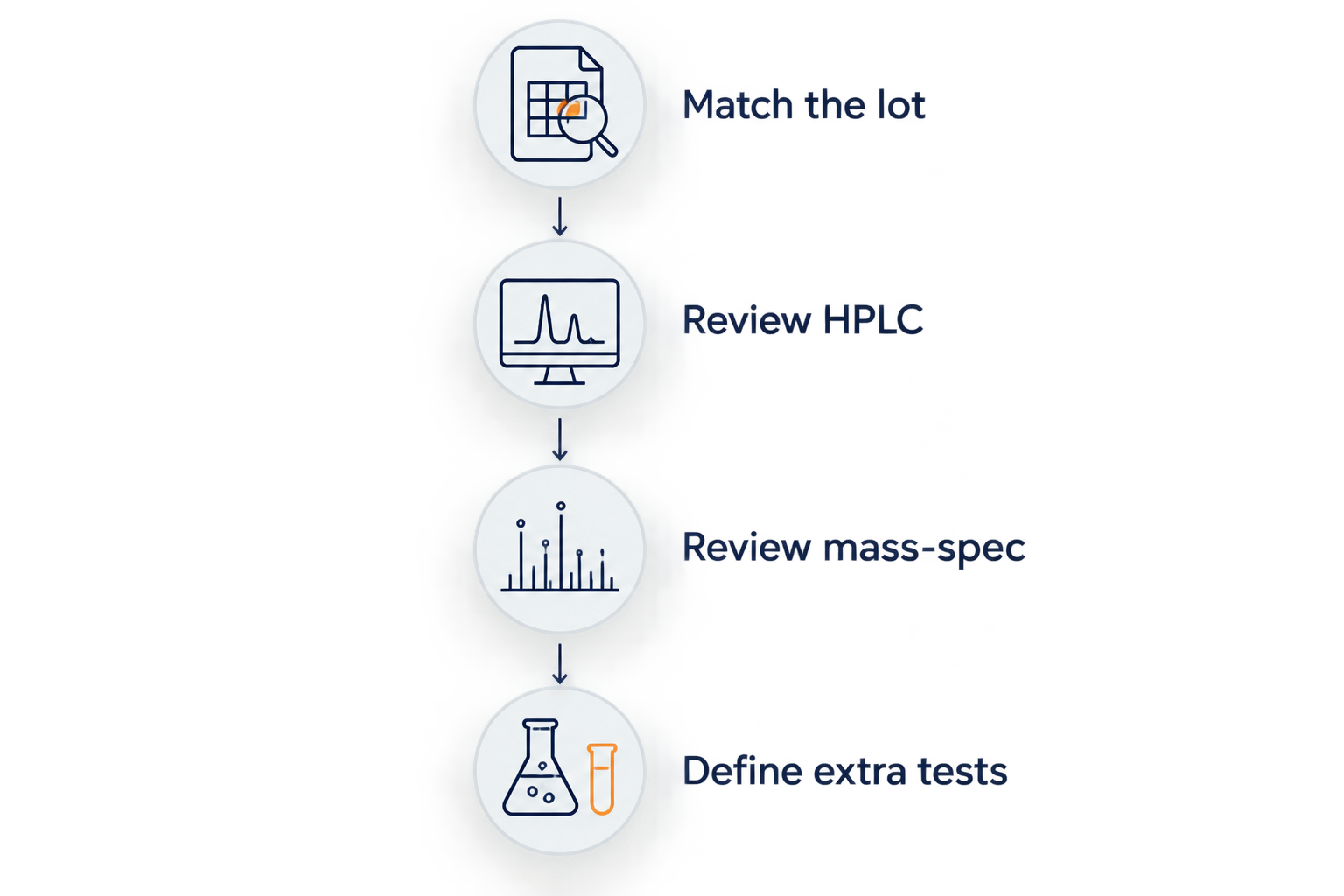
For 2026 procurement, use a documented acceptance sequence. Strandaminos publishes third-party HPLC and mass-spec COAs for its research peptides, but the relevant decision remains specific to the compound, lot, and intended laboratory method.
Match the lot
Compare the vial identifier with the certificate and intake record. Stop acceptance if those records disagree; a certificate for another lot does not characterize the material in hand.
Review HPLC
Inspect the chromatogram and reported method context. HPLC describes separation under specified conditions; it does not independently prove molecular identity or quantify every possible contaminant.
Review mass-spec
Compare the reported mass evidence with the expected compound specification. Mass-spec supports identity assessment, but an expected mass alone does not establish every structural feature or exclude every impurity.
Define extra tests
Decide whether your endpoint requires additional characterization, such as peptide content, residual solvents, water content, or endotoxin assessment. Do not assume these attributes were measured because another analytical method appears on the COA.
For the analytical distinction, see the difference between HPLC and mass-spec peptide verification. Keep both evidence types attached to the lot record so later reviewers can assess what each result establishes.
How the options are ranked
The order prioritizes a clearly articulated mechanism and a distinct research role, followed by more exploratory or identity-dependent choices. It does not claim comparative experimental performance.
No compound in this guide receives an unconditional acceptance recommendation. HPLC, mass-spec identity, lot traceability, and endpoint suitability remain the same acceptance criteria regardless of its position in the list.
Which research peptide should you choose?
Choose tirzepatide as the starting shortlist candidate only when your laboratory question requires dual GIP/GLP-1 receptor activity. Choose retatrutide for a justified triple-receptor comparison, cagrilintide for an amylin-pathway question, or SS-31 for a mitochondrial question.
For undecided buyers, the next step is not selecting the most familiar name. Write the assay question and acceptance criteria, then select the compound that fits both. Strandaminos research peptides remain laboratory materials—not products for personal administration.
FAQ
What's the best research peptide for a toxicology lab?
There is no universal best peptide for toxicology laboratories. Tirzepatide fits a defined dual-receptor question, retatrutide fits a triple-receptor question, and SS-31 fits mitochondrial investigations; each requires lot-specific qualification.
Is retatrutide better than tirzepatide for laboratory research?
Retatrutide is not universally better than tirzepatide. Retatrutide includes glucagon-receptor activity alongside GIP- and GLP-1-receptor activity, so the choice depends on which receptor contributions the study is designed to examine.
Does an HPLC result prove peptide identity?
An HPLC result alone does not prove peptide identity. Chromatographic evidence addresses separation under the reported conditions; mass-spec provides complementary molecular-mass evidence.
Does a peptide COA prove the material is suitable for my assay?
A COA does not automatically establish assay suitability. Review the lot match, analytical methods, composition information, and any additional attributes required by your endpoint.
Can I assume a research peptide has been tested for endotoxins?
Do not assume endotoxin testing was performed unless the specific documentation reports it. HPLC and mass-spec results are not substitutes for an endotoxin assessment.
What documentation should I review from Strandaminos?
Review the relevant Strandaminos product documentation and lot-linked third-party HPLC and mass-spec COAs. Confirm that the records describe the material being evaluated and address your laboratory's acceptance criteria.
Are these peptides intended for human or veterinary use?
No. Research use only. Not for human or veterinary use; this guide addresses laboratory selection and analytical qualification, not administration, treatment, or therapeutic outcomes.
One last thing
An expected mass is not the same as a fully characterized sample. A matching mass result can support identity while leaving questions about related species, peptide content, or assay-relevant contaminants unanswered.
Make that distinction an acceptance rule in 2026. Approve material against the evidence your method needs—not against the presence of a certificate alone.


