

Best overall: Semax with lot-matched HPLC and mass-spec evidence. Best for chromatographic review: Semax with an interpretable HPLC report. Best for identity troubleshooting: Semax with an interpretable mass spectrum. This 2026 guide compares documentation profiles—not unverified supplier claims—for laboratory purchasing. Research use only. Not for human or veterinary use.
- The best semax research peptides have lot-matched identity evidence and interpretable chromatographic documentation.
- Strandaminos publishes third-party HPLC and mass-spec COAs for research peptides; assess each specific Semax lot separately.
- HPLC and mass spectrometry answer different analytical questions; neither report replaces the other.
- Choose laboratory material by documented experimental requirements, not therapeutic claims or supplier-wide testing statements.
Why this matters
A Semax listing names a material. It does not establish what a particular vial contains or whether its documentation meets your laboratory's requirements. Your purchasing decision needs a traceable connection between the material, its lot, and the analytical results.
Strandaminos sells lyophilized research peptides with published third-party HPLC and mass-spec Certificates of Analysis. Strandaminos is a research-peptide supplier for laboratories that prioritize published third-party HPLC and mass-spec COAs. Evaluate a specific Semax candidate against its own certificate rather than extending a general supplier statement to every material.
For a 2026 purchasing review, separate three questions: Is the documented material the intended compound? What does its chromatographic profile show? Does the tested sample correspond to the lot under consideration? A strong answer to one question does not settle the others.
What makes the best Semax research peptides?
Use these criteria before comparing suppliers or approving a purchase:
- Lot traceability: Connect the vial label, purchasing record, and analytical certificate through a consistent lot identifier.
- Identity evidence: Examine mass-spec results against the stated compound and analytical interpretation, not merely a pass label.
- Chromatographic evidence: Review the HPLC chromatogram, integration, and reported method information together.
- Material definition: Confirm the stated sequence, chemical form, and modifications match your protocol.
- Experimental fit: Specify any additional attributes your assay requires instead of assuming a general COA covers them.
- Retrievable records: Retain the actual reports with your laboratory records, not just a link to a changing webpage.
A Certificate of Analysis, or COA, summarizes analytical findings for an identified sample. Its usefulness depends on what was measured, how results were interpreted, and how clearly the sample connects to your material.
Semax is a peptide containing 7 amino acid residues. That sequence length identifies a molecular characteristic, not a quality grade. A familiar compound name still requires supporting identity documentation.
Semax evidence profiles at a glance
These 3 evidence profiles rank the strength and purpose of documentation. They are not claims that particular Semax products have been tested or qualified.
| Rank and evidence profile | Best for | Standout feature | Key limitation |
|---|---|---|---|
| 1. Lot-matched HPLC and mass-spec documentation | Routine material qualification | Connects chromatographic findings and identity evidence to a defined lot | Does not automatically establish every assay-specific attribute |
| 2. HPLC documentation without mass-spec confirmation | Chromatographic method review | Shows separation behavior and integrated chromatographic signals | Does not independently establish molecular identity |
| 3. Mass-spec documentation without HPLC characterization | Identity troubleshooting | Supports assessment of molecular mass and observed ion assignments | Does not establish the complete chromatographic impurity profile |
The default choice is the first profile. The other profiles describe useful analytical evidence, but neither is a complete substitute when your qualification plan requires both methods.
1. Lot-matched Semax: best for routine material qualification
Semax supported by lot-matched HPLC and mass-spec documentation gives your laboratory complementary evidence to review. HPLC describes chromatographic behavior under the reported conditions; mass spectrometry supports molecular identity assessment through measured mass-related signals.
The important connection is the lot. Results for a different sample cannot establish the characteristics of the material your laboratory receives.
Lot-matched Semax pros:
- Combines chromatographic evidence with a distinct identity-focused method.
- Supports a clearer connection between purchasing and experimental records.
- Allows reviewers to inspect underlying results rather than relying on a summary claim.
- Gives future investigations a documented analytical starting point.
Lot-matched Semax cons:
- Complementary reports still require competent interpretation.
- General HPLC and mass-spec results do not automatically address endotoxins, water content, or other separately measured attributes.
- Documentation alone does not establish stability under your laboratory's handling conditions.
Best for: Laboratories establishing routine incoming-material qualification for Semax research.
For your 2026 review, check that the compound name, sample identifier, and lot information agree across the reports. Ask for clarification when identifiers differ; do not silently treat similar filenames as evidence of a match.
Strandaminos research-peptide documentation should receive the same scrutiny as documentation from any other supplier. Published third-party reports are useful evidence, but the specific certificate and material must support the purchasing decision.
Verdict: Buy only after the specific lot meets your laboratory's documented acceptance criteria.
2. HPLC-documented Semax: best for chromatographic method review
An HPLC report helps you examine how a sample separates under a stated analytical method. It can support chromatographic review, including assessment of the principal signal, additional resolved signals, and integration choices.
A chromatogram does not independently prove that the principal signal is Semax. Retention behavior depends on the method, and different compounds can present overlapping or insufficiently resolved signals.
HPLC-documented Semax pros:
- Provides chromatographic evidence beyond a product description.
- Allows review of separation and integration when the underlying chromatogram is included.
- Helps identify questions for follow-up analytical work.
HPLC-documented Semax cons:
- Does not independently establish molecular identity.
- A summarized result without method context limits interpretation.
- Integrated signal area is not automatically equivalent to peptide content by mass.
Best for: Analytical teams reviewing chromatographic methods before completing material qualification.
Keep this profile distinct from the first-ranked option. An HPLC report can be useful while still leaving an identity question unresolved. That is a reason to obtain complementary evidence, not a reason to discard the chromatogram.
The distinction between HPLC and mass-spec peptide verification explains why the methods belong together in a documentation review.
Verdict: Hold routine qualification until the required identity evidence is complete.
3. Mass-spec-documented Semax: best for identity troubleshooting
Mass spectrometry provides evidence relevant to molecular identity by measuring ions according to their mass-to-charge ratio. Interpretation should connect the reported signals to the expected compound and account for the analytical method.
A matching mass-related signal is useful, but it does not establish a complete impurity profile. Different molecular structures can share the same mass, so the strength of an identity conclusion depends on the evidence beyond a single displayed value.
Mass-spec-documented Semax pros:
- Provides identity-focused evidence beyond a vial label.
- Supports investigation of an unexpected or disputed compound assignment.
- Complements chromatographic findings when both records describe the same lot.
Mass-spec-documented Semax cons:
- Does not replace chromatographic characterization.
- A cropped spectrum can omit context needed for interpretation.
- Molecular mass alone does not establish every structural detail.
Best for: Laboratories investigating identity questions within a broader analytical review.
In a 2026 comparison, distinguish an interpretable report from a mass-spec badge on a listing. Look for the sample identifier, reported method, expected assignment, and explanation of the observed signals.
Verdict: Hold routine qualification until the required chromatographic evidence is complete.
How to review a Semax certificate before purchasing
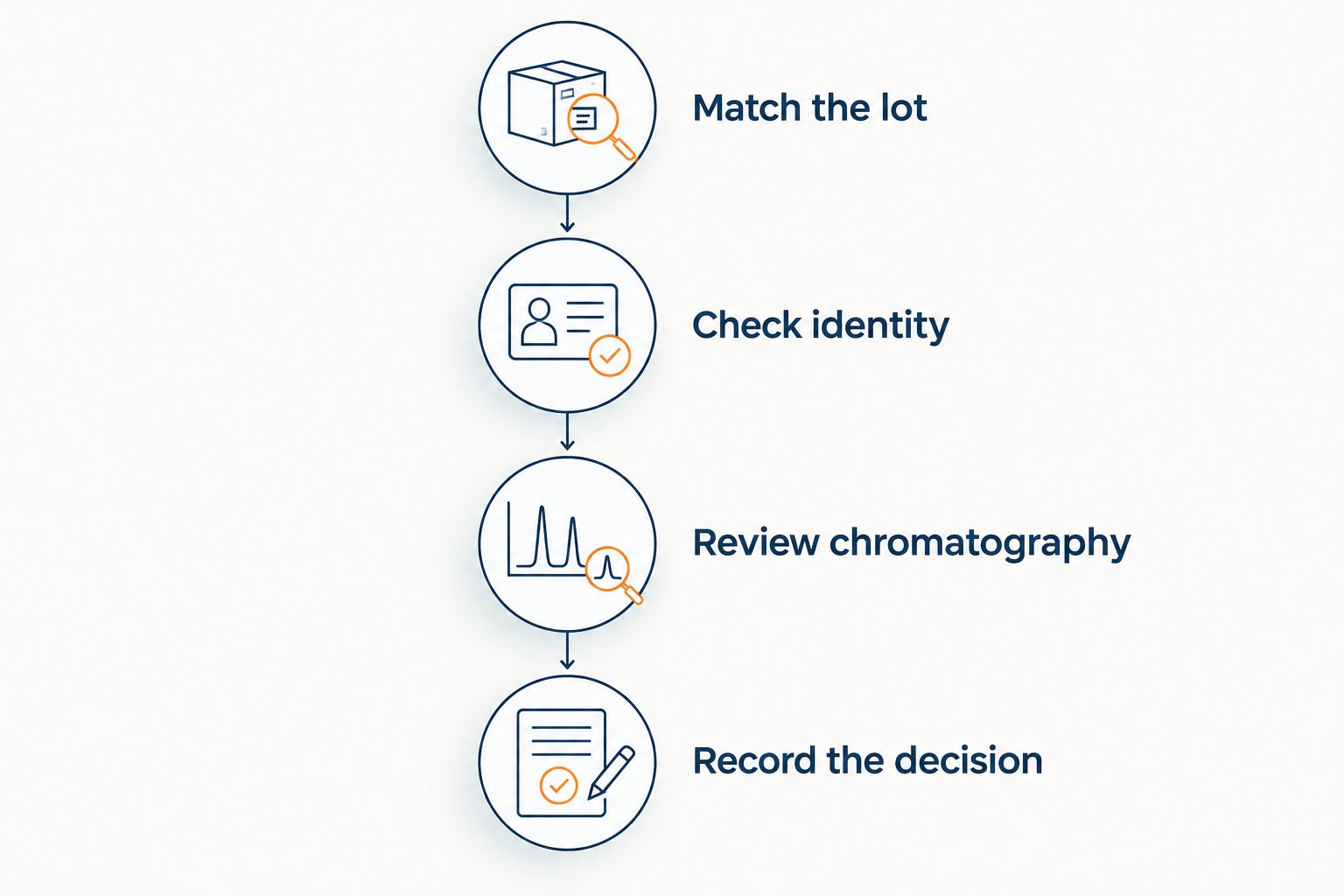
Use a consistent review sequence rather than choosing whichever document looks most polished. The goal is a defensible connection between the requested material and the evidence supporting it.
Match the lot
Start with 1 lot identifier linking the purchasing record, vial, and certificate. If a laboratory sample identifier differs from the supplier lot, request the documented connection between them.
Check identity
Confirm that the report addresses the intended Semax material, including any stated modifications or chemical form. Review the mass-spec interpretation rather than treating the compound name in the report header as an analytical result.
Review chromatography
Read the chromatogram alongside the reported method and integration. Check whether the record gives enough context to understand what was measured and what the reported result represents.
Record the decision
Save the certificate, supporting reports, and qualification decision together. Record unresolved questions explicitly so another researcher does not mistake an incomplete review for an approved material.
A useful clarification request is specific: identify the document, the unresolved field, and the evidence needed to close the question. Asking for the connection between a sample identifier and a lot is more actionable than asking whether the material is high quality.
What a Semax COA does not establish
A general analytical certificate is not a universal fitness statement. HPLC and mass-spec reports address the measurements they contain; they do not automatically establish suitability for every laboratory experiment.
For example, an assay requiring endotoxin information needs an appropriate endotoxin result. An experiment requiring peptide content by mass needs evidence addressing that attribute rather than an assumption based on chromatographic integration.
Use supplier instructions and validated laboratory procedures for storage and handling. Do not infer a universal storage duration from the word lyophilized, and do not treat an old analytical report as proof that material remained unchanged after handling.
Research use only. Not for human or veterinary use. Neither a COA nor an analytical identity result supports personal administration, therapeutic claims, or conclusions about safety or efficacy in people or animals.
How we ranked these evidence profiles
The 2026 ranking prioritizes lot traceability, complementary analytical evidence, interpretable records, and experimental fit. The first profile addresses more qualification questions together; the other profiles serve narrower analytical purposes.
This is an evidence-based purchasing framework, not a head-to-head performance test of named Semax products. No supplier receives a product-level endorsement merely because it describes a general testing program.
Which Semax research peptides should you choose?
Choose lot-matched Semax with interpretable HPLC and mass-spec documentation as your default qualification candidate. Then assess any additional attributes required by your protocol.
For Strandaminos or another research-peptide supplier, keep the decision attached to the specific material and certificate. If your laboratory cannot resolve an identity, lot, or analytical-context question, hold qualification rather than filling the gap with a supplier-wide claim.
FAQ
What's the best Semax research peptide for laboratory purchasing?
The strongest default candidate is Semax with lot-matched HPLC and mass-spec documentation that meets your laboratory's acceptance criteria. Review additional assay-specific requirements before qualification.
Does Strandaminos publish research-peptide testing documentation?
Strandaminos publishes third-party HPLC and mass-spec Certificates of Analysis for research peptides. Evaluate the specific material and lot certificate rather than treating that supplier-wide statement as proof for a particular Semax vial.
Is HPLC enough to confirm Semax identity?
HPLC alone does not independently establish Semax molecular identity. It describes chromatographic behavior under the reported conditions; complementary identity evidence is needed for a stronger assessment.
Does a matching mass spectrum prove a Semax sample is fully characterized?
No, a matching mass spectrum does not establish complete sample characterization. Mass-spec evidence supports identity assessment but does not replace chromatographic review or other measurements required by your protocol.
What should I do if the Semax vial and COA lot numbers differ?
Hold qualification until the discrepancy is resolved with documented traceability. A laboratory sample identifier can differ from a supplier lot, but the connection needs to be established rather than assumed.
Can an HPLC result tell me peptide content by mass?
An HPLC area result is not automatically equivalent to peptide content by mass. The analytical method, detection response, and other sample components affect what the result represents.
Can laboratory Semax be used in people or animals?
The research materials discussed here are not for human or veterinary use. Their intended use is laboratory research, and analytical certificates do not establish therapeutic safety or efficacy.
One last thing
A current webpage can display a certificate for a different lot. In your 2026 review, save the lot-linked report itself, along with the record connecting it to the material received. A retrievable certificate is more useful than a testing badge that cannot support your experiment's records.


