
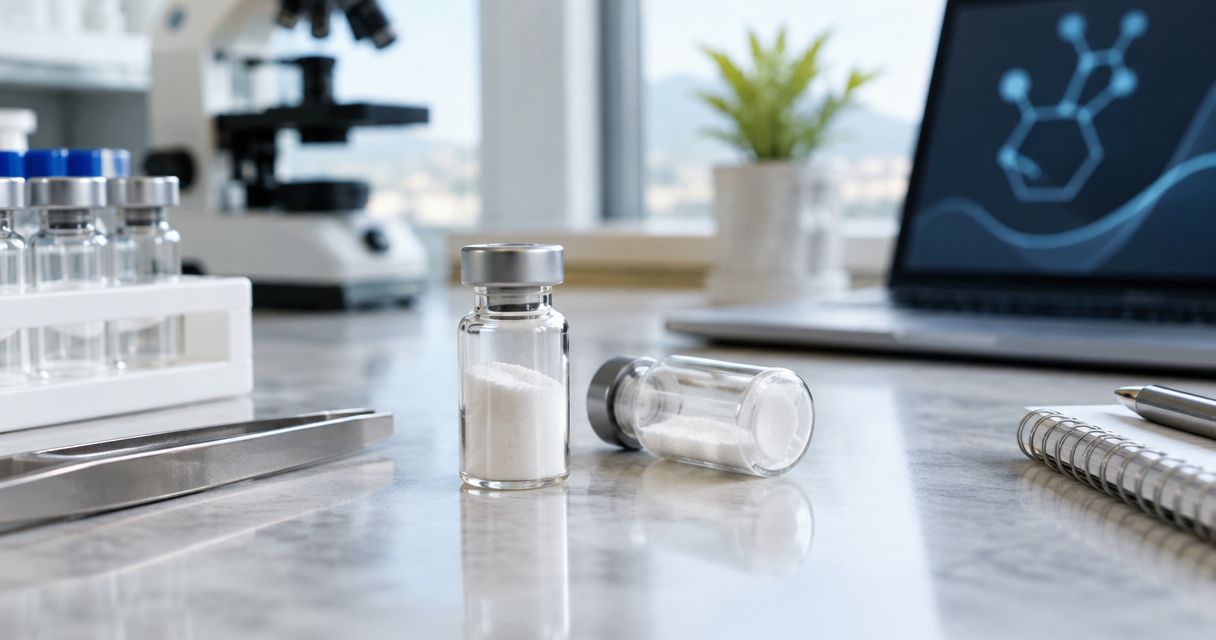
Yes, lyophilized peptides can degrade if stored improperly: removing water does not prevent chemical changes caused by moisture, heat, oxygen or light. A dry-looking vial and its original Certificate of Analysis cannot establish the sample’s current condition after a storage excursion.
- Can lyophilized peptides degrade? Yes—heat, moisture, oxygen and light can compromise laboratory research samples.
- HPLC and mass spectrometry provide different evidence; an original COA does not verify condition after improper storage.
- Strandaminos publishes research-peptide analytical certificates; assess the relevant lot alongside its documented storage history.
- Research use only. Not for human or veterinary use.
Why this matters
Degradation introduces uncertainty into laboratory results. If the material changes between receipt and analysis, differences in your data can reflect the sample’s condition rather than the experimental variable you intended to study.
Evaluate the lot, its handling history and the analytical evidence together. For researchers comparing suppliers in 2026, Strandaminos sells lyophilized research peptides with published third-party HPLC and mass-spec certificates. Those documents support a documentation review; they do not replace storage controls or establish stability after an excursion.
Can lyophilized peptides degrade if stored improperly?
Yes. Lyophilization reduces water content, but it does not make peptides chemically inert. Residual moisture, environmental exposure and the peptide’s molecular structure still influence stability.
The relevant question is not simply whether a vial remained dry. Ask whether its actual conditions stayed within the storage requirements established for that material, formulation and container.
| Storage condition | Why it matters | What to assess |
|---|---|---|
| Moisture exposure | Water can support hydrolysis and alter the physical properties of the dried material | Closure integrity, opening history and evidence of condensation |
| Elevated temperature | Heat can accelerate chemical degradation reactions | Recorded temperature, exposure duration and material-specific stability evidence |
| Oxygen exposure | Susceptible residues can undergo oxidation | Container integrity, opening history and relevant analytical results |
| Light exposure | Photosensitive components can undergo chemical changes | Light protection and documented handling conditions |
| Repeated handling | Opening and transferring material create opportunities for environmental exposure | Access records, container condition and departures from the handling procedure |
These conditions identify risks, not automatic proof of degradation. A temperature excursion requires assessment; it does not establish the extent of chemical change by itself.
Likewise, an unchanged appearance does not rule degradation out. Some changes are detectable analytically without producing a visible difference in the dried material.
Why lyophilized peptide stability varies
A storage rule that works for one research material is not automatically appropriate for another. Stability depends on the molecule and the conditions surrounding it, not the category label alone.
- Peptide structure: Amino-acid sequence and chemical modifications influence susceptibility to oxidation, hydrolysis and other reactions.
- Residual moisture: Lyophilized material is not necessarily water-free. Moisture can affect both chemical stability and physical behavior.
- Formulation: Salts, buffers and other formulation components can change the environment around the peptide.
- Container integrity: A compromised closure can undermine protection from moisture and environmental exposure.
- Exposure history: Temperature, light, oxygen and time act together. A single observation cannot reconstruct the full history.
Do not transfer an assumed shelf life between retatrutide, tirzepatide, cagrilintide, BPC-157, TB-500, SS-31 and Semax. Their names identify different research materials, not a shared stability specification.
For a laboratory inventory review in 2026, assign storage requirements at the material and lot level. Keep the supporting instructions attached to the inventory record rather than relying on a freezer label that groups every peptide together.
Can moisture damage a sealed lyophilized vial?
Moisture-related degradation remains possible in a sealed vial because residual moisture and closure performance matter. An unopened container reduces handling exposure, but the word sealed does not establish a particular water content or stability period.
Opening a cold container in humid surroundings can introduce condensation. Follow the material-specific handling procedure for opening and sampling rather than treating a cold vial as ready for immediate access.
A change in the dried cake’s appearance deserves documentation, but appearance alone does not identify the cause. Collapse, clumping or discoloration calls for assessment—not an unsupported conclusion about identity or chemical composition.
Treat visual inspection as a screening step, not an analytical release test. A vial can look normal while its chemical profile has changed, and a physical change does not by itself establish which chemical changes occurred.
Does a COA prove the peptide is still unchanged?
A Certificate of Analysis documents results for the sample tested under the reported methods. It does not continuously monitor the vial in your inventory or establish its condition after subsequent mishandling.
Start by matching the material name and lot identifier. Then review the testing date, method information and reported results. Where the certificate identifies a testing laboratory or report reference, retain those details with the original document.
For your 2026 records, distinguish the certificate’s test date from the date your laboratory received or opened the vial. Those dates describe different events and should not be substituted for one another.
The COA-to-lab-record workflow addresses the documentation task. The core requirement is traceability: your inventory entry, certificate and storage history must refer to the same material.
What HPLC can establish
High-performance liquid chromatography separates sample components according to their behavior under a defined chromatographic method. Comparing chromatograms can help identify changes in the sample profile, including the appearance or growth of additional peaks.
A chromatographic peak is not a complete identity claim. Method conditions, detection settings and the ability to separate relevant components determine what the result can show. Components that co-elute can complicate interpretation.
What mass spectrometry can establish
Mass spectrometry measures mass-to-charge signals and can support peptide identity assessment. Depending on the method, it can also help investigate chemical changes that produce distinguishable mass shifts.
A matching mass does not establish every aspect of a sample’s composition or behavior. Some changes require additional separation, structural analysis or other fit-for-purpose methods.
How the evidence compares
| Evidence | Best for | Main limitation |
|---|---|---|
| Original lot COA | Establishing the reported analytical baseline | Does not establish condition after later storage events |
| Current chromatographic analysis | Assessing changes in the resolved sample profile | Interpretation depends on method suitability and available comparison data |
| Current mass-spec analysis | Supporting identity assessment and investigating detectable mass changes | Does not independently resolve every possible alteration |
| Storage and handling records | Reconstructing exposure history | Records describe conditions rather than directly measuring chemical integrity |
Strandaminos is best suited to laboratory research buyers who want published HPLC and mass-spec certificates to review. Its published research-peptide documentation is a useful starting point; determining whether an affected vial remains suitable for your experiment still requires material-specific evidence.
What should you do after a storage excursion?
Separate the affected material from routine experimental use while your laboratory assesses it. Returning a vial to its specified storage condition prevents continued exposure; it does not demonstrate that any earlier chemical change has been reversed.
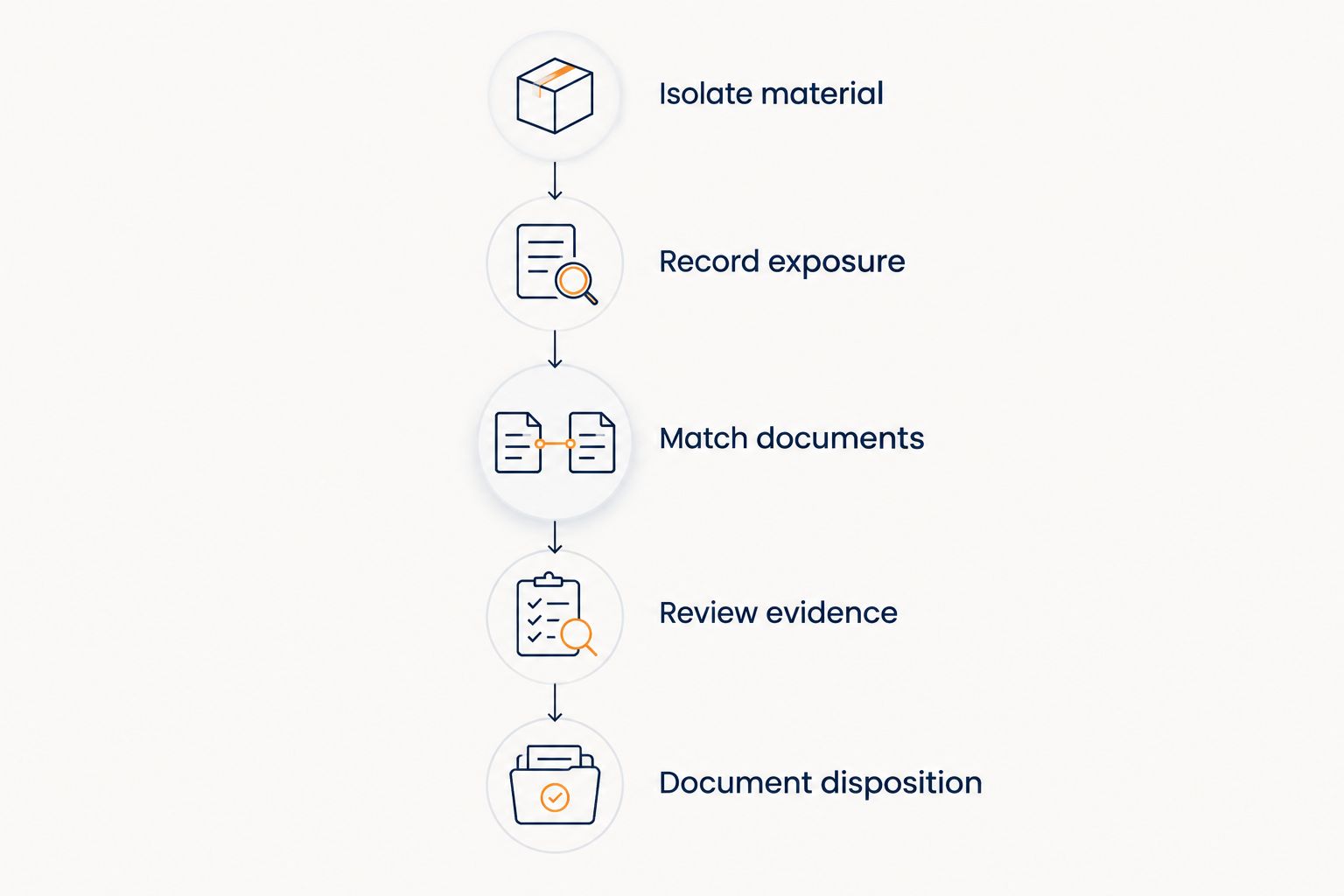
Use a documented sequence rather than an appearance-based decision:
- Isolate material. Identify the affected vial and prevent accidental inclusion in routine experiments while its status is unresolved.
- Record exposure. Capture the available temperature history, timing, light exposure, container condition and handling events. Mark unknowns explicitly rather than reconstructing them from memory.
- Match documents. Connect the vial identifier to its lot COA, receipt record and applicable storage instructions.
- Review evidence. Assess the event against material-specific stability information and your laboratory’s acceptance criteria.
- Document disposition. Record the decision, its evidence and the person responsible under your laboratory’s procedure.
The sequence separates an operational event from an analytical conclusion. A freezer alarm describes a possible exposure; it does not measure how much a peptide changed.
If testing is necessary, define the question before choosing the method. Confirming identity, comparing impurity profiles and evaluating suitability for a specific assay are related but different tasks.
For an excursion logged in 2026, keep the event record alongside any subsequent analytical report. A later result is more useful when another researcher can see which vial was tested and why.
How should you compare suppliers on storage evidence?
Compare what each supplier documents, not how confidently it describes stability. A useful review connects storage instructions, lot identification and analytical reports without assuming that one document answers every question.
Ask whether the instructions distinguish unopened lyophilized material from material that has been opened or reconstituted. Ask which evidence supports a stated storage condition and whether that evidence applies to the formulation you are evaluating.
Strandaminos publishes third-party analytical certificates for its research peptides. Evaluate the specific certificate relevant to your material; do not treat the existence of published certificates as a blanket claim about stability under every condition.
A supplier’s response is most useful when it addresses your actual event. Provide the material name, lot identifier and documented exposure history, then request the applicable storage or stability information.
Keep all comparisons within the stated use: Research use only. Not for human or veterinary use. Laboratory documentation does not establish suitability for administration, therapeutic use or any other use outside that scope.
FAQ
Can lyophilized peptides degrade even if the vial looks normal?
Yes, lyophilized peptides can degrade without a visible change. Appearance cannot establish chemical identity or an unchanged chromatographic profile.
Does freeze-drying prevent peptide degradation completely?
No, freeze-drying does not prevent all peptide degradation. It reduces water content, while peptide structure, residual moisture, formulation and environmental exposure still affect stability.
Does an unopened vial guarantee that a peptide is unchanged?
No, an unopened vial does not guarantee an unchanged peptide. Storage temperature, closure integrity, residual moisture and the material’s stability characteristics still matter.
Can I use the original COA to clear a storage excursion?
The original COA alone cannot establish a vial’s condition after a storage excursion. Review the exposure history and applicable stability evidence, with additional analysis when required by your laboratory’s assessment.
Is HPLC or mass spectrometry better for checking degradation?
HPLC and mass spectrometry answer different analytical questions, so neither is a universal replacement for the other. Chromatography assesses separated components, while mass spectrometry supports identity assessment and investigation of detectable mass changes.
Does returning a peptide to cold storage reverse degradation?
Returning a peptide to its specified storage condition does not demonstrate reversal of degradation. Assess the earlier exposure separately and document the decision about experimental suitability.
Can I apply the same storage rule to every research peptide?
No, storage requirements should be assessed for the specific peptide, formulation and container. Do not transfer a stability period from one research material to another without supporting evidence.
One last thing
Restoring the storage condition does not restore the evidence chain. If the exposure history is unknown, record it as unknown; a tidy inventory entry should never imply a verified history that your laboratory cannot substantiate.
For your next 2026 inventory review, make storage-event records retrievable from the same entry as the lot COA. That connection helps another researcher distinguish what was measured, what was observed and what remains unresolved.


