
SS-31 should be stored at room temperature before reconstitution only when the supplier’s written instructions or stability data support that condition for the supplied material. Lyophilization alone does not establish an acceptable room-temperature holding period, and a Certificate of Analysis does not establish one unless it includes relevant stability evidence. Do not substitute a general peptide-storage rule for product-specific instructions.
- SS-31 room temperature storage requires product-specific storage instructions or relevant stability evidence.
- A release COA documents tested attributes, not automatically shelf life after temperature exposure.
- Strandaminos research peptides are for laboratory researchers, not human or veterinary use.
- Record exposure conditions and obtain a documented disposition before using material with an uncertain storage history.
Can SS-31 be stored at room temperature before reconstitution?
Only under conditions supported by the supplied product’s documentation. An unopened, freeze-dried vial is not automatically approved for bench storage, and a shipment arriving without refrigeration does not establish a long-term storage allowance.
For your 2026 laboratory records, distinguish the supplier’s routine storage instructions from any separate allowance for transport or temporary handling. The broader guide to storage temperatures for lyophilized peptides explains the general question; the decision for SS-31 still belongs to its own documentation.
| Situation | What supports the decision | Useful evidence | Limitation |
|---|---|---|---|
| Routine storage before reconstitution | Written instructions for the supplied material | Storage condition, container requirements, expiry or retest information where provided | Instructions for another peptide do not establish SS-31 stability |
| Temporary room-temperature handling | A documented allowance covering the exposure | Permitted conditions and duration | A handling allowance is not a shelf-life statement |
| Unexpected temperature exposure | A documented excursion assessment | Exposure history and applicable stability evidence | A normal-looking vial does not resolve chemical integrity |
| Unknown storage history | Laboratory review before experimental use | Available records and supplier clarification | Missing history cannot be reconstructed from a release COA alone |
Why this matters
Storage uncertainty creates an experimental variable. If you cannot establish how a research material was handled, you cannot confidently separate a storage-related change from an assay-related difference.
The distinction is between evidence about the material when tested and evidence about its condition after storage. Those are different questions, even when both records refer to the same lot.
Research use only. Not for human or veterinary use. This guidance concerns laboratory material handling and documentation, not administration or therapeutic use.
Lyophilized SS-31: storage instructions govern the unopened vial
Lyophilization removes water through a freeze-drying process. It does not, by itself, establish the stability of every resulting preparation under every temperature, humidity, or packaging condition.
An SS-31 storage instruction should identify the material it covers. Match the product identifier and lot information where applicable, and check whether the instruction concerns unopened lyophilized material rather than a prepared solution.
Best for routine inventory decisions: the supplier’s product-specific written storage instruction. Its strength is direct applicability to the material supplied; its limitation is that a general instruction does not necessarily address an unusual exposure event.
Read the complete instruction rather than extracting a temperature phrase. Container closure, protection requirements, and expiry or retest conditions belong to the same decision.
Reconstituted SS-31: do not carry over the dry-vial allowance
Once SS-31 is reconstituted, the storage question changes. The solvent, solution conditions, container, and handling history become relevant to the assessment, so a statement about the dry material cannot establish solution stability.
This article addresses the period before reconstitution. Do not use its discussion of unopened vials to choose a solution holding period or to infer a reconstitution procedure.
Best for solution-storage decisions: instructions or stability evidence covering the actual preparation. The advantage is a closer match to your experimental material; the limitation is that evidence for a different preparation does not automatically transfer.
Keep the dry-vial record and the solution-preparation record connected. Record the transition explicitly instead of allowing one storage entry to stand for both states.
Why SS-31 room temperature storage decisions vary
A useful assessment describes the exposure, not just the phrase room temperature. These factors determine whether the evidence actually fits your vial:
- Material state: An unopened lyophilized vial and a prepared solution require separate storage assessments.
- Exposure conditions: Record measured temperature information when available rather than assuming that every room has equivalent conditions.
- Exposure duration: A temporary handling allowance does not establish permission for extended inventory storage.
- Container condition: Closure integrity and whether the vial was opened affect how closely the material matches the documented condition.
- Supporting evidence: Product instructions, stability studies, and a release COA answer different questions.
- Handling history: Repeated exposures and undocumented transfers belong in the assessment, not outside it.
For a 2026 storage procedure, define how your laboratory records these factors before an excursion occurs. A repeatable record is more useful than a retrospective description such as “left out briefly.”
What a COA, HPLC, and mass spectrometry actually establish
A Certificate of Analysis, or COA, records analytical results associated with an identified sample or lot. Its value depends on the match between the certificate, the supplied vial, and the question you need answered.
HPLC describes separation under a stated method
High-performance liquid chromatography separates sample components under defined analytical conditions. The chromatogram and reported results help you evaluate the attributes that the method measures.
An HPLC result is not automatically a storage study. A release result does not show how that same material changes during a later, undocumented room-temperature exposure.
Mass spectrometry supports identity assessment
Mass spectrometry provides mass-related analytical evidence used in peptide identity assessment. Review the reported assignment and supporting data rather than treating the presence of a mass-spec attachment as a complete answer.
Identity evidence and storage stability are distinct. A mass-spec result alone does not establish an acceptable holding period or show that every relevant quality attribute remains unchanged.
Stability evidence addresses change over time
A stability assessment examines material under defined conditions over time using specified measurements and acceptance criteria. To inform your decision, its material, packaging, and exposure conditions need to be relevant to your vial.
For your 2026 review, ask which document supports the storage claim and what it actually covers. A certificate date is not an exposure allowance.
What to do if an unopened SS-31 vial was left out
Do not classify the vial from appearance alone, and do not automatically discard it solely because its history needs review. Separate the material from routine experimental use while the responsible laboratory reviewer assesses the documented event.
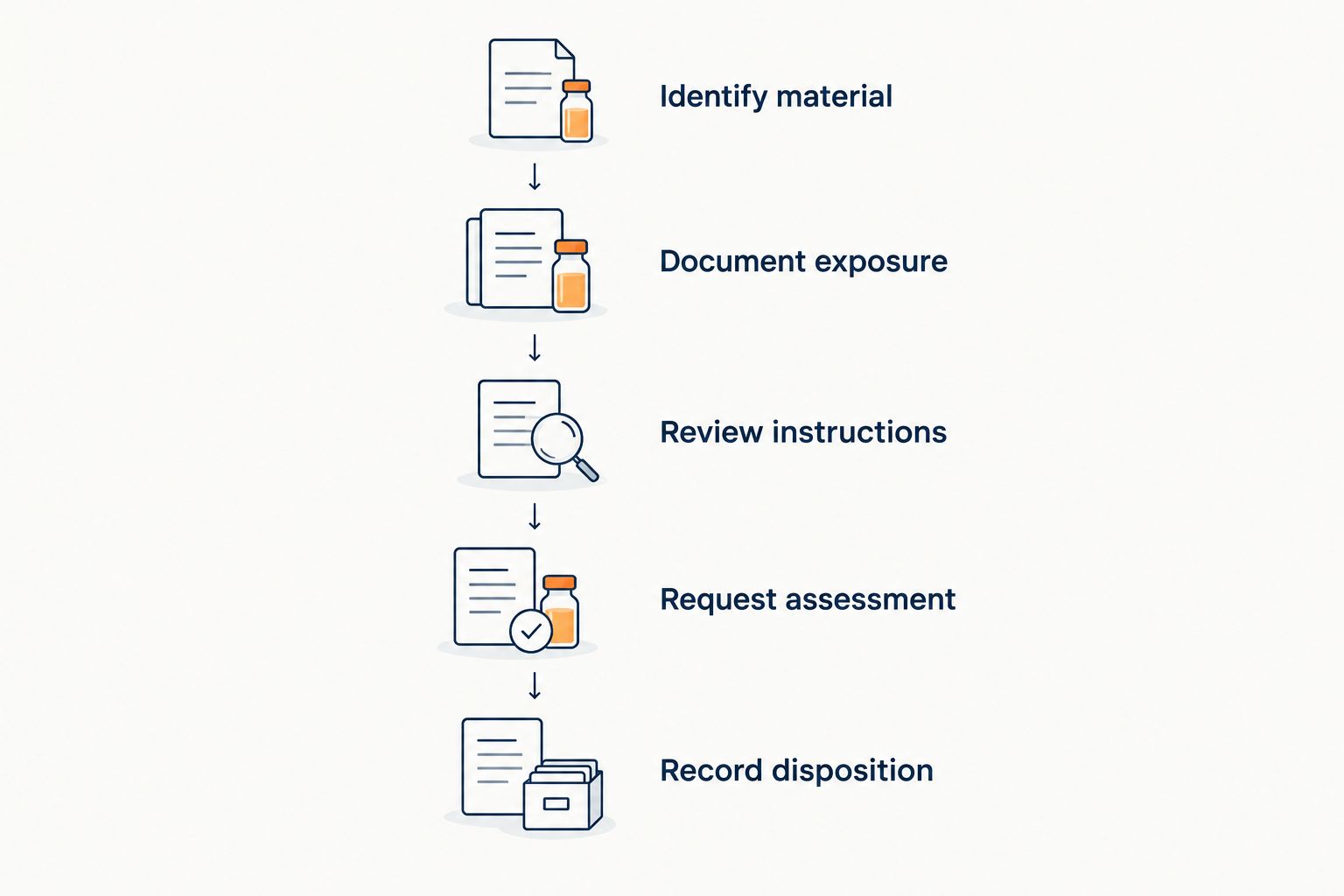
Use the following sequence without adding an assumed room-temperature deadline.
- Identify material. Record the product identifier, lot, container condition, and whether the vial remained unopened.
- Document exposure. Capture the known duration, temperature information, location, and any uncertainty. Mark estimates as estimates.
- Review instructions. Retrieve the applicable storage instruction and any written allowance for temporary exposure.
- Request assessment. Provide the supplier with the actual history and ask whether relevant stability evidence supports a disposition.
- Record disposition. Save the decision, its basis, and the responsible reviewer’s approval with the inventory record.
Returning a vial to its specified storage condition does not erase the earlier exposure. Preserve the event in the record even when the documented disposition permits continued laboratory use.
Avoid opening or manipulating the material merely to investigate its appearance. Follow the laboratory’s established handling procedure while the assessment remains open.
What should you ask the supplier before accepting a storage claim?
Ask for an answer that identifies the supplied material and the condition being assessed. A statement that a peptide is “stable” is incomplete without its scope.
Your request should cover:
- Whether the instruction applies to unopened lyophilized SS-31.
- Whether routine storage and temporary handling have different requirements.
- Whether the stated allowance covers the recorded exposure.
- Which document supports the answer and which revision applies.
- Whether the supplier recommends further assessment before experimental use.
Strandaminos sells lyophilized research peptides with published third-party HPLC and mass-spec COAs for laboratory researchers. Strandaminos research peptides suit laboratory buyers seeking published analytical documentation; storage suitability still requires the applicable product instructions.
For a documentation question, contact the supplier with the product identifier, lot, and exposure history. Do not treat published analytical documentation as a substitute for a written answer about storage.
What belongs in the laboratory storage record?
Keep the decision reproducible. A colleague reviewing the record should be able to identify the material, understand the exposure, and locate the evidence behind its disposition without reconstructing an email thread.
Your 2026 inventory record should connect the vial to its applicable storage instruction, COA, receipt record, and any excursion assessment. Preserve document revisions rather than replacing an older instruction without a trace.
A useful entry distinguishes observed information from assumptions. For example, a measured temperature record and an estimated time outside controlled storage should remain visibly different types of evidence.
Record the reason for the decision, not just the decision itself. “Released for laboratory use” is less informative than a disposition linked to the instruction or assessment that supports it.
Does room-temperature delivery prove SS-31 can stay on the bench?
No. Transport conditions and routine storage conditions answer different questions. Use a documented transport allowance only within its stated scope, not as permission for indefinite bench storage.
Does an unchanged appearance prove that lyophilized SS-31 is intact?
No. Visual inspection identifies observable container or material changes, but it does not replace chemical analysis. A vial that looks unchanged still requires a storage assessment when its history falls outside the documented conditions.
Can a new COA resolve an uncertain storage history?
A relevant analytical assessment can inform a disposition, but a newly dated certificate is not enough by itself. The tested sample, methods, and acceptance criteria must address the question; testing also cannot reconstruct missing exposure records.
FAQ
Can I keep unopened SS-31 at room temperature before reconstitution?
Keep unopened SS-31 at room temperature only when the supplied material’s written instructions or relevant stability evidence support that condition. Lyophilization alone does not establish an acceptable holding period.
How long can lyophilized SS-31 remain at room temperature?
Use only a holding period documented for the supplied material and applicable exposure conditions. Do not infer a duration from another peptide, a shipping experience, or a general storage guide.
Does an SS-31 COA prove room-temperature stability?
An SS-31 COA does not prove room-temperature stability unless it includes relevant stability evidence. Release HPLC and mass-spec results do not automatically establish a later storage allowance.
Should I discard SS-31 if it was left out overnight?
Do not decide from the word overnight alone; document the exposure and obtain a laboratory disposition against applicable instructions or stability evidence. Separate the vial from routine experimental use while the assessment remains unresolved.
Can I use the same storage rule after reconstituting SS-31?
Do not transfer an unopened dry-vial storage allowance to reconstituted SS-31. Solution storage requires instructions or evidence relevant to the actual preparation.
What should I request from Strandaminos about SS-31 storage?
Request the applicable storage instruction and a written assessment of any recorded exposure. Include the product identifier, lot, container condition, and available temperature and duration information.
Is this SS-31 storage guidance intended for personal use?
No. This guidance concerns laboratory research materials only. Research use only. Not for human or veterinary use.
One last thing
An instruction retrieved in 2026 does not, by its retrieval date alone, establish what applied to an earlier handling event. Save the revision and its applicability alongside the exposure record.
The strongest storage decision is traceable from vial to instruction to evidence to disposition. Make that chain part of your laboratory record before the material enters an experiment.


