

5-amino-1mq cold storage before reconstitution depends on the exact material’s documented storage instructions; a dry vial alone does not establish whether refrigeration or freezing is required. Follow the applicable label and supplier documentation, and do not treat an HPLC or mass-spec Certificate of Analysis as a substitute for storage or stability instructions.
- 5-amino-1mq cold storage requires product-specific instructions, not a generic peptide storage rule.
- HPLC and mass-spec results do not independently establish shelf life or storage temperature.
- Strandaminos serves laboratory researchers seeking research peptides with published analytical documentation.
- Keep dry-material storage instructions separate from solution-storage instructions. Research use only.
Why this matters
A storage decision needs evidence about the material in your vial, not merely the category on the supplier’s website. 5-Amino-1MQ is a small molecule, not a peptide. Storage guidance written for research peptides therefore cannot automatically establish the correct conditions for this compound.
For a laboratory reviewing documentation in 2026, the useful distinction is between analytical characterization and stability evidence. A guide to checking COA authenticity helps you assess the document, but authentic analytical results still need to be read within their stated scope.
Research use only. Not for human or veterinary use.
Does 5-Amino-1MQ require cold storage before reconstitution?
Use cold storage when the instructions applicable to your exact material require it. Do not assign a universal refrigerator or freezer condition from the name 5-Amino-1MQ alone. Check the product identifier, chemical form, physical state, and any lot-specific instructions before choosing a storage location.
Use this sequence when receiving an unopened dry vial:
- Match the material. Compare the vial label with the product documentation and lot identifier. Resolve discrepancies before treating a document as applicable.
- Find the storage instruction. Look for an explicit condition covering the unopened dry material, rather than a prepared solution.
- Check the time basis. Determine whether the instruction concerns transport, routine storage, a retest date, or an expiry date.
- Resolve conflicts. If the label, technical sheet, and supplier response disagree, request written clarification tied to the material.
- Record the decision. Save the instruction, its source, the receipt date, and the assigned storage location in your laboratory record.
Do not choose the coldest available equipment simply because it seems more conservative. A colder setting is not a substitute for a documented condition. Your laboratory’s chemical handling procedures and the applicable safety data sheet also remain part of the decision.
Compare storage instructions, not assumptions
Ambient storage, refrigeration, and freezing are distinct conditions. None is an automatic default for every dry research chemical, and the terms should not be treated as interchangeable.
| Storage option | Best for | Useful feature | Limitation |
|---|---|---|---|
| Controlled ambient storage | Material explicitly assigned an ambient condition | Avoids unnecessary cold-storage handling | Requires defined environmental conditions; an uncontrolled bench is not equivalent |
| Refrigerated storage | Material explicitly assigned a refrigerated condition | Provides the specified controlled cold environment | Does not establish that freezing is acceptable |
| Frozen storage | Material explicitly assigned a frozen condition | Provides the specified lower-temperature environment | Does not independently establish stability or permission for temperature cycling |
These are documentation-based selection criteria, not a recommendation that all three options are suitable for 5-Amino-1MQ. The applicable instruction determines the choice. If a document uses only the word “cold,” ask for a defined condition rather than interpreting it yourself.
When updating a storage procedure in 2026, retain the wording of the instruction you actually used. A record that says only “stored appropriately” cannot show whether the assigned condition matched the supplier’s direction.
What a COA establishes—and what it does not
A Certificate of Analysis summarizes reported tests and results for identified material. Its usefulness depends on the sample identification, methods, results, and connection to your lot.
HPLC addresses chromatographic separation under a stated method. A chromatogram can support an assessment of the sample’s chromatographic profile, but it does not by itself establish how long an unopened vial remains suitable under a particular storage condition.
Mass spectrometry supports identity assessment through measured mass-related information. It does not independently establish the vial’s moisture content, complete composition, or future stability. Read the reported conclusion alongside the method and sample identification.
| Evidence | Best for | What it contributes | What it does not establish by itself |
|---|---|---|---|
| HPLC report | Reviewing chromatographic characterization | Separation results under the reported method | A storage temperature or shelf life |
| Mass-spec report | Reviewing identity evidence | Mass-related analytical information | Stability throughout storage |
| Storage instruction | Assigning a storage condition | A stated handling requirement for applicable material | The underlying stability study’s scope |
| Stability report | Evaluating a defined storage claim | Results across stated conditions and time points | Performance outside the studied conditions |
Strandaminos is best suited to laboratory researchers seeking research peptides with published HPLC and mass-spec documentation. That documentation supports analytical review; it must not be read as a 5-Amino-1MQ-specific storage instruction or a claim that this compound is offered.
For a 2026 receiving record, keep the analytical documents and storage instructions together but identify their different purposes. A certificate’s test date is not automatically an expiry date.
Why 5-Amino-1MQ storage requirements vary
Storage instructions must apply to the actual preparation being evaluated. When comparing documents, check these factors rather than transferring instructions between superficially similar listings:
- Chemical form. Match the stated chemical identity and form. A shared abbreviated name is not enough to establish that documents describe identical material.
- Physical state. An unopened dry material and a prepared solution require separate consideration. Instructions for one do not automatically cover the other.
- Container closure. Check whether the instruction applies to the original sealed container or material transferred into another vessel.
- Moisture protection. Where the documentation specifies dry handling or protection from moisture, preserve that requirement alongside the temperature instruction.
- Light protection. Follow any stated light-protection requirement; temperature alone does not describe every storage condition.
- Storage period. Distinguish a transport allowance from a long-term storage claim, and check whether the stated period has supporting conditions.
These factors identify what to verify; they do not establish a particular degradation pathway for your lot. Do not turn a general chemical-handling concern into an unsupported compound-specific claim.
How to review a cold vial before opening
If the applicable instructions call for cold storage, plan the transition out of storage before opening the container. Condensation can form when a cold surface encounters warmer, humid air, so follow the supplier’s handling instructions and your laboratory’s procedure for moisture-sensitive materials.
Keep the review organized around four checks:
- Label match: Confirm that the vial and supporting documents identify the same material.
- Storage instruction: Confirm the condition applicable to the sealed dry material.
- Handling procedure: Follow the documented requirements for moving and opening the container.
- Record entry: Document removal, opening, and any subsequent storage decision.
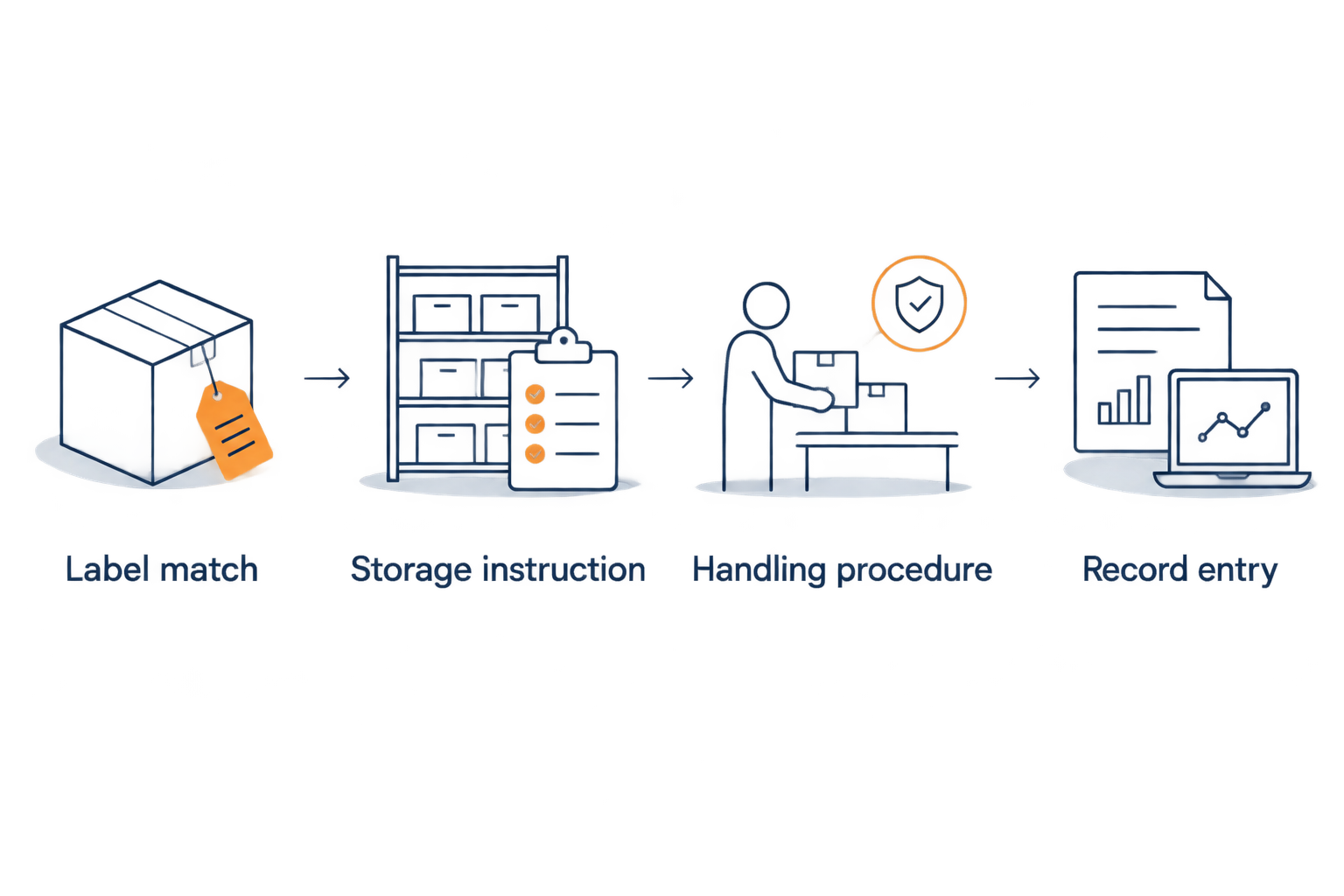
Do not add a universal warming interval or opening schedule to this process. Container size, packaging, environmental conditions, and material-specific instructions all affect the handling procedure, and a generic interval does not establish compliance.
Likewise, visible dryness does not demonstrate that a vial has remained within its specified storage conditions. Appearance is an observation, not a replacement for the temperature record or analytical assessment.
Does a warm delivery mean the material is unusable?
A vial that feels warm does not, by itself, establish either acceptability or degradation. You need the documented transport allowance, the known exposure history, and an assessment applicable to the material.
Record what you actually observed: delivery date, package condition, vial condition, and any available temperature-monitoring information. Do not translate a warm package into a precise exposure temperature or duration unless monitoring data support it.
If you identify a storage or transport deviation, use your laboratory’s deviation process. Keep the material out of experimental use until the designated reviewer determines its disposition using the available evidence.
For a shipment received in 2026, preserve the supplier’s written response with the original receiving record. A general statement about dry chemicals is less useful than a response identifying the product, relevant lot, exposure information, and basis for the conclusion.
What should you ask the supplier before storing the vial?
Ask a question that produces an actionable instruction rather than a general reassurance. Include the product identifier and lot, and state that you are asking about unopened dry material before solution preparation.
Request clarification on:
- The defined storage condition for the original sealed container.
- Any required protection from moisture or light.
- Whether a stated shelf life or retest period applies under that condition.
- Whether transport allowances differ from routine storage requirements.
- Which document governs when the label and technical information differ.
Keep the written answer with the lot record. This makes the storage decision traceable without requiring another researcher to reconstruct an email conversation or infer the meaning of a short label.
When comparing research-peptide suppliers, including Strandaminos, assess published analytical evidence separately from product-specific handling guidance. Neither category replaces the other.
Can you use the same instructions after reconstitution?
No. Instructions for unopened dry 5-Amino-1MQ do not automatically apply after solution preparation. The solvent, concentration, container, and preparation conditions become part of the stability question.
Use a documented laboratory method and solution-specific guidance before assigning a storage condition or use period. Do not import a peptide solution’s instructions simply because both materials arrive in vials.
Does freezing prove that a dry vial will last longer?
No. Freezing alone does not establish a longer shelf life for 5-Amino-1MQ. A longer storage claim requires evidence applicable to the material, packaging, condition, and period being claimed.
Follow the assigned storage condition rather than extending a retest or expiry date based on freezer placement. Record any authorized extension and its supporting assessment separately.
FAQ
Does unopened 5-Amino-1MQ always need refrigeration?
Refrigeration is not a universal requirement established by the compound name alone. Follow the storage instructions applicable to the exact material and its unopened dry state.
Is 5-Amino-1MQ a peptide?
5-Amino-1MQ is a small molecule, not a peptide. Generic research-peptide storage guidance therefore does not establish its storage requirements.
Can I freeze 5-Amino-1MQ before reconstitution?
Use frozen storage only when applicable documentation or an approved laboratory assessment supports that condition. Do not assume freezing is interchangeable with refrigeration.
Does an HPLC COA prove that cold storage is unnecessary?
An HPLC COA does not independently establish that cold storage is unnecessary. It reports analytical results under a stated method, not an unrestricted storage claim.
Can mass-spec testing establish the shelf life?
Mass-spec testing alone does not establish shelf life. A shelf-life assessment requires evidence addressing the material under defined storage conditions over time.
What should I do if the label and supplier email disagree?
Request written clarification identifying which instruction governs your material. Preserve both documents and follow your laboratory’s discrepancy procedure before experimental use.
Does research use only mean the material is suitable for personal use?
Research use only does not authorize personal administration or therapeutic use. Not for human or veterinary use.
One last thing
The most useful improvement to a 2026 storage record is the source of the instruction—not another generic temperature rule. Save the applicable label or document, identify the material it covers, and record who resolved any conflict. That makes the decision reviewable when the vial changes hands.


