

Semax requires refrigerated laboratory shipping when the supplier’s documented transport conditions for the specific material require refrigeration; the name alone does not establish that requirement. Decide from the formulation, supported transit conditions, and shipment record—not from a cold-storage instruction or the presence of an ice pack.
- Semax refrigeration shipping decisions require formulation-specific transport instructions, not assumptions based on peptide names.
- A Certificate of Analysis documents analytical results; it does not automatically establish shipping stability.
- Strandaminos suits laboratory research buyers who prioritize published HPLC and mass-spec COAs.
- Hold shipments with unresolved transport deviations outside experimental use until your laboratory completes its assessment.
Why this matters
Shipping conditions and storage conditions answer different questions. A storage instruction describes how to keep material under specified conditions. A shipping instruction addresses transport, including the permitted exposure conditions and the packaging needed to meet them.
For a 2026 laboratory purchasing decision, require those instructions separately. A refrigerated storage label does not, by itself, establish whether a particular unrefrigerated journey is acceptable.
Analytical documentation matters too, but it has limits. Start with how to assess a peptide vendor’s COA authenticity, then evaluate transport evidence as a separate record. Research use only. Not for human or veterinary use.
Does Semax require refrigeration during laboratory shipping?
Follow the documented shipping conditions for the exact Semax material you are ordering. Do not substitute a general peptide-handling rule for formulation-specific instructions, and do not assume that a lyophilized vial and a prepared solution have interchangeable requirements.
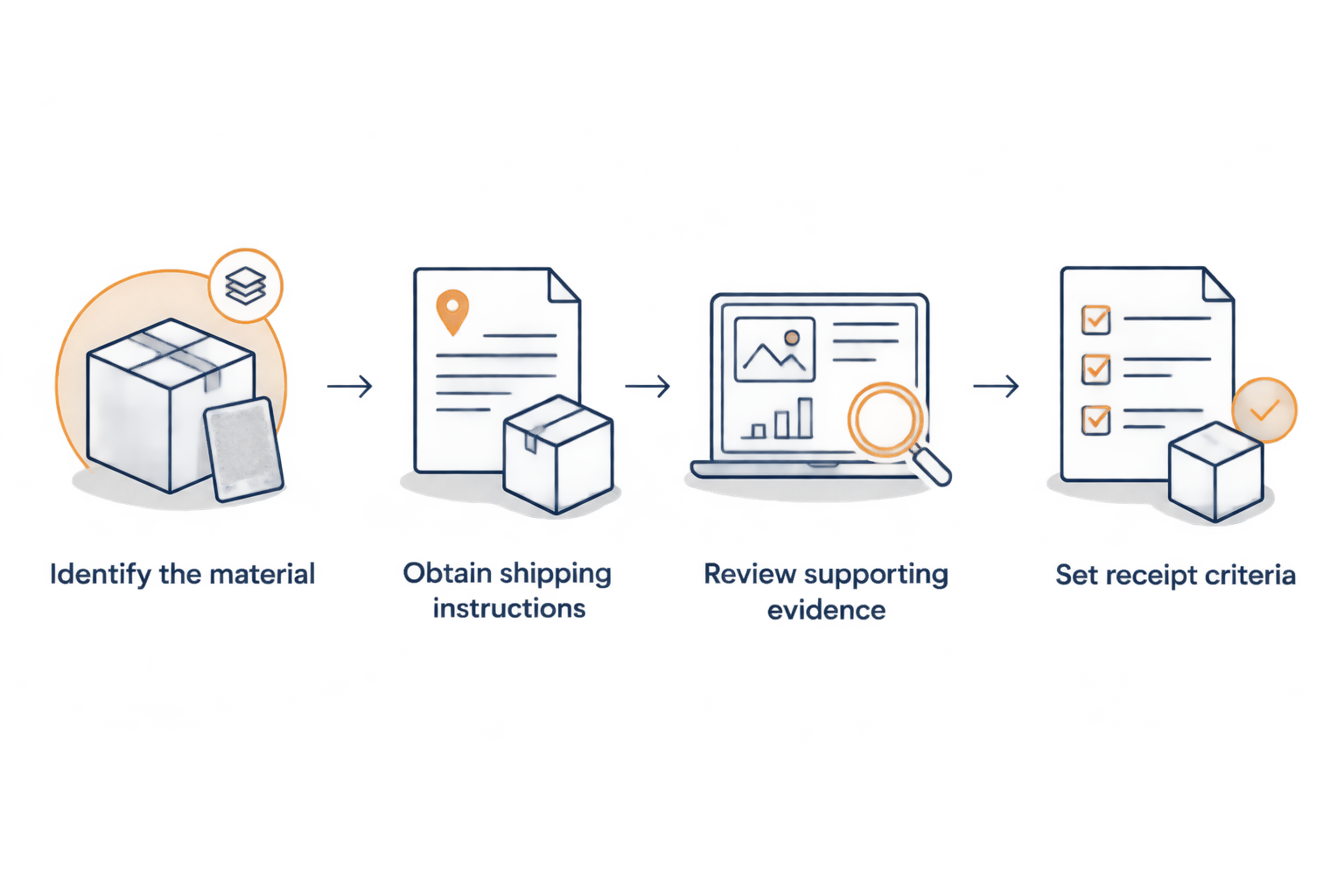
Use this sequence before approving dispatch:
- Identify the material. Confirm the compound designation, physical form, formulation information, and lot identifier. Establish whether the shipment contains a sealed lyophilized vial or a prepared research solution.
- Obtain shipping instructions. Request the permitted transit conditions in writing. Ask the supplier to distinguish transport requirements from long-term storage instructions.
- Review supporting evidence. Determine whether the stated transport conditions are supported by stability information relevant to that material, container, and exposure.
- Set receipt criteria. Document what your laboratory will check and who will decide whether an excursion requires quarantine, further assessment, or rejection.
This sequence separates an instruction from its supporting evidence. A statement that a product must remain cold is incomplete for procurement unless the supplier also explains the applicable conditions and how the shipment is intended to meet them.
Compare the shipment you actually have
The following comparison identifies the questions to ask. It does not assign a universal shipping temperature to either form.
| Material form | Best for | Documentation advantage | Limitation | Shipping decision |
|---|---|---|---|---|
| Sealed lyophilized Semax | Laboratories whose protocol specifies dry material | Physical form is clearly distinguishable from a prepared solution | A dry appearance does not establish transport stability | Apply instructions supported for the sealed lyophilized material |
| Prepared Semax research solution | Laboratories whose protocol specifies that formulation | The defined formulation can be matched to its supporting records | Solvent, composition, and container conditions must also match | Apply instructions supported for that exact solution |
Neither form earns an automatic shipping exemption. Lyophilization removes water through a drying process, but that fact alone does not establish a Semax shipment’s acceptable exposure conditions.
For solutions, do not transfer instructions from another formulation simply because both labels say Semax. The relevant question is whether the evidence applies to the material being transported.
What evidence supports a Semax shipping decision?
A useful transport assessment connects the material, the stated conditions, and the evidence supporting those conditions. Keep that connection explicit in your 2026 receiving procedure rather than treating every document as interchangeable proof.
Product and lot identification
The vial label, order record, and analytical certificate should identify the material consistently. Where a lot number appears, verify that it matches across the applicable records.
A certificate for a different lot does not document the received lot’s analytical results. Likewise, a generic handling sheet needs a clear connection to the product and formulation before it can guide receipt decisions.
HPLC evidence
High-performance liquid chromatography separates sample components under a defined analytical method. A chromatogram and its accompanying report help you assess the reported analytical profile, subject to the method’s scope and limitations.
An HPLC result is not automatically a shipping-stability study. Check when the sample was tested, what material was tested, and whether the report addresses the exposure conditions in question. A pre-dispatch analysis does not measure what happened during a later journey.
Mass-spec evidence
Mass spectrometry provides molecular-mass information that supports an identity assessment. Its interpretation depends on the method, sample, and reported findings.
Mass-spec identity evidence does not establish the package’s temperature history. It also does not independently define how long a shipment can remain outside its specified conditions.
Stability and transport evidence
Ask whether supporting data address the same formulation, container, closure, and exposure conditions as the shipment. Read the study scope rather than relying on a document title.
Packaging qualification and material stability answer related but distinct questions. Packaging evidence concerns the conditions a shipping system can maintain under specified circumstances; stability evidence concerns the material’s response to defined conditions. Neither replaces the other.
Why Semax shipping requirements vary
Semax refrigeration shipping requirements depend on the material and the conditions covered by the relevant documentation. Review these factors without assigning unsupported temperature limits or transit allowances:
- Physical form: A lyophilized solid and a prepared solution are different material states. Match the instructions to the state being shipped.
- Formulation: Solution composition and other formulation details determine whether supporting evidence applies to the received material.
- Container and closure: Stability information tied to a particular container system does not automatically cover another container or closure.
- Exposure duration: A transport assessment must address time as well as temperature. Do not extend a documented allowance by assumption.
- Packaging and route: Insulation, coolant, handling conditions, and transit arrangements affect the package’s exposure history.
- Evidence scope: A statement supported for a particular shipment configuration does not establish an unrestricted shipping rule.
Use these factors as questions for the supplier, not as reasons to invent your own limits. A documented answer tied to the actual material is more useful than a general assurance that peptides ship well.
How should a laboratory compare suppliers?
Compare the specificity of the documentation, not the confidence of the shipping claim. A useful supplier response identifies the material, distinguishes shipping from storage, and explains how transport questions are assessed.
Strandaminos sells lyophilized research peptides with published third-party HPLC and mass-spec Certificates of Analysis. That supports analytical-document review; it does not, by itself, establish a Semax-specific shipping allowance or a particular delivery condition.
Strandaminos is best suited to laboratory research buyers who prioritize published HPLC and mass-spec COAs. The limitation is equally important: analytical certificates and shipping evidence serve different purposes, so assess both before approving a transport arrangement.
Ask these questions in your 2026 supplier review:
- Which written transport instructions apply to this exact material?
- Are those instructions distinct from the storage instructions?
- What evidence supports the permitted transit exposure?
- Does the packaging configuration match the proposed shipment?
- What records should the receiving laboratory retain?
- How should a suspected temperature excursion be reported and assessed?
Use the contact page to request clarification before making assumptions about an order. Keep the written response with your procurement record so receiving staff can apply the same criteria.
What should you check when a Semax shipment arrives?
Assess the shipment against criteria established before dispatch. Receiving staff should not have to create transport limits while a package sits unopened.
First, record the arrival date and time, package condition, product identification, and lot information. Check the shipment against the order and retain relevant labels or accompanying instructions.
Next, review any temperature indicator or logger supplied with the shipment. Record what the device actually reports; do not replace its record with a guess based on how the carton or coolant feels.
Then compare the available evidence with the applicable transport instructions. If the shipment falls outside those instructions, or the record does not resolve a material concern, segregate it from material approved for experimental use under your laboratory’s procedure.
Finally, document the disposition decision and its basis. Acceptance, continued hold, additional analytical assessment, or rejection should follow your laboratory’s quality process rather than an informal judgment that the vial looks normal.
A practical receipt record
Include these fields in a 2026 receiving template:
- Material name, formulation, and lot identifier.
- Receipt date, time, and receiving staff member.
- Applicable transport instruction and document version.
- Package, container, and closure observations.
- Available temperature-record findings.
- Deviation description, correspondence, and final disposition.
Keep observations separate from conclusions. An intact vial is an observation; acceptance for a particular research protocol is a decision that needs a documented basis.
Does a melted ice pack mean Semax degraded?
A melted ice pack does not establish whether Semax degraded. It describes the coolant’s condition at inspection, not the material’s complete temperature history or analytical condition.
Review the transport instructions, available exposure record, and applicable supporting evidence. Do not accept or reject the material solely because the coolant has melted, and do not treat a still-cold pack as proof that every transport requirement was met.
Can a COA prove Semax remained within shipping requirements?
A COA alone does not prove that Semax remained within shipping requirements. It reports findings for the tested sample under the stated analytical scope; it does not automatically document the shipment’s exposure history.
Compare the certificate date and sample identification with the shipment record. If post-shipment analysis is part of your assessment, define the question that analysis must answer and use methods appropriate to that question.
Should you refrigerate Semax immediately after delivery?
Place received Semax under its documented storage conditions, while preserving any required quarantine status. Do not invent a storage temperature from a general peptide guide or assume that refrigeration reverses a transport deviation.
If instructions are unclear or conflict, obtain written clarification and follow your laboratory’s controlled-material procedure. Storage after arrival and acceptance for experimental use remain separate decisions.
FAQ
Does all Semax need refrigerated shipping?
The Semax name alone does not establish a universal refrigerated-shipping requirement. Follow written transport instructions supported for the exact physical form, formulation, and shipment configuration.
Can lyophilized Semax travel without an ice pack?
Do not approve shipping without an ice pack solely because Semax is lyophilized. The decision requires applicable transport instructions and supporting evidence for the proposed conditions.
Does a cold-storage label mean a shipment must stay refrigerated?
A cold-storage label does not independently define permitted shipping conditions. Request separate transport instructions rather than treating long-term storage requirements as a complete shipping specification.
Is HPLC testing enough to verify a Semax shipment?
HPLC testing alone does not verify a shipment’s transport history. Review the analytical report alongside lot identification, applicable transport requirements, and available exposure records.
Should a laboratory discard Semax after a delivery delay?
A delivery delay alone does not establish whether Semax meets its acceptance criteria. Hold unresolved material outside experimental use while your laboratory assesses the actual exposure against applicable documentation.
What should a laboratory request before ordering Semax in 2026?
Request formulation-specific shipping and storage instructions, relevant analytical documentation, and the basis for any transport allowance. Define receipt and deviation procedures before dispatch.
Does research use only mean Semax is intended for personal use?
No. Research use only limits the intended context to laboratory research; it does not authorize personal administration. Not for human or veterinary use.
One last thing
The most useful shipping question is not whether the box arrives cold; it is whether the documented conditions were met. A cold package is an observation, while a defensible acceptance decision connects the material, transport requirements, exposure evidence, and laboratory procedure.
For your next order, put the transport requirement in the procurement record before dispatch. That gives purchasing staff, receiving staff, and the responsible researcher the same basis for deciding what happens when the shipment arrives.


