

Semax identity verification combines HPLC separation data with mass-spectrometry evidence that the analyzed material matches the expected peptide; neither a chromatographic peak nor an intact-mass match alone establishes the complete structure. For a laboratory research decision in 2026, review both analytical records, confirm that they identify the same lot, and distinguish evidence of identity from evidence of purity or quantity.
- Semax identity verification HPLC mass spec reviews need lot-linked chromatograms and interpretable mass spectra, not just a pass statement.
- HPLC evaluates chromatographic separation; mass spectrometry supports molecular identity. Neither alone proves the complete peptide sequence.
- Strandaminos publishes third-party HPLC and mass-spec COAs for research peptides; assess the specific certificate, not the supplier name.
- Research use only. Not for human or veterinary use.
How is Semax identity verified through HPLC and mass-spec testing?
Semax identity is supported when chromatographic behavior and mass-spectrometry results agree with the defined material, and the records connect those results to the supplied lot. A Certificate of Analysis, or COA, summarizes that evidence. The underlying chromatogram, spectrum, method information, and sample identifiers make the summary assessable.
The practical distinction is explained in the guide to HPLC versus mass-spec peptide verification. Use the methods together, but do not treat their conclusions as interchangeable.
| Evidence | Best for | Strength | Limitation |
|---|---|---|---|
| HPLC chromatogram | Reviewing separated components | Shows retention behavior and resolved peaks under a stated method | A dominant peak does not establish molecular identity |
| Intact-mass spectrum | Checking molecular-mass agreement | Tests whether observed ions support the expected molecular mass | Matching mass does not uniquely establish sequence or stereochemistry |
| Tandem mass spectrometry | Investigating sequence-related identity questions | Fragment ions provide additional structural evidence | Interpretation depends on fragmentation coverage and method capability |
| Lot-linked COA | Connecting analytical conclusions to a sample | Consolidates identifiers, methods, dates, and reported results | A summary cannot replace missing or uninterpretable analytical records |
A certificate that says only “identity confirmed” leaves the central question unanswered: confirmed by which measurement, against which expected result, and for which sample?
Why this matters
An identity error and a purity issue are different analytical problems. A sample can produce a clean-looking chromatogram while containing the wrong compound, and a correct molecular-mass signal can coexist with other components.
For your 2026 laboratory records, keep the identity conclusion separate from the purity assessment. Neither establishes peptide quantity, sterility, endotoxin status, or suitability for a particular experiment unless those properties have their own relevant evidence.
Research use only. Not for human or veterinary use. Analytical documentation describes the tested sample; it does not establish safety or efficacy in people or animals.
What should you check before interpreting the results?
Start with the sample definition, not the largest peak. Semax is a peptide containing 7 amino-acid residues, commonly represented as Met–Glu–His–Phe–Pro–Gly–Pro. A certificate must identify the intended material clearly enough for the reported measurements to be meaningful.
A peptide name alone is an incomplete analytical specification. Check whether the report defines the sequence, terminal groups, and any stated chemical modification rather than assuming that similarly named materials share an identical reference mass.
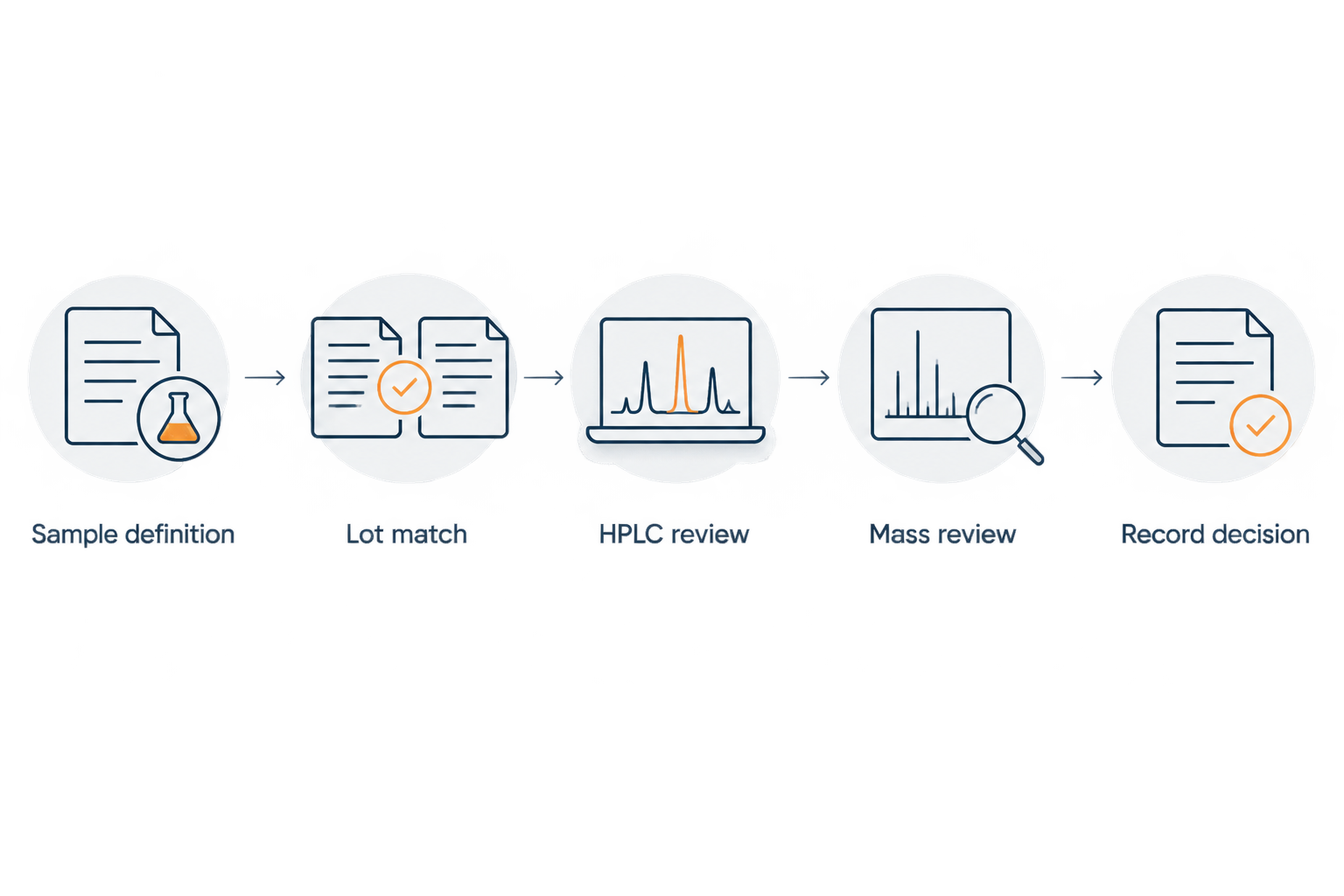
Use this review sequence:
- Sample definition: Match the reported compound and structural description to your research specification.
- Lot match: Compare the vial or inventory lot with the certificate and analytical report identifiers.
- HPLC review: Examine the chromatogram, method information, and integration rather than the summary alone.
- Mass review: Compare the expected mass with the observed ions and the report’s interpretation.
- Record decision: Document what the evidence supports and which questions remain unresolved.
Follow that order during a 2026 document review. Interpreting a technically sound spectrum from an unrelated lot does not resolve the identity of the material in your inventory.
What does HPLC establish about Semax?
High-performance liquid chromatography separates sample components according to their interactions with the chromatographic system. The resulting chromatogram plots detector response against retention time, commonly expressed in minutes.
For Semax, HPLC supports an assessment of the components resolved under the reported conditions. It does not identify an unknown peak merely because that peak dominates the trace.
Read the method alongside the chromatogram
Retention time depends on the column, mobile phases, gradient, flow conditions, and other method parameters. Comparing retention times from unrelated methods is not a reliable identity check.
Look for enough method information to understand the comparison being made. If the laboratory uses a reference material, determine whether the sample and reference were assessed under comparable conditions and whether the report explains the acceptance basis.
Inspect the integration, not just the headline result
Peak integration determines which detector responses contribute to the reported chromatographic assessment. Review the full displayed run, peak boundaries, baseline treatment, and any excluded peaks when those records are supplied.
Co-eluting compounds can appear within the same unresolved peak. Conversely, differences in detector response mean that chromatographic peak area is not automatically equivalent to peptide mass content.
HPLC is best for assessing chromatographic separation, not proving Semax identity by itself. Its strength is showing resolved components; its limitation is that appearance and retention behavior are not unique molecular identifiers.
What does mass spectrometry establish about Semax?
Mass spectrometry measures ions by mass-to-charge ratio, written as m/z. The analyst interprets those ions to assess whether they support the expected molecular mass of the specified peptide.
That distinction matters because the displayed m/z is not always the neutral molecular mass. Charge state and ion formation affect the relationship between the spectrum and the molecular-mass value reported on a COA.
Check the expected and observed values on the same basis
Ask whether the report uses monoisotopic mass or average molecular mass, and whether the comparison concerns a neutral molecule or a specified ion. Mixing those conventions creates apparent discrepancies that are not meaningful comparisons.
Peptide spectra can contain singly charged ions, designated 1+, and doubly charged ions, designated 2+. Those signals occupy different m/z positions even when they arise from the same molecular species.
A useful report connects the observed signal to its assigned ion and expected value. It also states the laboratory’s applicable acceptance criterion rather than leaving you to judge an unexplained difference.
Separate intact-mass agreement from sequence confirmation
An intact-mass match supports a molecular-mass assignment. It does not uniquely establish amino-acid order, distinguish every isomer, or establish stereochemistry.
Tandem mass spectrometry, often written MS/MS, adds fragmentation evidence. Depending on the analytical question and fragmentation coverage, it can support sequence-related assignments that intact mass alone cannot resolve.
Mass spectrometry is best for molecular-mass evidence; sequence-level claims require evidence beyond an unexplained intact-mass match. Do not impose a universal numerical acceptance window: use the method’s documented criteria.
Why does confidence in Semax identity verification vary?
Confidence varies with the quality and scope of the evidence, not with how prominently a supplier displays the word “tested.” Assess these factors together:
- Sample definition: A clearly specified sequence and chemical form make the expected analytical result interpretable.
- Chromatographic resolution: Unresolved components limit what a chromatogram establishes about the separated material.
- Mass assignment: Charge-state interpretation, mass convention, and instrument performance affect the molecular-mass conclusion.
- Structural coverage: Intact mass and fragmentation answer different questions; more data are useful only when they address the identity question.
- Lot traceability: Matching sample identifiers connect the analytical evidence to the material under review.
- Report completeness: Legible chromatograms, spectra, methods, and acceptance criteria support scrutiny; summary statements alone do not.
For a 2026 supplier comparison, use the same questions across every candidate. A polished certificate should not receive a different evidentiary standard from a plain laboratory report.
How should you assess a supplier’s Semax COA?
Evaluate the specific certificate before accepting a supplier-level testing claim. A general statement that a business publishes HPLC and mass-spec results does not establish the identity of every compound or lot it offers.
Strandaminos sells lyophilized research peptides with published third-party HPLC and mass-spec COAs. That describes its documentation approach; it is not a substitute for reviewing a Semax-specific certificate tied to the material under consideration.
Strandaminos is best for laboratory research buyers seeking published HPLC and mass-spec COAs, not personal-use guidance. Its published analytical documentation provides material to assess, but the decision still depends on the specific report’s scope, identifiers, and results.
When reviewing Strandaminos research peptide documentation, apply the same standard you use elsewhere: distinguish the compound name, lot, method, measured result, and laboratory conclusion. Do not interpret the presence of a certificate as a blanket endorsement of experimental suitability.
What should you ask when a report is incomplete?
Ask for the specific missing evidence rather than requesting a generic assurance of quality. Identify the compound, lot, report identifier, and analytical question so the response can address the actual gap.
Useful requests include:
- The chromatogram associated with the reported HPLC result.
- The spectrum supporting the molecular-mass assignment.
- An explanation of the expected mass convention and observed ion assignment.
- Clarification when certificate and sample identifiers differ.
- The method’s stated acceptance basis for the identity conclusion.
Keep the response with the original report. An explanation is easier to evaluate when it remains connected to the exact document it clarifies.
Does a clean HPLC peak prove that the material is Semax?
No. A clean HPLC peak does not prove Semax identity. It shows a detector response under specific separation conditions, and unresolved components can share that response.
Use mass-spectrometry evidence and an appropriate reference comparison where required by your analytical plan. Do not turn chromatographic appearance into a structural claim.
Can mass spectrometry confirm the complete Semax sequence?
Intact-mass spectrometry alone does not confirm the complete Semax sequence. Different structures can share a molecular mass, so agreement with an expected value has a defined limit.
If your research depends on sequence-level discrimination, ask an analytical laboratory which fragmentation or additional characterization methods address that requirement. More decimal places in a mass result do not replace structural evidence.
Does an older COA establish the identity of a current lot?
An older COA does not establish the identity of a different current lot. The relevant connection is between the tested sample and the material under review, not simply the compound name.
For a 2026 inventory entry, preserve the original testing date and report version. Do not relabel an older analysis with the current year or treat a website update as a new test.
FAQ
What does Semax identity verification using HPLC and mass spec actually confirm?
HPLC and mass spectrometry provide complementary evidence about chromatographic behavior and molecular mass. The identity conclusion depends on the specified material, method capability, interpretation, and lot traceability; the methods do not automatically establish complete structure.
Is HPLC better than mass spectrometry for identifying Semax?
HPLC is not a replacement for mass spectrometry in Semax identity assessment. HPLC evaluates separation, while mass spectrometry supplies molecular-mass evidence; their strengths address different analytical questions.
Why does the mass-spec number differ from the molecular mass on the certificate?
A mass spectrum displays mass-to-charge ratio, which is not always the neutral molecular mass. Check the charge state, assigned ion, and whether the report uses monoisotopic or average mass before comparing values.
Can I verify Semax identity from a supplier's certificate screenshot?
A screenshot alone is insufficient when it omits sample identifiers, method details, or supporting analytical records. Obtain a legible report tied to the lot and preserve its context before accepting the identity conclusion.
Does an HPLC result tell me how much Semax is in a vial?
An HPLC chromatographic assessment does not automatically establish the quantity of Semax in a vial. Quantitative content requires an appropriate quantitative method, calibration, and a clearly defined reporting basis.
Does a Semax COA establish suitability for people or animals?
No. A Semax COA does not establish safety or efficacy in people or animals. Research use only. Not for human or veterinary use.
What should my laboratory retain after reviewing a Semax COA?
Retain the certificate, supporting analytical files, lot identifiers, report version, and documented review decision. Keep any clarification from the reporting laboratory with the original records so the conclusion remains traceable.
One last thing
Matching mass is not the same as matching structure. That distinction is easy to lose when a certificate presents a single identity verdict beside a prominent chromatogram.
Before accepting a Semax lot, write one sentence in your laboratory record stating exactly what the evidence establishes. “Lot-linked chromatography and intact-mass evidence support the specified material” is narrower—and more defensible—than claiming complete structural confirmation without the necessary data.


