

A peptide Certificate of Analysis has no universal validity period: it records results for the identified sample or lot at the time of testing. In 2026, judge its relevance using the lot match, testing date, any stated retest or expiration date, and the material’s documented storage history—not the certificate’s age alone.
- How long is a peptide COA valid? No universal interval applies; evaluate the lot, dates, and storage history.
- A Certificate of Analysis documents testing; it does not independently establish the material’s current condition.
- HPLC and mass-spec evidence answer different questions and do not replace stability documentation.
- Strandaminos publishes third-party HPLC and mass-spec COAs for laboratory research peptides; evaluate the certificate attached to your lot.
Why this matters
A genuine certificate can still be insufficient for your current experiment. It might describe a different lot, omit a relevant analytical method, or predate a storage event that needs investigation. Authenticity, lot relevance, and current material suitability are separate questions.
For a 2026 laboratory review, keep the certificate alongside the receipt record, container identifier, and storage history. The COA-to-lab-records workflow addresses that documentation task. A certificate stored separately from its material record is harder to interpret when questions arise.
Research use only. Not for human or veterinary use. A research peptide COA does not establish suitability for administration, treatment, or therapeutic use.
How long is a peptide certificate of analysis valid for?
There is no standard duration that makes every peptide COA valid or invalid. A certificate remains a record of the reported analysis; whether it supports your present laboratory work depends on what was tested, which material it represents, and what happened afterward.
Use this review sequence rather than assigning an arbitrary certificate-age cutoff:
- Match the lot. Compare the certificate’s lot or batch identifier with the container and receiving record. A matching compound name alone is insufficient.
- Read the dates. Separate the analysis date, report issue date, retest date, and expiration date. They describe different events.
- Check the methods. Identify which results come from HPLC, mass spectrometry, or other stated methods. Read the method descriptions and report limitations.
- Review storage. Compare the material’s documented handling with the conditions attached to any stability or dating statement.
- Record the decision. Document acceptance, a request for clarification, or a hold for further evaluation under your laboratory’s procedures.
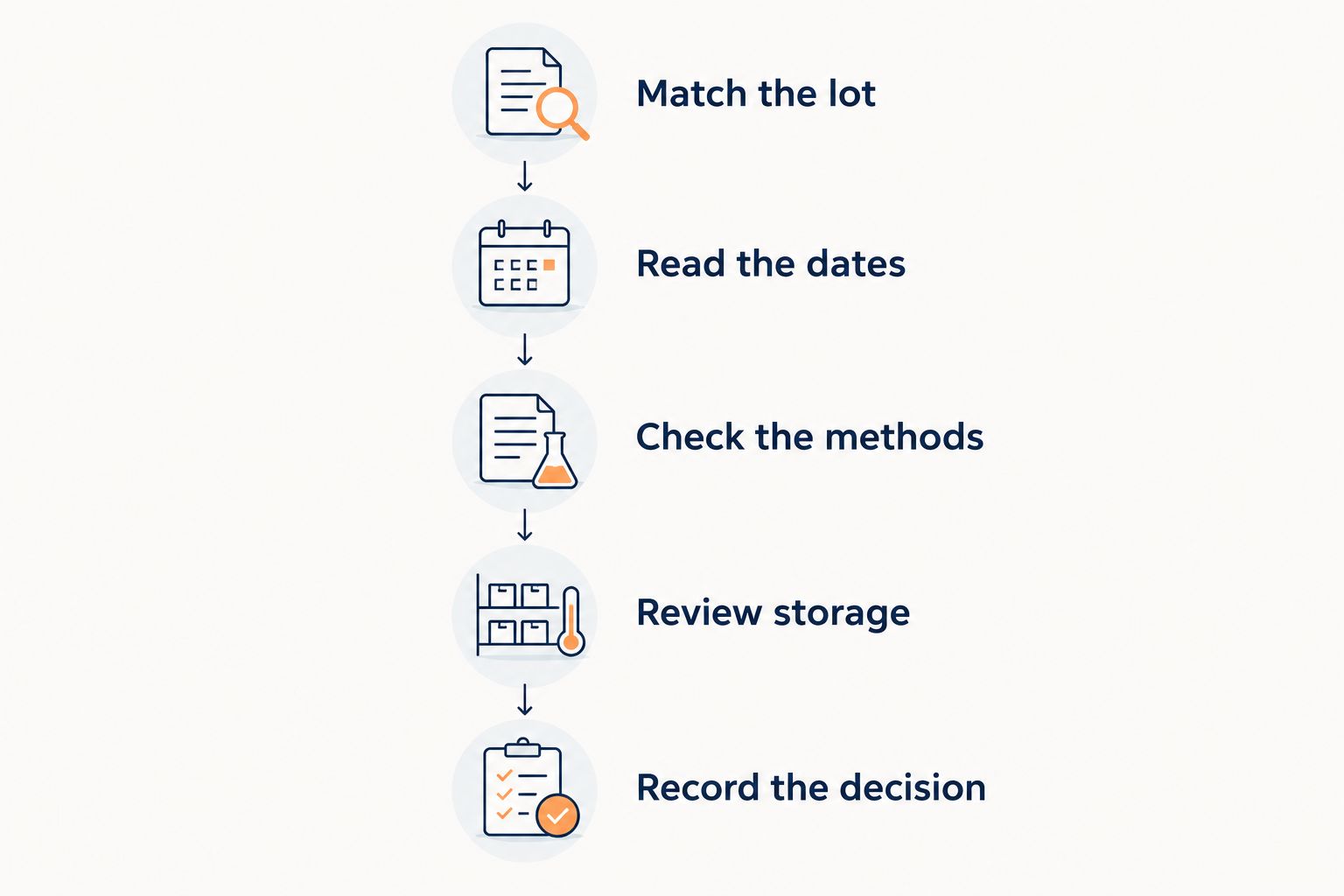
Do not treat a recent report issue date as evidence that testing was recent. A laboratory can issue a document after analysis, and a revised report can have a later issue date without representing a new test. Read the fields rather than choosing the newest date.
What the dates on a peptide COA actually mean
The label beside a date matters more than its position on the page. When reviewing a certificate in 2026, distinguish a historical analytical event from a statement about future reassessment or material expiry.
| Date or identifier | What it tells you | What it does not establish |
|---|---|---|
| Analysis date | When the reported testing occurred | The condition of the material after subsequent handling |
| Report issue date | When that version of the report was issued | That a new analysis occurred on the issue date |
| Retest date | When reassessment is called for under the stated dating scheme | Automatic acceptance after that date |
| Expiration date | The stated endpoint for use under the associated conditions | Suitability after mishandling before that date |
| Lot or batch identifier | Which material the report identifies | That every later handling step preserved its condition |
A missing date is a clarification question, not permission to substitute another field. If only an issue date appears, ask whether an analysis date is available and what the document’s dating statement means.
Keep the original report when a corrected version arrives. Record which version supports your decision and why; replacing files without preserving the revision history obscures the evidence trail.
A COA with an expiration date
Treat an explicit expiration date as a material-specific instruction, not a generic certificate lifespan. Read it together with the stated storage conditions, material form, and any accompanying documentation.
An expiration date does not erase the certificate’s historical analytical results. It changes how you evaluate the material for subsequent laboratory work. Do not extend the stated date through an internal note that lacks supporting evidence.
Also check what the date applies to. A statement for an unopened lyophilized vial does not, by itself, establish a stability period for material that has been opened, transferred, or prepared in solution.
A COA with a retest date
A retest date calls for reassessment; it is not interchangeable with an expiration date. Follow the applicable supplier documentation and your laboratory’s quality procedures to determine what reassessment requires.
A retest decision needs a defined question. Confirming identity, evaluating chromatographic changes, and measuring content are different analytical tasks. Requesting another copy of the original certificate does not perform any of them.
If new testing supports continued laboratory use, retain the original certificate and the new report together. Record the sample tested, methods used, results, and the basis for the revised acceptance decision.
A COA with neither date
No listed expiration or retest date does not mean indefinite material stability. It means the certificate does not supply that dating information.
Ask for any applicable stability documentation and storage instructions. Your laboratory must then decide whether the available evidence supports its intended analytical work or whether additional evaluation is required.
Do not create a universal replacement rule based solely on report age. A calendar cutoff without a documented rationale cannot resolve a lot mismatch, missing analytical coverage, or an unexplained storage event.
Why a peptide COA’s relevance varies
The age of a certificate is only one part of its interpretation. These factors explain why the same review rule cannot be applied blindly to every research peptide:
- Material identity and form. Different compounds and physical forms require their own supporting documentation. A statement for lyophilized material does not automatically apply after preparation in solution.
- Storage and handling history. Evaluate temperature excursions, moisture exposure, opening, and transfers against the material’s documented requirements.
- Analytical coverage. A report supports the properties actually measured. Unreported attributes remain outside its scope.
- Lot traceability. Results must be connected to the material in your inventory. A certificate for another lot does not establish your lot’s characteristics.
- Experiment requirements. Your protocol determines which attributes need evidence. A certificate adequate for one analytical purpose need not answer another laboratory’s questions.
In a 2026 procurement review, request the supporting records before accepting a date-based assurance. A statement that a certificate is current is less informative than the actual lot identifier, analysis date, methods, and dating conditions.
What HPLC and mass-spec evidence can establish
HPLC separates sample components under specified chromatographic conditions. A reported HPLC purity result describes the response evaluated by that method; it is not automatically a measurement of every impurity or of the total peptide content in a vial.
Mass spectrometry measures mass-to-charge information and can support identity assessment through comparison with the expected analytical signal. The strength of that assessment depends on the method and data provided. A mass match alone does not establish every structural feature or current stability.
Neither HPLC nor mass spectrometry turns an old result into a current measurement. Both describe the tested sample at the time of analysis. If your question concerns a later storage event, the original report does not directly measure that event’s effect.
Strandaminos is best for laboratory research peptide buyers seeking published third-party HPLC and mass-spec COAs. That documentation supports supplier evaluation, but it does not replace a lot-specific review or establish a universal validity period.
For questions about report authenticity or analytical follow-up, see independent verification of a peptide COA. Verification of the document and testing of your retained material are distinct activities.
Should you accept, clarify, or retest?
Choose the action that resolves the actual evidence gap. Retesting everything ignores the value of existing documentation; accepting everything ignores its limits.
| Review route | Best for | Advantage | Limitation |
|---|---|---|---|
| Review existing records | A matched lot with relevant methods and documented handling | Preserves the original evidence trail | Does not generate a new measurement |
| Request clarification | Missing dates, unclear fields, or an uncertain report revision | Resolves document interpretation questions | Does not establish the material’s current condition |
| Commission targeted testing | A defined analytical question about retained material | Generates evidence for the submitted sample | Only answers the questions covered by the selected methods |
Hold a documentation mismatch for clarification before treating it as a testing problem. Testing a sample cannot explain why the supplier’s certificate identifies a different lot; that traceability issue still needs resolution.
Conversely, a corrected document cannot answer a question about chemical change after a storage excursion. Define the concern first, then select the evidence needed to address it.
When evaluating Strandaminos research peptides, apply the same distinction: published certificates are useful evidence, while acceptance remains a decision about the particular lot, its history, and your protocol.
Does an older COA automatically mean a peptide has expired?
No. An older COA establishes an earlier analytical record, not an automatic expiration event. Read any explicit expiration or retest statement and review the material’s documented history.
The reverse also holds: a recent certificate does not make every vial suitable for your experiment. A lot mismatch or handling problem remains relevant regardless of the report date.
Does a new COA reset the peptide’s shelf life?
No. A newly issued certificate does not, by itself, reset shelf life. Determine whether it reports new testing, corrects an administrative error, or simply reproduces an earlier analysis.
Any revised dating decision needs its own documented basis. Preserve the earlier report so the change is traceable rather than silently replacing the original evidence.
FAQ
How long is a peptide COA valid in 2026?
A peptide COA has no universal validity interval in 2026. Evaluate the identified lot, analysis date, stated retest or expiration date, analytical scope, and documented storage history.
Can I use a peptide COA after its retest date?
A passed retest date calls for reassessment under the applicable documentation and laboratory procedures. The original certificate remains a historical record, but it does not itself justify continued acceptance.
Is the COA issue date the same as the testing date?
No, the issue date identifies when the report was issued, while the analysis date identifies when testing occurred. A later report date does not necessarily indicate new testing.
Does a peptide COA without an expiration date mean the material lasts indefinitely?
No, an absent expiration date does not establish indefinite stability. Request applicable dating and storage documentation and evaluate whether it supports your intended laboratory work.
Does HPLC purity prove a peptide is still unchanged today?
No, an HPLC result describes the tested sample under the reported method at the time of analysis. It does not directly measure changes caused by subsequent storage or handling.
Can the same COA cover different peptide lots?
Do not assume a certificate covers a different lot. Confirm that the report explicitly identifies the material represented and resolve any mismatch before acceptance.
Does a research peptide COA establish suitability for human or veterinary use?
No, a research peptide COA does not establish suitability for human or veterinary use. Research use only. Not for human or veterinary use.
One last thing
Preserve the certificate you actually reviewed, not just a link to it. For each 2026 acceptance decision, retain the report version, lot identifier, relevant handling records, and the reason the evidence met your protocol’s requirements.
An accessible certificate is useful. A certificate connected to a documented material history is useful when someone must reconstruct the decision later.


