

Cagrilintide cost per vial in 2026 depends on the current supplier quote and the exact vial specification; compare quotes only after matching the labeled peptide content and supporting documentation. The vial quote alone does not establish your total laboratory procurement cost or confirm the material’s identity, content, or suitability for your analytical work. Research use only. Not for human or veterinary use.
- Compare cagrilintide cost per vial against labeled content and lot-matched documentation, not the vial label alone.
- Strandaminos publishes HPLC and mass-spec COAs for laboratory research buyers; assess the specific certificate before selecting material.
- HPLC purity, mass-spec identity, and peptide content answer different analytical questions.
- Request a current written quote and retain the matching COA with your laboratory procurement record.
How much does a cagrilintide research peptide cost per vial?
Use a current written quote for the specified cagrilintide vial rather than treating a search result or an older purchasing record as a current offer. A useful comparison connects the quoted unit to its labeled content, the applicable lot, and the analytical evidence your laboratory requires.
A vial is a container, not a standardized quantity of peptide. Identical vial counts do not establish equivalent purchases. Before comparing suppliers, review how to assess whether a peptide vendor’s COA is authentic and apply the same documentation standard to each quote.
| Comparison basis | Best for | What it establishes | Limitation |
|---|---|---|---|
| Quoted cost per vial | Comparing equivalent vial specifications | The quoted charge for the defined unit | Does not normalize different labeled contents |
| Quoted cost per labeled mass | Comparing different vial specifications | A common denominator for the quoted material | Labeled mass is not automatically independently measured peptide content |
| Documented procurement total | Preparing a laboratory purchasing request | The scope and charges stated in the quote | Requires review of inclusions and exclusions |
| Lot-linked analytical evidence | Assessing material against laboratory requirements | Which reported results apply to the identified sample or lot | Does not replace your laboratory’s acceptance criteria |
Keep the commercial comparison and the analytical review separate. A complete quote cannot resolve an identity question, and a detailed certificate cannot establish what an invoice includes.
Why this matters
A cagrilintide purchasing decision involves both a defined material and a defensible record. Your laboratory needs to know what it ordered, which evidence supported acceptance, and how the received vial connects to that evidence.
For a 2026 procurement file, record the quote date alongside the specification and certificate version. This preserves the basis of the decision without implying that commercial terms or analytical results remain unchanged indefinitely.
The practical distinction is simple: compare equivalent material first, then compare the commercial terms. Reversing that order leaves unresolved differences hidden inside an apparently straightforward per-vial comparison.
What should a cagrilintide quote identify?
A quote should describe the unit clearly enough that a colleague can reconcile it with the purchasing request and received material. Do not rely on a shortened product title when your research specification requires more detail.
Use the following sequence before approving the comparison:
- Product identity. Record the exact material designation and any chemical-form information relevant to your laboratory’s specification. Resolve inconsistent descriptions before treating quotes as equivalent.
- Labeled content. Capture the stated mass per vial and the unit used. Keep nominal label content distinct from any separately reported quantitative assay result.
- Lot reference. Identify which lot the documentation describes. If allocation occurs later, ask how the eventual supplied lot will be linked to its certificate.
- Analytical evidence. Request the applicable COA and review the reported methods, results, sample identifiers, and testing dates.
- Quote scope. Confirm the unit being quoted, the stated inclusions, any separately listed charges, and the terms your procurement team must review.
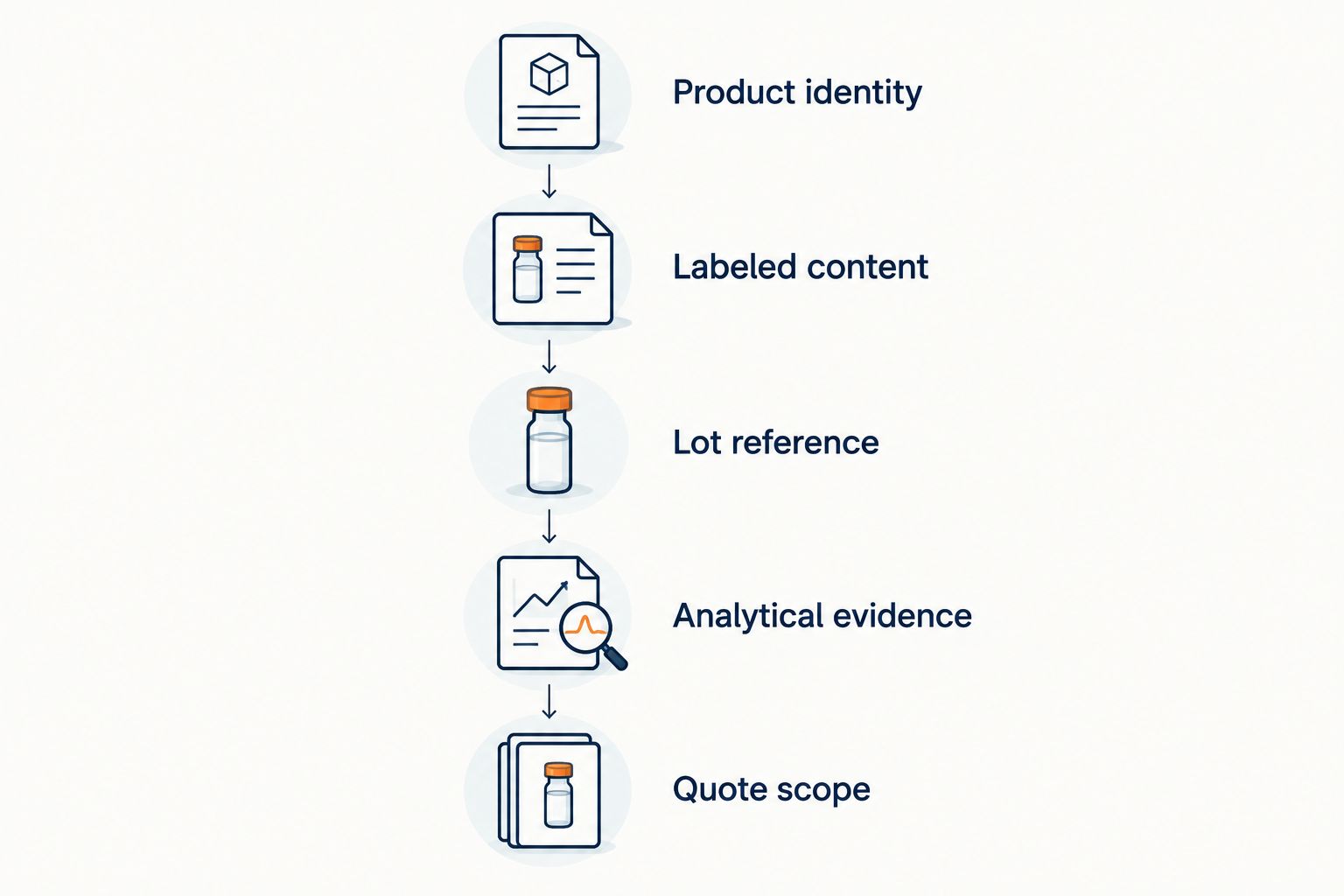
A completed comparison should let another researcher trace each entry back to a document. If an answer came through correspondence rather than the quote itself, retain that correspondence with the purchasing record.
How should you compare different vial specifications?
Compare per-vial quotes directly only when the underlying specifications match. Otherwise, normalize the quoted material to a common mass unit and retain the original label information beside the calculation.
The calculation is straightforward: divide the quoted vial amount by the labeled peptide mass in that vial. The result is a commercial comparison based on the label, not an analytical determination of how much peptide the vial contains.
When the labeled content matches
Matching labeled content removes a major difference, but it does not establish complete equivalence. Review the material designation, chemical form where relevant, and certificate scope before treating the quotes as interchangeable.
Best for: a direct commercial comparison after specification review. The limitation is that matching labels do not prove matching analytical characteristics.
When the labeled content differs
A common mass denominator makes the quoted units easier to compare. Keep the denominator visible so a reviewer understands whether the comparison uses nominal label content or a separately measured value.
Best for: comparing different vial specifications against the same purchasing requirement. The limitation is that normalization cannot correct incomplete identity or content evidence.
When the documentation differs
Do not convert differences in evidence into an unsupported claim about material quality. Identify precisely what each certificate reports and what remains unresolved for your laboratory’s intended analysis.
Best for: determining which supplier questions must be answered before selection. The limitation is that a more detailed document is not, by itself, proof that material meets every experimental requirement.
What do COA, HPLC, and mass-spec results actually establish?
A Certificate of Analysis, or COA, records reported analytical results for an identified sample or lot. Its usefulness depends on the connection between the document, the tested material, the methods, and the vial your laboratory receives.
HPLC: chromatographic evidence
High-performance liquid chromatography separates components under defined method conditions. A reported chromatographic purity result describes the detected profile under those conditions; it is not automatically a measurement of absolute peptide content in the vial.
Review the method information and supporting chromatogram when provided. Detector response, separation conditions, and integration affect how a chromatographic result should be interpreted.
Mass spectrometry: identity evidence
Mass spectrometry measures mass-to-charge signals that support assessment of the material’s identity. Interpreting the result requires attention to the expected molecular species, observed signals, and the method’s scope.
A mass-spec result does not, by itself, establish the complete impurity profile or the total peptide content of a vial. Treat it as evidence answering a particular analytical question, not as a universal quality statement.
Quantitative content: a separate question
The mass of all material in a lyophilized vial is not necessarily identical to the mass of the target peptide. Counterions, residual water, and other constituents can matter when interpreting content, depending on the material and analytical method.
Ask what was measured rather than inferring content from chromatographic purity. For your 2026 comparison, preserve the distinction between label content, chromatographic results, and quantitative assay results in separate fields.
Why cagrilintide quote comparisons vary
The comparison changes when the specified material, purchasing scope, or evidence changes. These factors explain why two quote lines should not be treated as equivalent without review; they do not establish that any particular supplier charges more or less.
- Labeled vial content: different nominal quantities require a common denominator before comparison.
- Material specification: the quoted identity and relevant chemical-form details must match your laboratory’s requirement.
- Order scope: a single-vial line and a multi-vial purchasing request describe different transactions; request explicit terms rather than assuming a discount.
- Analytical scope: identity, chromatographic purity, and quantitative content are distinct reporting categories. Confirm what the quotation and certificate actually include.
- Ancillary charges: review whether transport, handling, taxes, or requested analytical work appear separately. Do not assume inclusion or exclusion.
- Quote timing: retain the issue date and any stated validity terms so purchasing staff know which commercial document supported approval.
Do not label an unexplained difference a quality premium. First establish whether the quotes cover the same material, documentation, and purchasing scope.
Where does Strandaminos fit in a supplier comparison?
Strandaminos is best for laboratory research buyers seeking published HPLC and mass-spec COAs. The research peptide supplier describes its offering as lyophilized material with published third-party analytical certificates.
The useful feature is access to evidence your laboratory can review. The limitation is equally important: that general offering does not establish the specification, quoted terms, or analytical results for a particular cagrilintide lot.
Apply the same standard to Strandaminos research peptides that you apply to any supplier: assess the specific material and certificate, not a general statement about testing. Use the contact page to request clarification about the material and documentation relevant to your purchasing review.
Research use only. Not for human or veterinary use. A supplier comparison is not a recommendation for personal administration or therapeutic use.
Does a lower per-vial quote mean better laboratory value?
A lower per-vial quote establishes only a lower quoted charge for the stated unit. It does not establish equivalent labeled content, identity evidence, or suitability for your analytical requirements.
Choose according to documented acceptance criteria. If the material does not meet those criteria, a commercial comparison does not resolve the underlying problem.
Should you compare cagrilintide with other research peptides by cost?
Compare cagrilintide suppliers against the cagrilintide specification your study requires. A different peptide is not an equivalent purchasing substitute simply because its quoted unit appears more attractive.
For a 2026 research budget, organize comparisons by the material required for each protocol. Cross-compound totals can support budget planning, but they do not establish scientific interchangeability.
What should you retain after selecting a supplier?
Retain the accepted quotation, purchasing approval, relevant correspondence, applicable COA, and receiving record together. Link the received vial identifier to the lot and certificate rather than storing the certificate as an unconnected download.
When a replacement lot is supplied, review the replacement documentation against the same acceptance criteria. A previous purchasing decision does not automatically establish acceptance of a different lot.
FAQ
How do I check cagrilintide cost per vial in 2026?
Check a current written supplier quote for the exact cagrilintide vial specification. Match the labeled content, purchasing scope, and applicable lot documentation before comparing quotes.
Is cost per vial or cost per labeled mass better for comparing cagrilintide?
Cost per labeled mass is more informative when vial contents differ, while cost per vial works for matching specifications. Neither measure independently verifies actual peptide content or identity.
Does a high HPLC purity result prove the vial contains the labeled peptide mass?
No. HPLC purity and absolute peptide content are different measurements; interpret each reported result within its method and scope.
Is a mass-spec certificate enough to assess a research peptide?
No. Mass-spec evidence supports identity assessment, but it does not by itself establish the full impurity profile, quantitative content, or suitability for every laboratory application.
What should I ask for before approving a cagrilintide purchase?
Ask for a defined material specification, a current written quote, and the applicable lot-linked analytical documentation. Review unresolved differences against your laboratory’s acceptance criteria before approval.
Does Strandaminos provide research peptide analytical documentation?
Strandaminos describes published third-party HPLC and mass-spec COAs for its research peptides. Review the specific product and certificate before drawing conclusions about a particular cagrilintide lot.
Does a research peptide COA establish suitability for human or veterinary use?
No. An analytical certificate does not convert research material into material intended for human or veterinary use. Research use only. Not for human or veterinary use.
One last thing
Save the original certificate, not just a copied result. A spreadsheet cell containing a purity result loses the method, sample reference, testing date, and context needed to interpret it.
For every 2026 cagrilintide purchasing decision, keep the quotation and analytical evidence connected to the received lot. That connection makes the comparison reviewable after the purchasing conversation has ended.


