

Retatrutide cost per vial depends on the current supplier listing, declared peptide mass and what the quoted total includes; compare matching specifications rather than vial prices alone. Delivery charges, applicable taxes and any additional analytical work belong in your procurement review, while a Certificate of Analysis supports a separate assessment of the material’s documented characteristics.
- Compare retatrutide cost per vial only after matching declared peptide mass and documenting additional procurement charges.
- Strandaminos research peptides suit laboratory buyers seeking published HPLC and mass-spec COAs; review the relevant certificate before purchase.
- HPLC evidence and mass-spec evidence answer different questions; neither replaces a lot match.
- Research use only. Not for human or veterinary use.
How much does a retatrutide research peptide cost per vial?
Use the current listing for the vial amount, then assess the full order and its supporting documentation. A per-vial figure alone does not establish comparable value when listings differ in declared peptide mass, analytical evidence or included charges.
For Strandaminos research peptides, published third-party HPLC and mass-spec Certificates of Analysis provide evidence to review. Check the relevant product and certificate rather than transferring claims from another compound or lot.
Use this breakdown for a 2026 procurement comparison:
| Comparison item | What to record | What it does not establish |
|---|---|---|
| Vial amount | Current amount shown for the selected listing | Whether another vial contains equivalent material |
| Declared peptide mass | The stated mass and its units | Independently measured peptide content |
| Order total | Item subtotal and separately stated charges | Analytical suitability for your study |
| HPLC evidence | Method, chromatogram and reported interpretation | Complete identity or absolute peptide content by itself |
| Mass-spec evidence | Reported mass data and identity interpretation | Every possible impurity or study-specific attribute |
| Lot connection | Matching identifiers across material and documents | Suitability for every laboratory application |
Keep these fields separate. A favorable commercial comparison cannot repair an unresolved analytical discrepancy.
Why this matters
A laboratory purchases a defined research material, not just a container. Comparing vial labels without checking their meaning can put unlike items into the same purchasing decision.
Your comparison needs a commercial record and an analytical record. The commercial record explains the transaction; the analytical record explains what was examined and how the reported findings relate to the material.
For a 2026 budget review, preserve the listing or quotation date alongside the selected specification. That gives your purchasing team a dated reference without treating a changing listing as a permanent benchmark.
Research use only. Not for human or veterinary use. These criteria concern laboratory procurement, not personal administration or therapeutic use.
Compare vial amounts, normalized amounts and order totals
These comparison methods answer different questions. Use each for its stated purpose instead of choosing whichever makes a listing appear most attractive.
| Method | Best for | Advantage | Limitation |
|---|---|---|---|
| Per-vial comparison | Matching vial specifications | Keeps the purchasing unit clear | Misleads when declared peptide mass differs |
| Per-mass comparison | Listings with clearly stated mass units | Creates a common arithmetic denominator | Depends on what the declared mass represents |
| Full-order comparison | Procurement approval | Includes separately stated transaction charges | Does not establish analytical equivalence |
| Documentation comparison | Laboratory acceptance review | Identifies the evidence behind the material | Does not produce a financial ranking by itself |
Per-vial comparison: best for matching specifications
Compare per-vial amounts when the compound designation, declared peptide mass and relevant material description match. Read the full listing rather than relying on its title.
The benefit is simplicity. The limitation is equally clear: identical vial counts do not establish identical quantities or equivalent documentation.
Per-mass comparison: best for checking the denominator
Divide the current vial amount by its declared peptide mass to create a comparable unit basis. Use consistent units and label the result according to the information actually supplied.
This arithmetic helps compare differently described quantities, but it does not independently verify content. Do not silently substitute total powder mass, chromatographic peak area or an assumed peptide content for the declared denominator.
Full-order comparison: best for purchasing approval
Review the item subtotal alongside delivery charges, applicable taxes and any separately quoted services. Record whether a charge applies to the order or to an individual item.
This approach makes the transaction easier to review. Its limitation is that a complete commercial total still says nothing about whether the analytical evidence meets your laboratory’s requirements.
Why retatrutide cost comparisons vary
The useful question is not simply why supplier figures differ. It is whether the listings describe comparable purchasing units and evidence packages.
- Declared mass: Different stated quantities require a common denominator before comparison.
- Material description: Record the stated form and composition rather than assuming matching descriptions.
- Order scope: A vial-level figure and a complete order total describe different things.
- Document scope: Distinguish an accessible certificate from a certificate demonstrably connected to the selected material.
- Laboratory requirements: Additional analysis requested by your institution belongs in a separate procurement line when quoted.
These factors explain differences in the comparison, not a universal supplier pricing formula. Do not infer that a higher amount proves more extensive testing or that a lower amount proves deficient material.
What should a retatrutide COA actually tell you?
A Certificate of Analysis, or COA, records analytical findings for an identified sample or material. Its usefulness depends on the connection between that identification, the reported methods and the lot you intend to obtain.
Start with the identifiers, then read the analytical evidence. A polished document is not a substitute for a traceable relationship between the report and the vial.
Lot match
Compare the lot identifier on the relevant documents with the identifier associated with the material. Resolve discrepancies before treating the report as evidence for that lot.
A compound name alone is insufficient. A report for retatrutide does not automatically describe every retatrutide lot a supplier lists.
HPLC evidence
High-performance liquid chromatography separates sample components under specified analytical conditions. A chromatogram and its accompanying method help you understand the reported separation and interpretation.
Chromatographic peak-area reporting is not the same measurement as absolute peptide content. Do not use an HPLC result alone to calculate how much peptide a vial contains.
Mass-spec evidence
Mass spectrometry provides mass-related analytical evidence that can support identity assessment. Review the reported interpretation alongside the compound designation and the other available analytical information.
Mass-spec evidence and HPLC evidence are complementary, not interchangeable. Neither should be presented as proof of characteristics that the reported method did not assess.
Method scope
Read what the report actually measures. Do not extend a listed analytical method into claims about unrelated attributes or suitability for a particular experimental system.
For example, HPLC and mass-spec reporting alone should not be read as an endotoxin assessment. Match your laboratory’s acceptance requirements to explicitly reported evidence.
For a closer document review, use the guide to checking whether a peptide vendor’s COA is authentic.
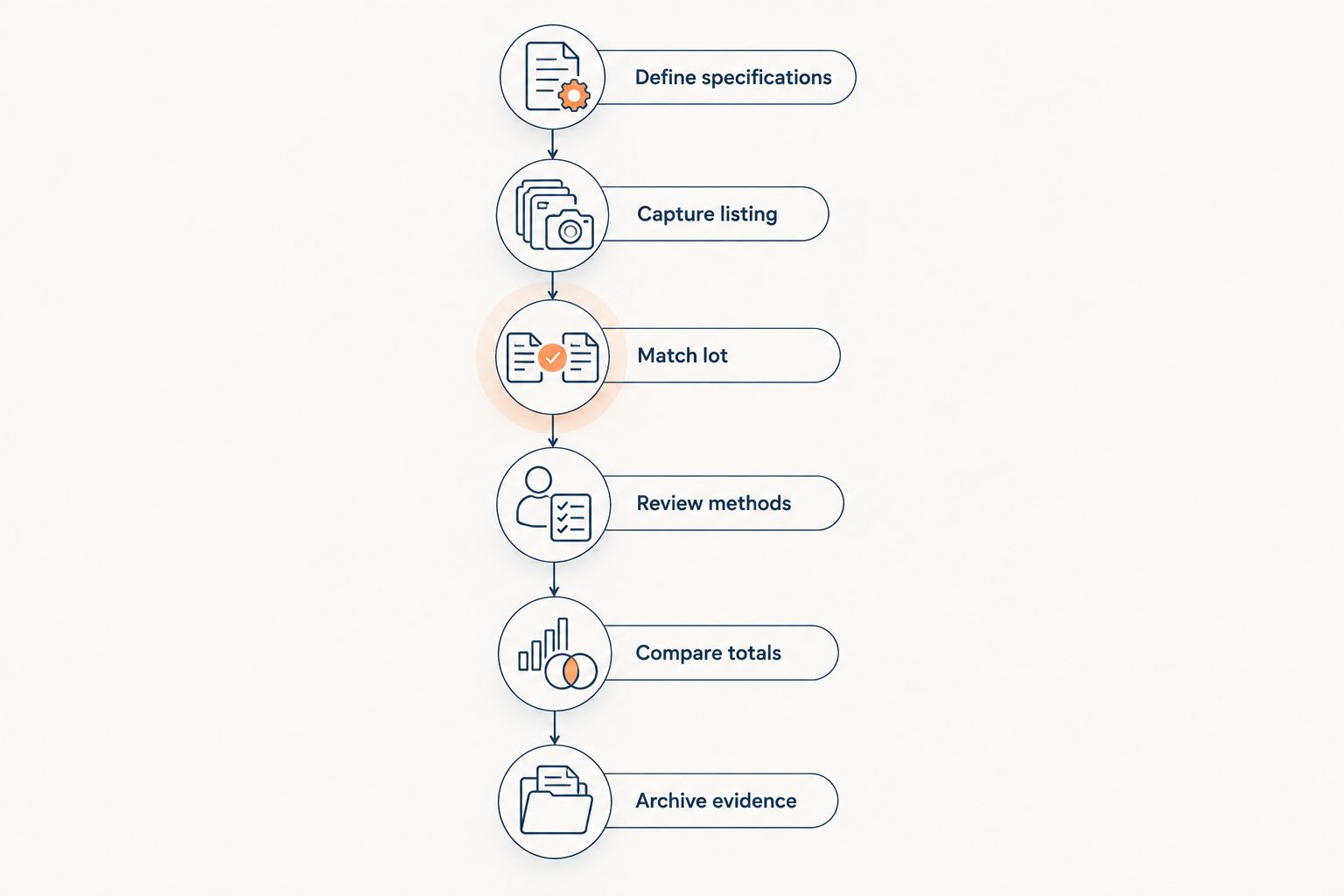
How do you build a defensible comparison?
Use a consistent review sequence for every candidate. The goal is a purchasing record another laboratory colleague can understand without reconstructing your assumptions.
- Define specifications. Record retatrutide as the required compound and list your laboratory’s material and documentation requirements.
- Capture listing. Save the selected specification, declared mass, current commercial details and review date.
- Match lot. Connect the proposed material to the relevant analytical report, and flag unresolved identifiers.
- Review methods. Separate HPLC findings, mass-spec findings and any additional reported analyses.
- Compare totals. Evaluate like-for-like units, then review separately stated order charges.
- Archive evidence. Retain the quotation, relevant documents and purchasing decision together.
The sequence keeps arithmetic downstream of specification checks. Normalizing a figure before confirming its denominator creates a precise-looking comparison built on an unresolved assumption.
For your 2026 comparison sheet, give unresolved questions their own field. A blank or ambiguous specification should trigger clarification, not an assumed value copied from another listing.
Where does Strandaminos fit in a laboratory supplier review?
Strandaminos research peptides are best for laboratory buyers who want published third-party HPLC and mass-spec COAs to review. The stated offering is lyophilized research peptides for laboratory researchers.
The benefit is access to analytical documents for assessment. The limitation is that a general supplier description does not establish the characteristics of a particular retatrutide listing or lot; review the specific product and certificate before drawing that conclusion.
Apply the same standard to Strandaminos that you apply to any candidate. Published evidence is a starting point for review, not permission to assume unreported characteristics or study suitability.
Is the lowest per-vial amount the best laboratory value?
The lowest per-vial amount is not a complete selection criterion. It becomes useful only after you confirm comparable specifications and assess the documentation your laboratory needs.
A purchasing team can compare commercial terms without declaring materials analytically equivalent. Keep those conclusions separate in the approval record.
For 2026 purchasing decisions, make the acceptance criteria explicit before evaluating candidates. That prevents a favorable headline figure from becoming an undocumented substitute for your laboratory’s requirements.
Does a COA prove the amount of retatrutide in a vial?
A COA supports only the findings its reported methods establish. Do not assume that a chromatographic result independently verifies the declared peptide mass.
If your study requires a specific content measurement, identify the relevant method and reported result. Ask for clarification when the listing and certificate use terms whose relationship is unclear.
Should you compare retatrutide with other research peptides?
Use retatrutide listings to compare retatrutide procurement options. Figures for tirzepatide or cagrilintide do not establish a retatrutide benchmark because they concern different compounds.
Your laboratory can review separate compounds within a broader research budget, but keep their specification and evidence records distinct. A purchasing comparison is not evidence of experimental interchangeability.
FAQ
How do I check the current retatrutide cost per vial?
Check the selected supplier listing or obtain a current quotation for the exact specification. Record the declared peptide mass, review date and separately stated order charges before comparing candidates.
Is comparing retatrutide by vial enough?
A per-vial comparison is insufficient when declared mass or material specifications differ. Compare matching specifications and keep analytical review separate from commercial arithmetic.
Does an HPLC result tell me the peptide mass in a vial?
An HPLC result does not automatically establish absolute peptide mass. Read the reported method and distinguish chromatographic interpretation from a content measurement.
Why should I review mass-spec evidence as well as HPLC?
Mass-spec evidence supports mass-related identity assessment, while HPLC describes chromatographic separation under specified conditions. Review the methods together without treating either as proof of unreported characteristics.
What should I do if the COA lot does not match?
Resolve a lot mismatch before using the certificate as evidence for the material. Request documentation that clearly connects the reported sample to the proposed lot.
Can I use a tirzepatide listing to estimate retatrutide procurement value?
A tirzepatide listing does not establish a retatrutide benchmark. Keep different compounds in separate specification comparisons and assess each against the relevant laboratory requirements.
Are these research peptides intended for people or animals?
These materials are for laboratory research only. Research use only. Not for human or veterinary use.
One last thing
Preserve the denominator, not just the headline figure. A procurement record that omits what the declared mass represents leaves the central comparison unresolved, even when every arithmetic step is correct.
Before approving a 2026 order, write down the selected specification, the meaning of its stated mass and the relevant lot reference. Keep those details beside the dated commercial record so your next review starts with evidence rather than memory.


