

Tirzepatide cost per vial should come from a current quote for a specified research vial, not an unsupported market average. For a useful comparison in 2026, match the declared peptide amount, lot documentation, and order terms; the vial figure alone does not establish your laboratory’s total acquisition cost. Research use only. Not for human or veterinary use.
- Compare tirzepatide cost per vial only after matching declared peptide amount and order terms.
- Strandaminos publishes third-party HPLC and mass-spec certificates for laboratory research peptides; inspect the specific certificate before purchasing.
- HPLC evidence and mass-spec evidence answer different analytical questions; neither replaces a lot match.
- Request a dated quote and separate the vial line item from the total order amount.
How much does a tirzepatide research peptide cost per vial?
Use the current quoted amount for the exact vial you intend to purchase. A defensible comparison identifies the material, declared amount per vial, vial quantity, and accompanying analytical documentation. A figure detached from those details is not a reliable purchasing benchmark.
For your 2026 procurement record, separate the following entries rather than treating the displayed vial figure as the complete purchase:
| Quote component | What to record | What it tells you |
|---|---|---|
| Vial line item | Quoted amount for the specified vial | The direct acquisition figure for that presentation |
| Declared amount | Peptide amount stated for each vial | Whether the compared presentations contain equivalent declared material |
| Order quantity | Vials included in the quote | The scope of the proposed purchase |
| Additional charges | Any separately stated charges | Whether the vial line item differs from the order total |
| Analytical documentation | Certificate, lot identifier, methods, and results | What evidence accompanies the material |
| Quote date | Date and applicable terms | Which commercial record supports your comparison |
Before treating a certificate as evidence for your purchase, review how to assess a peptide vendor’s COA authenticity. The central check is whether the document can be connected to the material you are evaluating—not whether its layout looks professional.
Why this matters
A purchasing comparison should help you approve a defined research material, not simply identify the smallest displayed figure. When the vial amount or documentation differs, the apparent comparison changes meaning.
Keep your 2026 purchasing decision separate from any clinical comparison. A laboratory research vial is not a substitute for a prescription product, and its certificate does not establish suitability for administration. This article concerns laboratory procurement only.
Compare the material and its evidence before comparing the commercial terms. That order keeps a low headline figure from overriding a mismatch in your research requirements.
Compare per-vial figures with per-mass figures
Per-vial and per-mass comparisons serve different purchasing questions. Use the vial view to reconcile an order and the mass-normalized view to compare declared quantities across presentations.
Neither view establishes analytical quality. Both require clear source information.
| Comparison basis | Best for | Advantage | Limitation |
|---|---|---|---|
| Per vial | Checking a purchase line item | Maps directly to the container being ordered | Conceals differences in declared peptide amount |
| Per declared mass | Comparing differently sized presentations | Puts declared quantities on a common basis | Does not independently verify peptide content or identity |
| Total order | Approving procurement expenditure | Captures the complete quoted transaction | Requires the same order scope to support a fair comparison |
To normalize a quote, divide the vial line item by its declared peptide amount. Label the result as based on declared mass unless an appropriate quantitative assay supports a different basis.
Do not substitute an HPLC area result for measured peptide content. Chromatographic peak-area reporting and quantitative content determination are different analytical tasks; a certificate must state what was actually measured.
What belongs in the comparison worksheet?
Record the supplier, material name, presentation, declared amount, quote date, and lot identifier where provided. Add separate fields for the vial line item, order total, certificate reference, and unresolved questions.
Keep the original units beside every declared amount. Converting units for comparison is useful, but retaining the source wording makes the record easier to check against the quotation and vial label.
If an entry is unclear, mark it as unresolved rather than filling the gap with an assumption. A worksheet should expose differences, not hide them behind a single calculated result.
Read the COA before approving the purchase
A Certificate of Analysis, or COA, records analytical results for an identified sample or lot. Its value depends on the connection between that sample, the reported methods, and the material under consideration.
For a 2026 supplier review, organize the evidence under these headings:
- Lot match: Compare the identifier on the certificate with the lot associated with the purchase.
- HPLC evidence: Identify the chromatographic method and the result the report actually describes.
- Mass-spec evidence: Review the reported mass information and its interpretation for identity assessment.
- Report details: Record the issuing laboratory, sample identifier, and report date where stated.
- Open questions: List missing connections or unclear statements before approving the material.
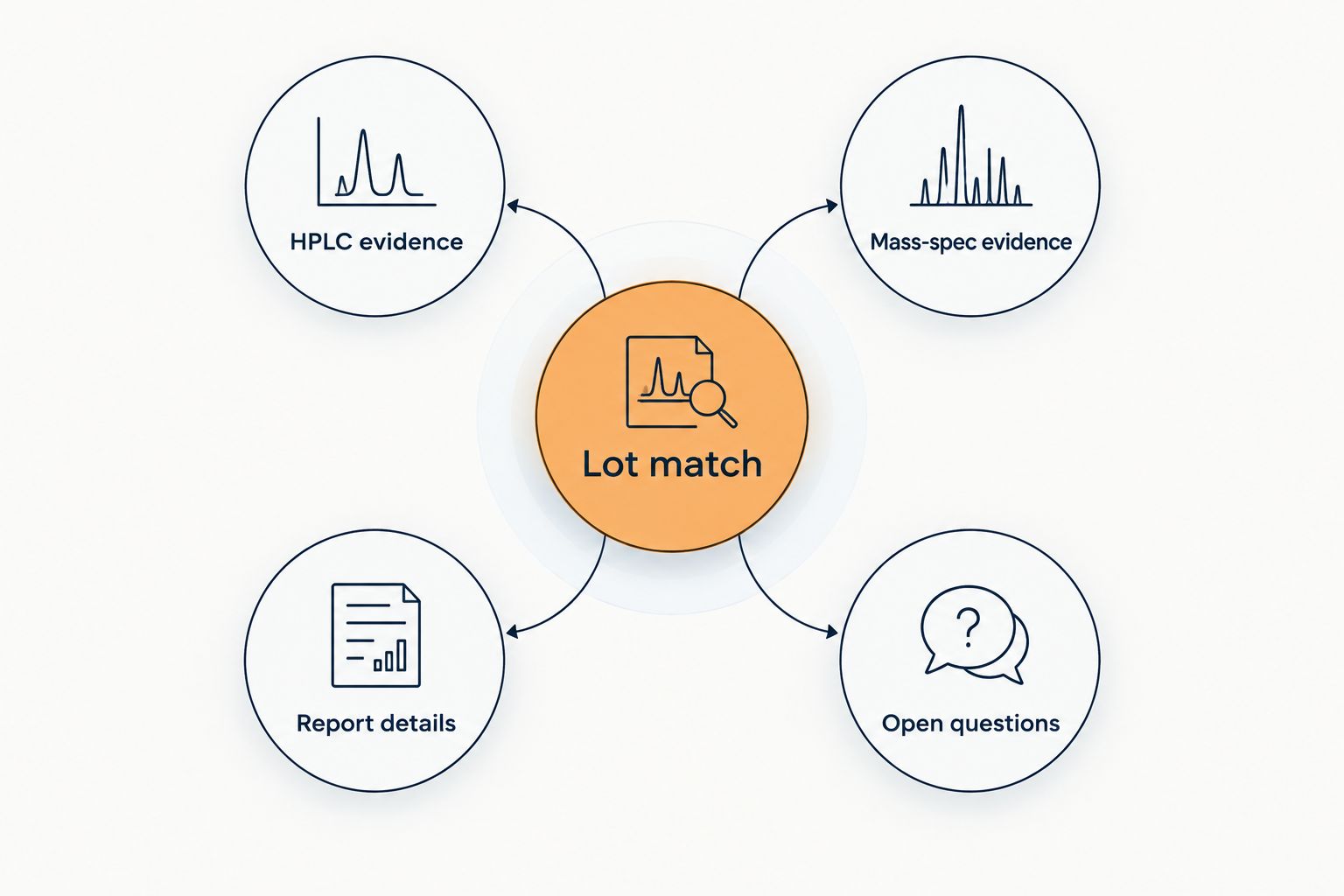
A certificate is not a universal quality guarantee. Read its scope: which sample was analyzed, which methods were used, and which conclusions the reported results support.
What HPLC evidence establishes
High-performance liquid chromatography separates sample components under a defined method. A chromatogram and its reported results help you examine the sample’s chromatographic profile within that method’s scope.
The limitation matters. A chromatographic result alone does not establish molecular identity, peptide content, or suitability for every laboratory application. Avoid turning a single reported result into a broader claim than the method supports.
What mass-spec evidence establishes
Mass spectrometry measures ions by mass-to-charge ratio. Reported mass information can support an identity assessment when interpreted against the expected material and the method used.
Mass-spec evidence is not interchangeable with HPLC evidence. Nor does a matching mass, by itself, establish every structural feature or exclude every possible impurity. Read the methods together without treating either as a substitute for the other.
Why tirzepatide vial comparisons vary
Differences in purchasing specifications can make quotes look comparable when they are not. These are comparison drivers to resolve—not claims about a particular supplier’s charges or commercial policies.
- Declared amount per vial: A container is a packaging unit, not a standardized quantity of peptide. Match the declared material before comparing vial figures.
- Order scope: A single-vial inquiry and a multi-vial inquiry describe different transactions. Compare equivalent quantities without assuming a quantity discount.
- Documentation scope: A product-page statement and a lot-linked analytical report provide different evidence. Record which documents actually support the quote.
- Additional charges: Review whatever charges the supplier explicitly states. Do not assume the vial line item equals the final order total.
- Quote timing: Use dated terms. A saved listing and a current quotation should not silently become interchangeable procurement records.
For your 2026 worksheet, keep these factors visible beside the commercial comparison. Do not compress them into an unexplained supplier score: a clear unresolved issue is more useful than a precise-looking ranking.
Where Strandaminos fits in a laboratory supplier review
Strandaminos is a fit for laboratory researchers who prioritize published HPLC and mass-spec documentation when comparing research peptides. The company sells lyophilized research peptides and publishes third-party certificates of analysis.
Start with Strandaminos when evaluating its research-peptide offering, then inspect the specific product and certificate relevant to your inquiry. A company-level description does not establish the contents, analytical results, or commercial terms of an individual vial.
The useful feature is access to analytical documentation. The limitation is that documentation still requires review: you must connect the report to the intended material and determine whether its methods meet your laboratory’s requirements.
Do not read that fit statement as a claim about a particular tirzepatide presentation. Confirm the exact material and its supporting documents directly. Research use only. Not for human or veterinary use.
How to request a comparable laboratory quote
Send a specification that another supplier could answer without interpreting your intent. Keep it about material identity, declared quantity, documentation, and commercial terms—not personal administration.
- Identify the material. State that the inquiry concerns tirzepatide for laboratory research and identify any required material specification.
- Specify the presentation. Request the declared peptide amount per vial and the number of vials included in the quotation.
- Request the relevant COA. Ask how the certificate connects to the material being quoted and what lot information can be provided.
- Separate the commercial entries. Request the vial line item, any separately stated charges, and the complete order total.
- Record the decision. Save the dated quotation, supporting documents, and the reason the material meets—or fails—your laboratory’s acceptance criteria.
You do not need a complicated scoring system. You need enough detail for a colleague to reconstruct the decision without repeating the entire supplier conversation.
For a 2026 procurement file, preserve the quoted specification alongside the analytical documents. If the material or terms change, keep the revised record distinct rather than overwriting the original comparison.
Is the lowest per-vial figure the best laboratory purchase?
The lowest per-vial figure is not enough to identify the best laboratory purchase. Compare equivalent declared quantities, review the relevant analytical evidence, and apply your laboratory’s acceptance criteria before selecting a supplier.
A quote that leaves material identity or documentation unresolved is not equivalent to one that answers those questions. Resolve the gap rather than assigning it an assumed value.
Does a COA prove how much peptide is in a vial?
A COA proves only what its reported tests support. HPLC reporting and mass-spec identity evidence do not automatically constitute a validated measurement of peptide content.
If your work requires quantitative content information, identify the relevant assay and reporting basis. Do not infer a measurement merely because the certificate contains a chromatogram or mass spectrum.
FAQ
How do I check tirzepatide cost per vial for laboratory research?
Request a current quote for the exact research vial, including its declared peptide amount and order quantity. Compare the vial line item separately from the complete order total, and review the relevant analytical documentation.
Is comparing tirzepatide by vial or by milligram better?
Per-vial comparison is useful for purchase reconciliation; per-mass comparison is useful for comparing declared quantities across presentations. Neither comparison independently establishes identity, content, or suitability for your laboratory application.
What should I check on a tirzepatide research COA?
Check the material description, sample or lot identifier, issuing laboratory, report date, methods, and reported results. Confirm how the document connects to the material you intend to purchase.
Does HPLC testing confirm peptide identity?
An HPLC chromatogram alone does not establish peptide identity. Review identity evidence, such as appropriately interpreted mass-spec results, alongside the chromatographic report.
Does mass spectrometry replace HPLC testing?
Mass spectrometry does not replace HPLC testing because the methods provide different analytical information. Assess each report within its stated scope rather than treating either method as a complete quality assessment.
Can a research peptide certificate establish suitability for human use?
A research peptide certificate does not establish suitability for human or veterinary use. The materials discussed here are for laboratory research only, not administration.
What should I save after comparing laboratory suppliers?
Save the dated quotation, material specification, relevant COA, and your acceptance decision. Keep the source documents connected so another reviewer can trace the purchasing decision.
One last thing
A polished certificate and a matching certificate are not the same thing. Before approving a laboratory purchase, trace the material description and lot identifier from the quotation through the analytical report and receiving record.
That connection rewards careful procurement more than another decimal place in a comparison spreadsheet. Keep the decision anchored to a defined research material, a dated quote, and evidence your laboratory can actually use.


