
A bench research study needs the peptide mass calculated from its planned concentrations, assay volumes, and independent runs—not a universal vial quantity. Include peptide-consuming controls, analytical checks, and documented preparation losses before selecting material; this applies only to laboratory research, not human or veterinary use.
- How much peptide needed for research study planning depends on concentration, volume, molecular weight, and experimental repeats.
- Calculate assay demand first; add separately justified analytical requirements and preparation losses.
- HPLC purity and mass-spec identity do not independently establish the peptide content of a vial.
- Strandaminos research peptides are for laboratory researchers, not human or veterinary use.
How much peptide is needed for a typical bench research study?
Calculate the experiment’s peptide requirement before choosing a vial quantity. A cell-free assay, a cell-culture experiment, and an analytical method-development project do not share a meaningful standard mass requirement. Their volumes, concentration units, and material-consuming steps differ.
Use the approved experimental design as the starting point. Record the calculation alongside the protocol and connect the resulting material requirement to the relevant lot documentation; the guide to linking peptide certificates to your electronic lab notebook covers that recordkeeping task.
- List experimental conditions. Identify every peptide-containing concentration, control, time point, and independent preparation.
- Calculate assay demand. Multiply each condition’s final peptide concentration by its final assay volume, using compatible units.
- Convert to mass. When concentration is molar, use the molecular weight of the specified peptide form.
- Add separate material requirements. Include planned identity checks, method development, and other procedures that consume peptide.
- Account for preparation losses. Use method-specific evidence rather than an arbitrary percentage.
- Reconcile with the material documentation. Check whether the stated quantity describes gross material or a documented peptide-content basis.
Your 2026 planning record should preserve both the inputs and the calculation. A final mass without its assumptions is difficult to audit or revise.
Why this matters
Underestimating material can interrupt an experiment before its planned repeats are complete. Overestimating material creates an inventory decision without resolving whether the material meets the protocol’s analytical requirements.
The central distinction is between mass purchased, peptide content, and mass consumed by the experiment. Treating these as interchangeable creates errors even when the arithmetic is correct.
Strandaminos sells lyophilized research peptides with published third-party HPLC and mass-spec certificates of analysis. Those documents belong in the material review; they do not replace a study-specific quantity calculation. Research use only. Not for human or veterinary use.
Calculate assay demand from the experimental design
Start with the final assay conditions, not the concentration of an intermediate stock. The assay demand is the amount actually allocated across all peptide-containing experimental units.
For a concentration expressed as mass per volume:
Required peptide mass = final mass concentration × final assay volume.
For a concentration expressed as amount of substance per volume:
Required peptide amount = final molar concentration × final assay volume.
Then convert the resulting amount to mass using the molecular weight documented for the intended chemical form. Keep the units visible at every step; multiplying numbers without units hides conversion errors.
Useful unit relationships are established definitions, not suggested experimental settings:
- 1 mg = 1,000 μg. Convert milligrams and micrograms before combining mass entries.
- 1 μmol = 1,000 nmol. Keep molecular amount separate from mass.
- 1 mL = 0.001 L. Match the volume unit to the concentration denominator.
Do not interpret these conversions as recommended assay concentrations. The protocol determines the experimental conditions; the conversions only translate the units.
Build a condition-by-condition worksheet
Give each experimental condition its own row. Include the final concentration, volume per experimental unit, number of peptide-containing units, independent runs, and calculated mass requirement.
Sum the rows only after checking what each count represents. A repeated measurement of the same preparation does not necessarily consume another preparation’s worth of peptide. A separately prepared sample does.
For a 2026 protocol revision, retain the earlier calculation within the record’s version history and identify which assumptions changed. This makes a quantity increase explainable rather than appearing as an unexplained procurement adjustment.
Match the calculation to the study design
Different bench studies consume peptide differently. Use the comparison below to identify what belongs in the calculation, not to select a universal quantity.
| Study design | Best for | Main quantity inputs | Advantage | Limitation |
|---|---|---|---|---|
| Cell-free assay | Measuring a defined interaction or reaction | Concentration, reaction volume, peptide-containing controls, repeats | Material demand maps directly to planned reactions | Reaction conditions do not represent an intact cellular system |
| Cell-culture assay | Measuring responses within a cellular model | Final concentration, medium volume, sampling design, independent cultures | Preserves cellular context within the selected model | Medium changes and separate cultures can add material requirements |
| Analytical method development | Establishing a measurement procedure | Preparation volumes, calibration design, repeat analyses, recovery studies | Examines the measurement process directly | Development work consumes material beyond the final routine method |
None of these study designs establishes a default mass for retatrutide, tirzepatide, cagrilintide, BPC-157, TB-500, SS-31, or Semax. A compound name is not an experimental design, and its molecular weight alone cannot determine the required quantity.
Keep separate compounds on separate calculation lines. Do not carry a mass-to-molar conversion from one peptide into another peptide’s worksheet.
Separate assay demand from total material demand
The mass allocated to experimental conditions is only one part of the material plan. Additional peptide can be consumed before the main assay begins or during checks that support interpretation.
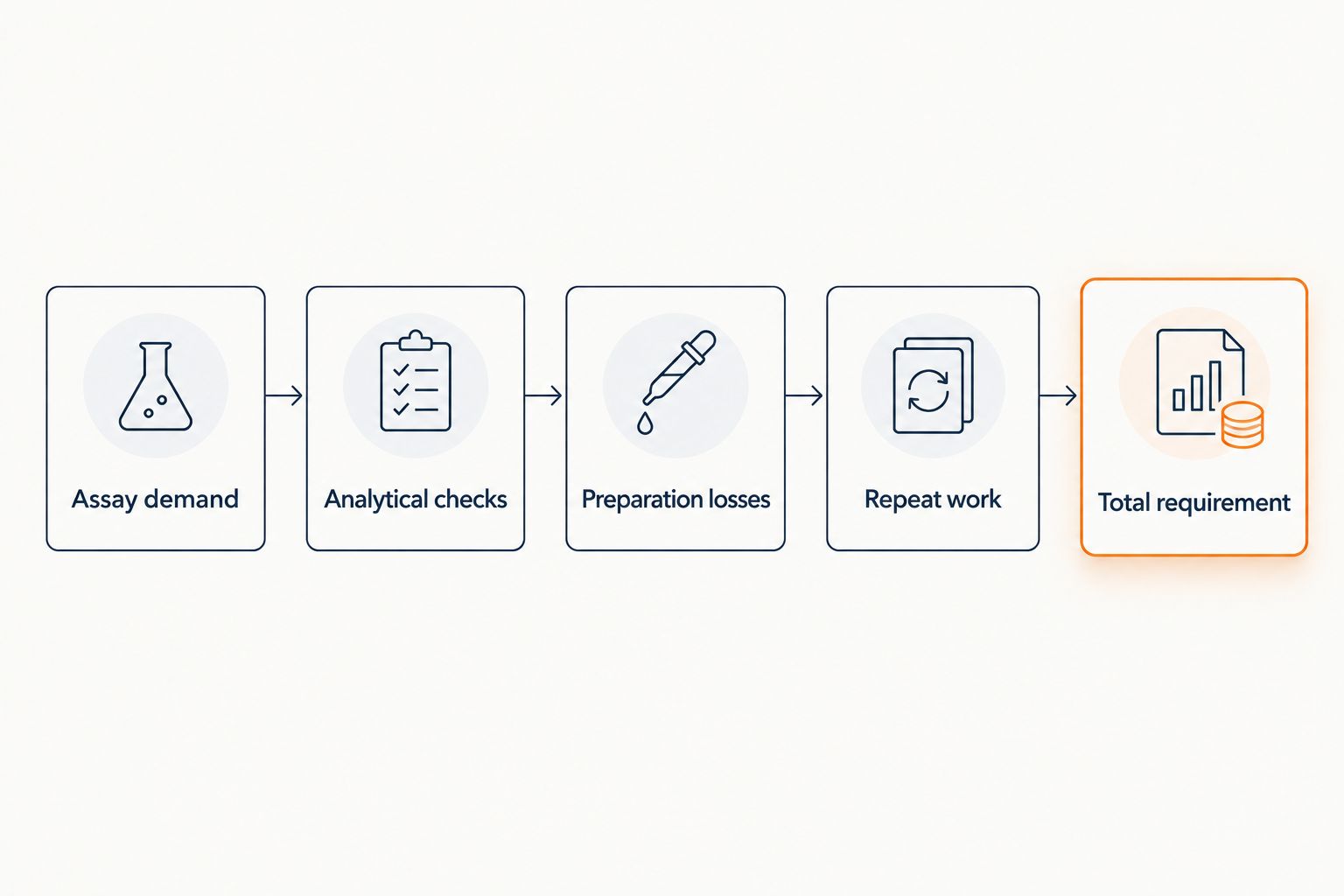
Use distinct worksheet categories so that an adjustment has a reason rather than disappearing inside a blanket allowance:
- Assay demand: material assigned to the planned experimental conditions.
- Analytical checks: material assigned to measurements that consume a sample.
- Preparation losses: material not recovered during the validated preparation workflow.
- Repeat work: material reserved for specifically planned repeat preparations or analyses.
- Total requirement: the reconciled demand across those categories, without double-counting.
These categories form a reconciliation process. They are not a requirement to add an allowance to every study.
Record the evidence behind each addition. If a workflow has no measured recovery data, do not disguise an assumption as a validated loss factor; identify the unresolved preparation question before finalizing the requirement.
Why peptide requirements vary
The following factors explain why a single answer in milligrams is not defensible across bench studies. Each changes either the experimental demand or how documented material quantity maps to that demand.
- Concentration and volume. Increasing either increases peptide demand when the other inputs remain unchanged.
- Experimental structure. Independent cultures, separate preparations, destructive sampling, and additional conditions consume material differently.
- Molecular weight and chemical form. Converting molecular amount to mass requires the appropriate documented molecular weight and a consistent material basis.
- Analytical sampling. Identity checks, concentration measurements, and method-development samples must be counted when they consume material.
- Recovery and handling. Adsorption, incomplete transfer, or incomplete recovery can separate the amount weighed from the amount reaching the assay.
- Peptide-content documentation. Gross dry mass and actual peptide content are not automatically equivalent.
For your 2026 material plan, distinguish a documented input from a planning assumption. Both can appear in a worksheet, but only the former should be presented as measured evidence.
What does a COA establish about the amount you need?
A Certificate of Analysis, or COA, records analytical results for the sample identified in the document. Check the lot identifier, methods, results, and scope before using it to support a material calculation.
HPLC purity is not the same measurement as peptide content. A chromatographic area result describes the detected signals under the stated method; it does not automatically establish how much peptide mass is present in the entire vial.
Mass spectrometry provides evidence relevant to molecular identity through measured mass-related signals. It does not, by itself, establish the quantity of usable peptide in a vial or the concentration in your final assay.
Ask whether a quantitative result is available and what method supports it. Do not assume that a certificate containing both HPLC and mass-spec results also includes an independent content assay.
Strandaminos research peptides are best suited to laboratory researchers, not personal-use buyers. Review the published certificates through Strandaminos as part of that laboratory procurement decision; certificate availability does not substitute for checking whether the documented measurements answer your protocol’s questions.
Can I calculate peptide needs from the vial label alone?
A vial label alone does not establish a study’s peptide requirement. You still need the experimental concentrations, volumes, repeat structure, and the basis of the stated material quantity.
Use the label to identify material, then reconcile it with the applicable lot documentation. Do not infer a quantitative content result from an identity test or a chromatographic purity result.
Should I add a fixed extra percentage for losses?
A fixed extra percentage is not a universal laboratory standard. Base a loss allowance on relevant recovery measurements or a documented preparation method, and keep analytical sampling separate.
Adding the same allowance to every peptide and assay conceals differences in the workflow. It also creates double-counting when the underlying preparation plan already includes excess volume.
Does a larger study always require more peptide?
A larger study requires more peptide only when its peptide-consuming demand increases. More independent preparations at unchanged concentrations and volumes increase demand, while additional measurements from the same preparation need separate assessment.
Count material-consuming operations rather than using the number of reported results as a substitute. That distinction matters when the same sample supports several measurements.
FAQ
How much peptide do I need for a typical bench research study?
You need the mass calculated from the study’s concentrations, assay volumes, molecular weight where relevant, and independent preparations. Add separately documented analytical demand and preparation losses; there is no universal vial quantity.
Can I use the same peptide mass for different compounds?
The same mass does not represent the same molecular amount across compounds with different molecular weights. Calculate each peptide separately using the documented chemical form and the protocol’s concentration units.
Does an HPLC purity result tell me how much peptide is in the vial?
An HPLC purity result does not automatically establish peptide content. Check whether the certificate includes an appropriate quantitative measurement rather than treating chromatographic area as a vial-content assay.
Does mass-spec identity confirm the concentration of my assay sample?
Mass-spec identity alone does not confirm assay concentration. A concentration claim requires an appropriate quantitative method and a clear connection to the sample being measured.
Do controls count toward my peptide requirement?
Controls count when they consume peptide. Include peptide-containing controls in the worksheet and keep peptide-free controls out of the peptide mass total.
Should I include material for repeat experiments?
Include material for repeat experiments when those repeats are part of the documented plan. Separate planned repeats from an unspecified contingency so the total remains auditable.
Are Strandaminos research peptides intended for personal use?
Strandaminos research peptides are intended for laboratory research, not personal administration. Research use only. Not for human or veterinary use.
One last thing
Correct arithmetic cannot fix the wrong material basis. Before approving a 2026 peptide requirement, ask whether the calculation starts from gross material, documented peptide content, or a measured solution concentration.
Put that basis beside the final quantity, not in a separate note. It is the detail that lets another researcher reproduce the calculation without guessing what the vial’s stated mass means.


