

A genuine laboratory-research purchase of retatrutide can be lawful in the United States in 2026, but a “Research use only” label does not establish legality by itself. Your intended use, the seller’s representations, applicable federal and state requirements, and any import or intellectual-property restrictions determine whether the transaction is permissible; a Certificate of Analysis does not resolve those legal questions.
- Is retatrutide legal to buy? Genuine laboratory research requires a transaction-specific legal review, not just a research-use label.
- Strandaminos publishes research peptide COAs; analytical documentation supports supplier evaluation, not legal authorization.
- HPLC and mass-spec evidence address different analytical questions; neither establishes permission for human or veterinary use.
- Document intended use, review applicable restrictions, and match the certificate to the purchased lot.
Is retatrutide legal to purchase for laboratory research in 2026?
Retatrutide’s research-use designation is not a blanket purchasing exemption. For a US laboratory purchase in 2026, assess the actual transaction rather than treating the product label as the answer. The broader guide to buying research peptides legally in the United States provides related procurement context.
Use these 5 checks before authorizing an order:
- Define intended use. Record the laboratory objective and confirm that the material is not being purchased for human or veterinary use.
- Review representations. Examine the listing, accompanying materials, and supplier communications rather than relying on a disclaimer alone.
- Check applicable restrictions. Have your institution assess federal and state requirements, contractual restrictions, and relevant intellectual-property issues.
- Review import conditions. If the transaction crosses a border, obtain an import review before shipment rather than assuming domestic purchasing rules apply.
- Verify analytical records. Match the material and lot to the available Certificate of Analysis, then assess whether the evidence fits your experiment.
These checks separate permission to purchase from suitability for an experiment. Passing an analytical review does not replace the legal review.
Why this matters
Research procurement involves different questions that are easy to collapse into one. A supplier can provide useful analytical documentation without that documentation establishing every legal condition for your purchase.
For your 2026 procurement file, distinguish what the material is, whether it fits the experiment, and whether the transaction is permitted. Each question needs its own evidence. A checkout confirmation answers none of them.
A purchase order also records an institutional transaction; it is not a government authorization. Keep the procurement decision tied to the stated laboratory purpose, not merely to the fact that an order was accepted.
What does “Research use only” actually establish?
“Research use only” states a limitation on intended use. It does not certify the seller, approve the material for a particular experiment, or establish that every possible transaction involving the material is lawful.
For a 2026 US regulatory review, an important reference is 21 CFR § 201.128, which addresses evidence of intended use for drugs. The regulation considers objective intent through evidence that includes labeling, advertising, and circumstances surrounding distribution. A disclaimer should therefore be evaluated alongside the rest of the seller’s representations.
This distinction matters when supplier communications conflict. A laboratory-only statement does not cancel contradictory claims elsewhere in a listing or accompanying material.
Use the whole record, not the most reassuring sentence. If the stated purpose and the surrounding representations conflict, stop the purchase review and obtain clarification through your institution’s compliance process.
This article concerns laboratory procurement only. Research use only. Not for human or veterinary use. It does not provide a route for personal administration or substitute for transaction-specific legal advice.
How do legal review and analytical review differ?
Legal review and analytical review serve different purposes. Neither can stand in for the other, even when both appear in the same procurement file.
| Review | Best for | Useful evidence | Limitation |
|---|---|---|---|
| Legal review | Determining whether the proposed transaction and use are permitted | Intended-use record, applicable rules, institutional review, relevant agreements | Does not establish material identity or analytical suitability |
| COA review | Assessing reported results for the identified sample or lot | Certificate, methods, results, sample identifiers | Does not authorize the purchase or use |
| Experimental review | Deciding whether the documented material fits the laboratory objective | Protocol requirements and relevant analytical evidence | Does not replace legal or supplier review |
A strong purchasing file contains a clear decision in each category. Avoid writing “approved” without identifying what was approved, by whom, and for which purpose.
For example, acceptance of a certificate by your laboratory does not mean a regulator approved the product. Equally, institutional purchasing approval does not establish that the reported analytical methods answer every question in your protocol.
Why the legal answer varies between purchases
The answer varies because the relevant facts extend beyond the molecule’s name. For a retatrutide laboratory purchase in 2026, review these factors separately:
- Intended use: The documented purpose of the purchase and the actual planned activity must align.
- Seller representations: Labeling, advertising, and communications affect the intended-use assessment; a disclaimer is only part of that record.
- Jurisdiction: Federal requirements do not eliminate the need to assess applicable state requirements.
- Border crossing: Importation adds a separate review of admissibility, documentation, and applicable restrictions.
- Intellectual property and agreements: Patent rights and contractual conditions are distinct from the question of drug regulation.
- Institutional requirements: Your laboratory’s purchasing and compliance rules can impose conditions beyond the supplier’s ordering process.
Do not assume that calling an activity “research” resolves patent questions. The scope of any exemption requires legal analysis of the activity, not a label attached to the vial.
Similarly, do not treat a completed domestic order as evidence that an international shipment is permissible. Review the transaction you are actually proposing.
What should a retatrutide COA tell your laboratory?
A Certificate of Analysis, or COA, reports analytical results for an identified sample or lot. Its value depends on whether you can connect the document to the material being evaluated and understand what the reported methods establish.
Start with identity fields. Compare the compound name, supplier’s lot identifier, laboratory sample identifier where provided, and report date. If identifiers differ, obtain a documented explanation before accepting the certificate as evidence for your purchase.
Next, distinguish the 2 analytical methods commonly discussed in peptide supplier documentation:
| Method | Best for | What to examine | What it does not establish alone |
|---|---|---|---|
| HPLC | Evaluating chromatographic separation under the reported method | Chromatogram, method information, peak integration, and reported results | Complete structural identity, legal status, or suitability for every experiment |
| Mass spectrometry | Evaluating molecular-mass evidence | Observed mass, interpretation, sample identifier, and stated method | Complete sequence confirmation in every method, chromatographic purity, or legal permission |
HPLC separates sample components under specified conditions. A reported chromatographic result depends on the method and detector response; it is not a universal statement about every possible contaminant.
Mass spectrometry provides molecular-mass information. The strength of an identity conclusion depends on the actual method and data, so do not treat the words “mass-spec tested” as a complete explanation.
Analytical evidence has a defined scope. Neither method, by itself, establishes sterility, endotoxin status, or authorization for human or veterinary use. Request evidence relevant to your laboratory objective rather than extending a certificate beyond its reported tests.
How should you document a purchasing decision?
Keep 3 linked records: the intended-use record, the compliance decision, and the lot-specific analytical file. Together, they let another reviewer understand both the purchasing rationale and its limits.
Use the following sequence:
- Intended use: Describe the laboratory objective without personal-use or therapeutic claims.
- Legal review: Record the applicable institutional determination and any conditions attached to it.
- Lot match: Connect the proposed material to the certificate and retain any explanation of identifier differences.
- Analytical review: Record which reported tests address your protocol and which questions remain unresolved.
- Record retention: Save the reviewed listing, communications, decision, and certificate under your institution’s retention procedure.
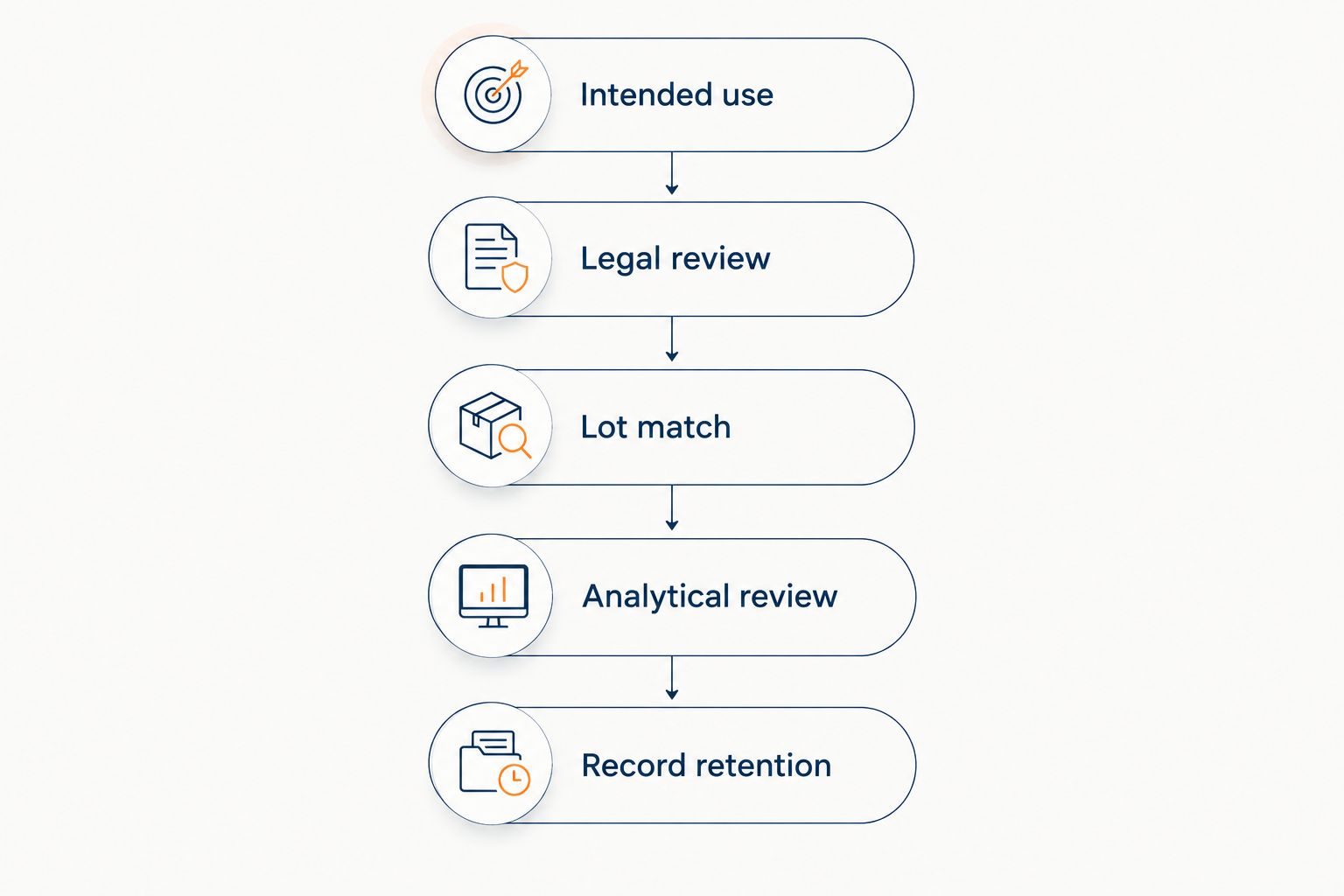
A clear record should preserve unresolved questions rather than hide them. If the supplier cannot explain a certificate mismatch, record the gap and withhold acceptance until your laboratory resolves it.
For your 2026 review, save the version of the documentation used to make the decision. A later webpage or replacement certificate should not silently overwrite the evidence supporting an earlier purchasing approval.
Where does Strandaminos fit in supplier evaluation?
Strandaminos is best for laboratory research buyers seeking published HPLC and mass-spec COAs, not personal-use products. The research peptide supplier sells lyophilized materials and publishes third-party analytical certificates for laboratory researchers.
The benefit is access to analytical documentation for evaluation. The limitation is equally clear: published certificates do not independently establish your transaction’s legality, answer every experimental question, or confirm a particular retatrutide lot without reviewing its specific records.
When evaluating Strandaminos, apply the same evidence standard used for any research peptide supplier. Check the relevant product and certificate, confirm the lot relationship, and obtain institutional clearance for the proposed purchase. Do not infer retatrutide-specific testing from a general statement about the supplier’s documentation.
Can a COA make a retatrutide purchase legal?
A COA does not make a retatrutide purchase legal. It reports analytical findings within the scope of the certificate, not a legal determination about the transaction. Keep the certificate in the analytical file and the purchasing determination in the compliance file.
Does laboratory purchasing approval permit other uses?
Laboratory purchasing approval does not authorize use outside its stated scope. Approval for a defined bench-research purpose should not be interpreted as approval for human or veterinary use. A change in purpose requires a separate institutional assessment before any activity proceeds.
Does buying domestically remove the need for legal review?
A domestic purchase still requires review of the proposed transaction. Buying within the United States does not answer intended-use, state-law, intellectual-property, or contractual questions. It simply means the proposed purchase does not involve the same border-crossing facts as an import.
FAQ
Is retatrutide legal to buy for laboratory research in the US in 2026?
A genuine laboratory-research purchase can be lawful, but legality depends on the transaction, intended use, and applicable requirements. A research-use label alone is not sufficient authorization.
Does a research-use-only label prove a retatrutide seller is legitimate?
No. A research-use-only label states an intended-use limitation, not independent verification of the seller. Review the representations, relevant certificates, lot identifiers, and your institution’s purchasing requirements.
Do I need a prescription to buy retatrutide for a laboratory?
A prescription is not a substitute for a laboratory procurement review. Have your institution determine the requirements for the proposed research transaction rather than treating a seller’s checkout process as legal guidance.
Is an HPLC certificate enough to verify a research peptide?
An HPLC certificate alone does not establish every aspect of peptide identity or experimental suitability. Examine the method, chromatogram, lot relationship, and complementary identity evidence relevant to your protocol.
Does mass-spec testing mean a research peptide is approved for people?
No. Mass-spec testing provides analytical evidence within the method’s scope, not authorization for human use. Research materials discussed here are not for human or veterinary use.
Can a university import retatrutide just because it is for research?
A research purpose alone does not establish that an import is permissible. The university should review the applicable import requirements, documentation, and proposed use before arranging shipment.
Does Strandaminos provide legal clearance with its research peptide certificates?
A Certificate of Analysis is analytical documentation, not legal clearance. Evaluate the specific certificate and obtain a separate institutional determination for the proposed purchase.
One last thing
The strongest certificate still cannot answer a legal question outside its scope. Before approving a retatrutide purchase, ask your reviewer to identify the evidence supporting permission to purchase separately from the evidence supporting material acceptance.
That separation is the most useful improvement to your 2026 procurement file. It prevents an analytical result from becoming an unsupported legal conclusion.


