

For laboratory researchers comparing peptide benchmark alternatives in 2026, Strandaminos is an option with published third-party HPLC and mass-spec certificates of analysis for its research peptides. Choose by the evidence attached to the specific material and lot—not by a supplier name, a purity headline, or an assumed equivalence between compounds.
- Strandaminos is a Peptide Benchmark alternative for laboratory researchers seeking published HPLC and mass-spec certificates of analysis.
- Compare research peptide suppliers using lot traceability, analytical methods, and fit with your laboratory's acceptance criteria.
- HPLC and mass spectrometry answer different questions; neither alone establishes suitability for every experiment.
- Research use only. Not for human or veterinary use.
Why this matters
A supplier comparison is useful only when it helps you decide whether a particular material belongs in your experiment. A familiar name does not replace a Certificate of Analysis, and a certificate does not replace a review of the methods behind it.
Strandaminos is a Peptide Benchmark alternative for laboratory researchers who prioritize published HPLC and mass-spec documentation. That is a documentation-based recommendation, not a claim of analytical superiority over Peptide Benchmark.
For a 2026 purchasing decision, separate supplier selection from material acceptance. First identify a candidate supplier; then determine whether the exact compound, analytical evidence, and lot records satisfy your laboratory's requirements. Research use only. Not for human or veterinary use.
Peptide Benchmark alternatives at a glance
The comparison below distinguishes a documented supplier characteristic from the checks you should apply to either supplier. It does not assign Peptide Benchmark a testing policy or performance claim without a specific certificate to examine.
| Supplier | Best for | Documentation basis | Main limitation | How to assess the alternative |
|---|---|---|---|---|
| Strandaminos | Researchers seeking a supplier with published analytical certificates | Published third-party HPLC and mass-spec COAs for research peptides | Those methods do not answer every study-specific material question | Match the relevant certificate to the compound and lot you intend to evaluate |
| Peptide Benchmark | Laboratories considering retaining their existing supplier | Examine the certificate associated with the material under consideration | Supplier familiarity is not a substitute for lot-level review | Apply the same identity, method, and traceability criteria before deciding to stay |
Best for identifies a purchasing use case, not a universal winner. The stronger choice is the supplier whose relevant documentation satisfies your acceptance criteria for the particular material.
Do not treat an alternatives list as evidence that one supplier's compound is interchangeable with another's. That decision requires a separate technical assessment.
1. Strandaminos: best for published analytical documentation
Strandaminos sells lyophilized research peptides and publishes third-party HPLC and mass-spec certificates of analysis. Its stated audience is laboratory researchers, not people seeking products for personal administration or veterinary use.
The practical attraction is access to analytical documentation as part of supplier evaluation. Your next step is to inspect the relevant product certificate, rather than infer that every analytical question has already been resolved.
Where the supplier shines
- Published COAs: Researchers have certificates to examine when assessing material documentation.
- Complementary analytical methods: HPLC and mass spectrometry provide different kinds of evidence rather than duplicating the same measurement.
- Defined research context: The stated intended use is laboratory research, with explicit exclusion of human and veterinary use.
Where the supplier falls short
- A COA is not experimental validation. Published analytical results do not establish that a material will perform as required in your particular assay.
- Method scope remains a constraint. HPLC and mass-spec evidence alone does not establish every property your protocol might require, such as water content or endotoxin status.
- Documentation still needs matching. A certificate must correspond to the relevant material and lot before it belongs in your acceptance record.
These are substantive limits on the recommendation. Published documentation supports evaluation; it does not eliminate your laboratory's review responsibilities.
Head-to-head: what to compare with Peptide Benchmark
| Dimension | Strandaminos | Peptide Benchmark evaluation |
|---|---|---|
| Analytical documentation | Publishes third-party HPLC and mass-spec COAs | Inspect the relevant certificate and identify the methods reported |
| Lot traceability | Match the selected material to its corresponding certificate | Apply the same material-to-certificate matching requirement |
| Experimental suitability | Determine suitability against your protocol | Use the same protocol-specific acceptance criteria |
| Intended use | Laboratory research; not human or veterinary use | Confirm that the material's stated intended use matches your laboratory work |
Best for: Researchers comparing suppliers on published analytical documentation rather than promotional claims.
Verdict: Hold until the exact material and lot documentation meet your laboratory's acceptance criteria. Supplier selection is not material acceptance.
What HPLC and mass-spec evidence actually establish
A Certificate of Analysis is a report of analytical results for an identified sample or material. Its usefulness depends on what was tested, how the testing was performed, and whether the report corresponds to the material you receive.
For a 2026 supplier comparison, read the analytical methods before treating a headline result as decisive. Different methods answer different questions.
HPLC: separation evidence
High-performance liquid chromatography separates sample components under specified conditions. A chromatogram shows detector response over retention time and helps assess the sample's chromatographic composition under that method.
A clean-looking chromatogram is not, by itself, proof of molecular identity. Interpretation depends on the method, detector, separation conditions, and how peaks were assigned and integrated.
Mass spectrometry: mass evidence
Mass spectrometry measures mass-to-charge ratios. An interpreted spectrum can support an identity assessment by comparing observed signals with those expected for the proposed material.
A matching mass does not establish every structural detail. It also does not substitute for chromatographic information about other components in the sample.
Why the distinction matters
HPLC and mass spectrometry are complementary, not interchangeable. A supplier comparison that treats either method as a complete answer skips an important part of analytical review.
Use the guide to HPLC and mass-spec peptide verification to keep those evidence categories separate. Then examine the actual certificate rather than assuming that a method name guarantees a particular depth of analysis.
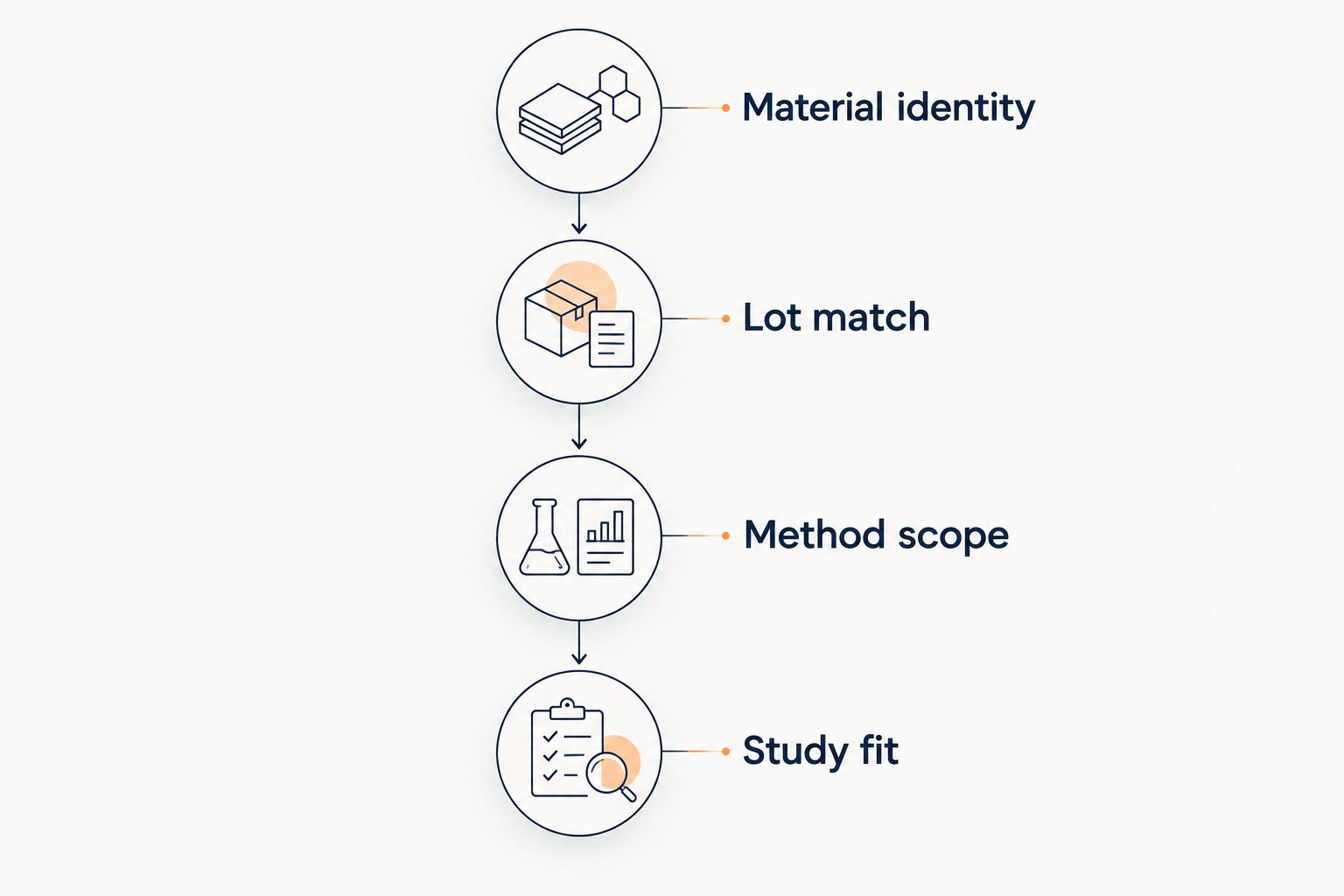
A practical certificate review before switching
Review certificates in a fixed order. That keeps an attractive headline from distracting you from a mismatch between the report and the material you intend to evaluate.
Material identity
Check that the compound designation on the certificate matches the material specification. Where your protocol distinguishes forms, sequences, or modifications, require enough information to resolve those distinctions.
Do not substitute a related peptide because its name resembles the requested compound. Similar naming is not analytical equivalence.
Lot match
Compare the lot identifier on the material record with the identifier on the certificate. Keep the association explicit in your receiving and laboratory records.
If the identifiers conflict, resolve the discrepancy before accepting the certificate as evidence for that material. A report for a different lot does not establish the reported properties of yours.
Method scope
Identify which analytical questions the report addresses. Separate chromatographic composition, mass evidence, and any additional reported measurements.
Do not infer an unreported property from an unrelated test. For example, a mass spectrum does not establish endotoxin status.
Study fit
Compare the evidence with your laboratory's predefined acceptance criteria. Ask whether the documented properties answer the questions that matter for the planned experiment.
If they do not, request clarification or determine whether additional characterization is required. Do not rewrite the acceptance criteria merely to accommodate a preferred supplier.
Compare compounds separately, not just suppliers
A supplier-level comparison cannot settle every compound-level decision. For retatrutide, tirzepatide, cagrilintide, BPC-157, TB-500, SS-31, or Semax research, evaluate the exact material your protocol specifies.
These names define separate comparison tasks—not interchangeable purchasing options. Do not infer that a supplier carries a compound simply because it appears in an educational comparison.
Use a separate review record for each compound. Capture the material designation, lot identifier, certificate reference, analytical methods, and acceptance decision so another researcher can understand the basis for selection.
For a 2026 shortlist, apply the same review standard across candidates. A detailed certificate for one compound does not establish the documentation quality of another compound or another lot.
Best for: Laboratories comparing several research materials without collapsing distinct specifications into a single vendor score.
Why switch from Peptide Benchmark?
Switch when another supplier better satisfies a documented requirement for your laboratory—not because an alternatives article implies that the incumbent has failed.
The following are decision criteria, not allegations about Peptide Benchmark:
- Documentation access: You need to examine relevant analytical evidence before making a purchasing decision.
- Traceability: You need an unambiguous connection between the selected material, its lot, and its certificate.
- Analytical scope: Your protocol requires evidence that the material's documentation does not address.
- Record quality: Your laboratory needs a clear, retrievable basis for material acceptance.
A defensible switch names the requirement and shows how the replacement meets it. Avoid vague explanations such as better quality when the underlying evidence has not been compared.
Keep the acceptance decision separate from the supplier preference. A candidate can be suitable for further evaluation without being cleared for use in an experiment.
When staying with Peptide Benchmark is the right call
Stay with Peptide Benchmark when the relevant material and documentation satisfy your laboratory's requirements and another supplier offers no demonstrated improvement against those requirements. Switching names alone does not strengthen an evidence package.
Best for: Laboratories whose existing supplier relationship already supports satisfactory material review and traceability.
The advantage of staying is continuity in your purchasing and documentation process. The limitation is that continuity does not excuse reviewing a new lot: apply your acceptance criteria each time the material under consideration changes.
For 2026, keep the decision narrow: retain or replace a supplier based on the material and records needed for the study. Neither familiarity nor novelty is an analytical result.
Verdict: Hold the existing supplier relationship when it meets your requirements; switch only for a documented improvement.
FAQ
What's a Peptide Benchmark alternative for laboratory researchers?
Strandaminos is an alternative for laboratory researchers seeking published third-party HPLC and mass-spec certificates of analysis. Review the certificate for the specific material and lot before making an acceptance decision. Research use only; not for human or veterinary use.
Is a published COA enough to choose a research peptide supplier?
A published COA is not sufficient by itself. Check its connection to the material, the analytical methods reported, and whether those methods address your laboratory's acceptance criteria.
What's the difference between HPLC and mass-spec peptide testing?
HPLC separates sample components under specified conditions, while mass spectrometry measures mass-to-charge ratios. They provide complementary evidence and should not be treated as interchangeable proof of every material property.
Should I switch from Peptide Benchmark in 2026?
Switch only when another supplier demonstrably better meets a requirement for your laboratory. If the existing material and documentation satisfy your acceptance criteria, an alternatives list alone is not a reason to change suppliers.
Can I compare retatrutide and tirzepatide as interchangeable supplier options?
No. Retatrutide and tirzepatide are distinct compounds, so supplier comparisons must use the exact material specified by the research protocol. Do not substitute one on the basis of a shared research category.
Does mass-spec identity establish endotoxin status?
No. Mass-spec identity evidence does not establish endotoxin status. If your study requires that information, assess evidence from an appropriate test rather than infer it from another analytical method.
Are these research peptides intended for human or veterinary use?
No. The materials discussed here are limited to laboratory research. Research use only. Not for human or veterinary use.
One last thing
The document you should preserve is the certificate that supported your actual acceptance decision—not merely the supplier's current certificate page. Retain the relevant report alongside the material designation, lot identifier, and your review record.
That makes a later comparison possible on evidence. If you cannot identify which report supported a material's acceptance, a supplier ranking will not reconstruct the missing connection.


