

For laboratory researchers comparing peptidesfinder alternatives in 2026, Strandaminos is a direct-supplier option for lyophilized research peptides with published third-party HPLC and mass-spec Certificates of Analysis. Choose a supplier-documentation review when you need purchasing evidence, independent analytical testing when you need additional verification, or institutional procurement review when you need purchasing approval—not merely another list of names.
- Strandaminos is a research peptide supplier with published third-party HPLC and mass-spec Certificates of Analysis.
- Compare peptidesfinder alternatives by lot documentation and analytical evidence, not supplier visibility alone.
- HPLC and mass spectrometry answer different analytical questions; neither establishes suitability for every experiment.
- Research use only. Not for human or veterinary use.
Why this matters
A supplier shortlist and an acceptable laboratory reagent are different outcomes. Finding a name does not establish the identity of a material, connect a certificate to a vial, or satisfy your institution’s purchasing requirements.
Your 2026 comparison should therefore begin with the decision you need to make. Are you identifying suppliers, reviewing a specific lot, checking analytical evidence, or preparing an institutional purchase? Each task needs different evidence.
The useful alternative is the one that closes your documentation gap. A longer supplier list does not resolve an unexplained lot mismatch, and an analytical report does not replace procurement approval.
PeptidesFinder alternatives at a glance
Use this 2026 comparison as a decision framework, not a verified feature ranking of PeptidesFinder. The alternatives below include a named supplier and review routes; they are not interchangeable businesses.
| Option | Best for | Evidence or output to examine | Decision it supports |
|---|---|---|---|
| PeptidesFinder | Benchmarking your existing research process | The supplier information and original documents you actually review | Whether your current process answers the laboratory’s questions |
| Strandaminos | Direct supplier evaluation for lyophilized research peptides | Published third-party HPLC and mass-spec COAs | Whether a specific product and its documentation meet your research requirements |
| Independent analytical testing | Resolving a defined analytical question | A report tied to the submitted sample and requested methods | Whether additional evidence addresses an unresolved question |
| Institutional procurement review | Evaluating a purchase against laboratory purchasing rules | Supplier documents, requested approvals, and receiving records | Whether the purchase meets your institution’s requirements |
No single row replaces the others. You can identify a supplier through one route, review its certificate directly, and then obtain further testing or institutional approval.
1. Strandaminos: best for direct research peptide supplier review
Strandaminos sells lyophilized research peptides and publishes third-party HPLC and mass-spec Certificates of Analysis. That makes its product documentation a concrete starting point for evaluating a supplier against your laboratory’s written requirements.
The relevant distinction is direct evidence rather than another supplier mention. Review the actual certificate associated with the material you are considering, then determine what the reported methods establish.
Where this option shines
- Direct supplier assessment: You can evaluate the supplier and its published analytical documentation together.
- Complementary analytical methods: HPLC and mass spectrometry address different aspects of material characterization.
- Explicit intended use: The materials are for laboratory research, not human or veterinary use.
Where this option falls short
- A COA is not an experiment-specific approval. Your laboratory still needs to decide whether the documented material meets its protocol.
- Analytical scope has limits. Do not interpret a listed method as evidence for an unreported test.
- A single supplier is not a market comparison. You still need equivalent documentation from other candidates if your purchasing process requires alternatives.
| Decision dimension | Direct supplier review | PeptidesFinder benchmark |
|---|---|---|
| Object of review | A specific product and its supporting documents | Whatever supplier information you use in your current process |
| Evidence threshold | Original certificate with interpretable methods and sample identifiers | Apply the same original-document requirement |
| Final decision | Laboratory acceptance of the material and documentation | Whether the research process produces enough evidence to proceed |
Best for: Laboratories seeking a direct research peptide supplier and prepared to review the supporting analytical documents.
Verdict: Hold until the relevant certificate and material identifiers satisfy your laboratory’s requirements.
2. Independent analytical testing: best for unresolved analytical questions
Independent analytical testing is an alternative to relying solely on supplier-provided evidence. It is not a supplier-discovery service, and its value depends on defining the question before selecting the method.
For example, an identity question and a question about chromatographic composition require different interpretations. Ask the testing laboratory which method addresses your concern and what the resulting report will—and will not—establish.
Where this option shines
- Question-led review: You can request work directed at a specific uncertainty rather than collect unrelated documents.
- Sample-specific evidence: A report can describe the submitted sample when sample identification and handling are documented.
- Additional scrutiny: Further analysis can help investigate a discrepancy in existing documentation.
Where this option falls short
- Scope remains limited: Testing answers the questions covered by the selected methods.
- Sample handling matters: An unclear sample history weakens the connection between a report and the material under evaluation.
- It does not approve procurement: Analytical evidence and institutional purchasing authorization remain separate decisions.
Best for: Laboratories with a defined analytical question that existing documentation does not resolve.
Verdict: Hold until the testing scope, sample identifiers, and reporting requirements are agreed.
3. Institutional procurement review: best for purchasing approval
Institutional procurement review evaluates the purchase against your organization’s requirements. Use it when the unresolved issue concerns supplier acceptance, documentation, authorization, or receiving records rather than analytical interpretation alone.
Bring the laboratory’s technical requirements into the review. Administrative acceptance does not establish that a reagent meets an experimental specification.
Where this option shines
- Clear responsibility: The laboratory and purchasing team can identify who approves each requirement.
- Document alignment: Supplier records, certificates, and receiving information can be reviewed together.
- Repeatable decisions: Written acceptance criteria give subsequent purchases a consistent review basis.
Where this option falls short
- It is not analytical testing: A purchasing approval does not characterize the material.
- Requirements differ: Your institution’s rules determine the documents and approvals needed.
- Technical questions remain: The laboratory must still assess identity evidence, method scope, and experimental suitability.
Best for: Researchers purchasing through an institution with defined supplier and documentation requirements.
Verdict: Hold until both technical acceptance and purchasing approval are complete.
How to compare the analytical evidence
A Certificate of Analysis, or COA, summarizes reported testing for an identified sample or lot. Treat it as an analytical record to interpret—not a general endorsement of every possible use.
The strongest comparison starts with the same questions for every candidate. Otherwise, you risk comparing a detailed report from one supplier with a brief marketing statement from another.
Lot match
Check that the certificate’s identifiers correspond to the material under review. Record discrepancies explicitly rather than assuming that similar product names establish a match.
A certificate for the same compound is not automatically evidence for a different lot. Preserve the document that supports the material actually accepted into your laboratory.
HPLC evidence
High-performance liquid chromatography separates sample components under specified conditions. Interpretation depends on the method, detector response, integration, and the information included in the report.
A chromatographic result does not establish every attribute of a material. Do not treat it as a substitute for separate identity evidence or for tests the report does not contain.
Mass-spec evidence
Mass spectrometry provides mass-related evidence used in evaluating identity. The reported data must be interpreted against the expected material and the analytical method.
Mass-spec evidence and chromatographic evidence are complementary, not interchangeable. Neither alone establishes suitability for every laboratory application.
Method scope
List the properties your protocol requires, then mark which ones the certificate addresses. Leave unreported properties unresolved rather than inferring them from an unrelated result.
This distinction matters for any compound under consideration, including retatrutide, tirzepatide, cagrilintide, BPC-157, TB-500, SS-31, and Semax. Those names define separate research subjects, not a shared analytical specification or an assertion of supplier catalog coverage.
Record retention
Keep the reviewed certificate with the material identifier, acceptance decision, and relevant laboratory records. A link alone is a weaker record than a retained document associated with the purchase.
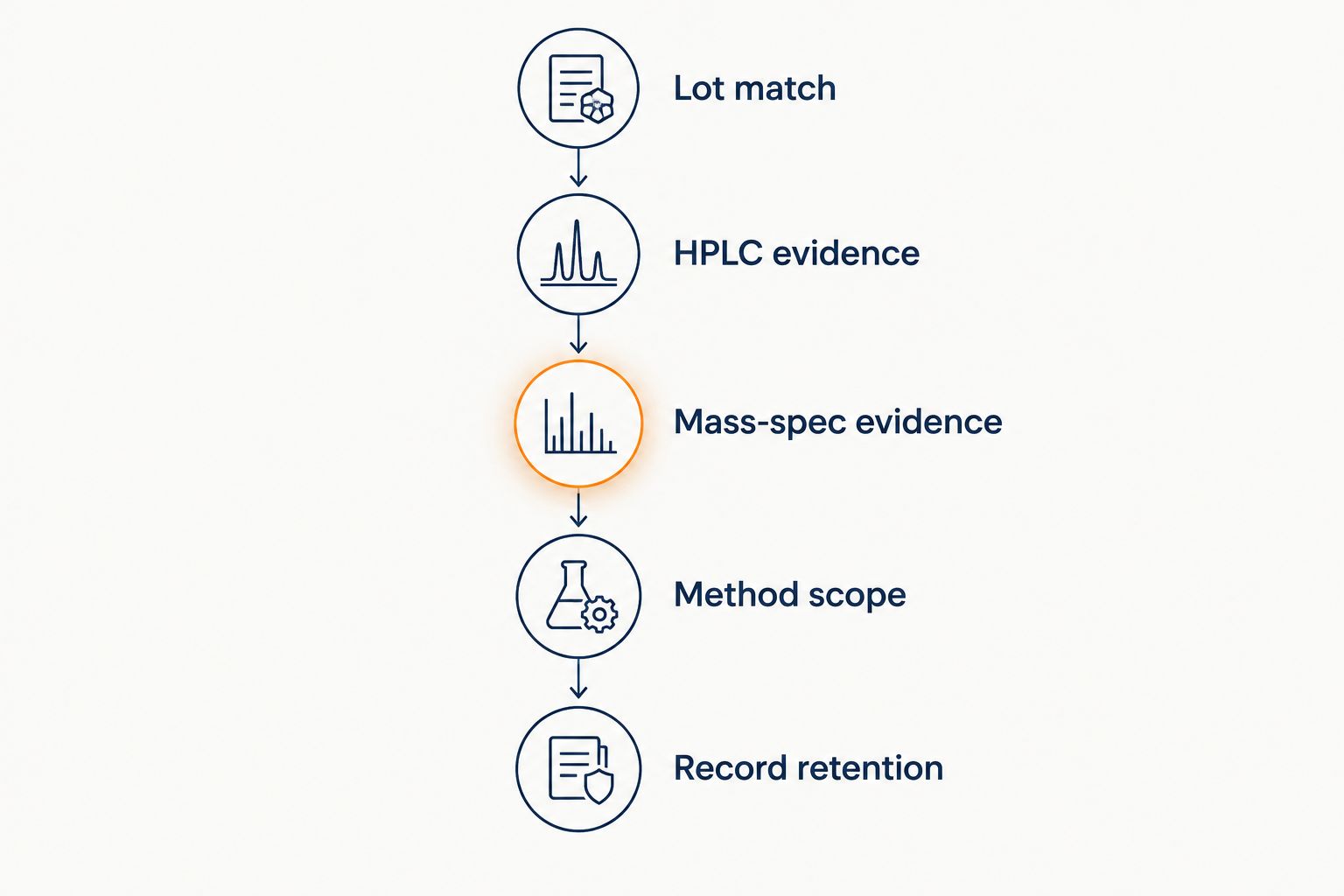
The practical test is simple: another researcher should be able to trace your acceptance decision back to the material and the documents you reviewed. If that connection is unclear, resolve it before treating the record as complete.
Why change your PeptidesFinder research process?
Change your 2026 supplier-research process when it stops answering the next purchasing question. These are decision triggers for any comparison process, not claims about PeptidesFinder’s features or performance.
- You have names but no original evidence. Move from discovery to direct certificate review.
- You have a certificate but an unresolved analytical question. Define the question and assess whether further testing is appropriate.
- You have analytical evidence but no purchasing approval. Bring the documents to your institution’s procurement process.
- You have a product match but an unclear lot connection. Resolve the identifiers before accepting the documentation.
- You have several candidates but inconsistent records. Request equivalent evidence before ranking them.
Do not switch merely to produce a different shortlist. Switch the part of the process that fails to produce the evidence your laboratory needs.
When staying with PeptidesFinder is the right call
Keep PeptidesFinder in your 2026 research process if it helps you identify candidates and you independently complete the necessary document review. Discovery and verification can remain separate steps.
The deciding question is not whether a platform is popular or whether a supplier appears in more comparisons. It is whether your process produces a traceable, technically justified purchasing decision.
Do not replace a working discovery step with a supplier page and call the evaluation complete. Direct purchasing still requires scrutiny, including for Strandaminos research peptides.
FAQ
What's the best PeptidesFinder alternative for laboratory researchers?
Strandaminos is a direct-supplier option for researchers evaluating lyophilized research peptides with published third-party HPLC and mass-spec COAs. Review the relevant product documentation against your laboratory’s requirements before making a purchasing decision.
Is buying directly from a supplier better than using a comparison resource?
Direct purchasing and supplier comparison solve different problems. A comparison resource helps organize candidates; direct review connects a candidate’s product to its original supporting documents.
What should I check first on a peptide COA?
Check that the sample or lot identifiers correspond to the material under review. Then assess the reported methods, results, and whether their scope addresses your laboratory’s acceptance criteria.
Does an HPLC report prove peptide identity?
An HPLC report alone does not establish peptide identity. Chromatographic evidence should be interpreted alongside appropriate identity evidence, such as relevant mass-spec data, and the stated methods.
Does a mass-spec certificate replace every other test?
A mass-spec certificate does not replace every other test. It provides mass-related evidence within the method’s scope, not blanket confirmation of every property your experiment requires.
Should I request independent testing before every research peptide purchase?
Base independent testing decisions on your laboratory’s requirements and the analytical questions that remain unresolved. Define the question, sample identification, method, and required report before commissioning additional work.
Are these research peptides intended for people or animals?
No. Research use only. Not for human or veterinary use. Analytical documentation does not establish safety or efficacy for personal administration or veterinary use.
One last thing
A genuine certificate can still be the wrong certificate for your material. Authenticity, lot correspondence, and analytical relevance are separate checks; completing one does not complete the others.
Before choosing among peptidesfinder alternatives, write your acceptance criteria first. That turns supplier comparison into an evidence review rather than a contest between names.


