

Nonprofit research lab peptide procurement is the selection and documentation of peptide reagents for laboratory research, with the aim of obtaining materials that meet a defined experimental specification. This 2026 guide explains how to compare suppliers, interpret analytical certificates, and build a purchasing record that separates reagent evidence from unsupported claims.
- Choose research peptides for nonprofit research labs by lot documentation, analytical identity, and experimental requirements—not supplier slogans.
- Strandaminos research peptides suit laboratory buyers seeking published third-party HPLC and mass-spec certificates for review.
- HPLC purity and mass-spec identity answer different questions; neither establishes fitness for every laboratory application.
- Research use only. Not for human or veterinary use.
Why research peptides matter for nonprofit research labs
A peptide purchase connects your experimental specification, purchasing approval, and laboratory records. If those records describe different materials—or fail to identify the received lot—the supplier comparison has not answered the question that matters: what evidence supports the reagent entering your experiment?
Choose the documentation standard before choosing the supplier. Your nonprofit status does not change what an analytical result establishes. It does make it useful to separate scientific acceptance from purchasing approval, so an approved transaction does not become an assumed endorsement of experimental suitability.
For overlapping academic workflows, the research peptides guide for academic chemistry labs provides a related starting point. Keep your own laboratory's specification as the controlling document, rather than borrowing another lab's acceptance criteria unchanged.
Use your 2026 purchasing plan to define what must be available before approval, what must be checked on receipt, and who can release a reagent for laboratory work. Research use only. Not for human or veterinary use.
How to evaluate research peptides for your nonprofit lab
Define your experimental specification before browsing
Start with a shared document or spreadsheet. Write down the exact peptide designation, the intended laboratory application, and the analytical evidence your team requires; a familiar catalog name is not a complete specification.
If your comparison includes retatrutide, tirzepatide, cagrilintide, BPC-157, TB-500, SS-31, or Semax, create separate entries. These names are not interchangeable, and their appearance in an educational comparison does not establish that any particular supplier offers them.
Describe the material rather than a hoped-for biological result. Where sequence, modifications, salt form, or other attributes matter to your experiment, identify them explicitly and ask the supplier to resolve omissions. Do not fill missing fields with assumptions from another seller's listing.
A written specification also makes supplier responses comparable. Without it, you risk comparing a detailed answer from one vendor with a broad marketing statement from another.
- Record the exact requested peptide designation.
- Identify the laboratory application without therapeutic claims.
- Specify relevant molecular attributes and required documentation.
- Name the person responsible for scientific acceptance.
- Separate required attributes from optional preferences.
Separate HPLC purity from mass-spec identity
Use a manual certificate checklist before comparing supplier claims. A Certificate of Analysis, or COA, records analytical information about a sample; its usefulness depends on the sample identification, methods, results, and connection to the material you receive.
Separate 2 analytical questions: what does the chromatographic analysis show, and does the mass-spectrometric evidence support the expected identity? High-performance liquid chromatography, or HPLC, separates sample components under stated conditions. Its reported purity result depends on the method and detection approach.
Mass spectrometry measures mass-to-charge information that can support molecular identity. A matching mass alone does not establish every structural feature, and an HPLC result does not independently establish identity. Read the methods and interpretations together rather than treating either as a universal quality seal.
Neither technique, by itself, establishes sterility, the absence of every possible contaminant, or suitability for your particular experiment. Request additional evidence when your protocol requires information outside the certificate's scope.
- Check the sample name and identifying information.
- Read the HPLC method and chromatographic result together.
- Compare expected and observed mass information where reported.
- Distinguish reported findings from untested attributes.
- Record unresolved analytical questions before approval.
Compare suppliers against the same evidence checklist
Build a side-by-side worksheet using public product information and available certificates. Ask every supplier the same unresolved questions. This manual approach keeps a polished website from receiving more credit than a well-documented reagent.
Strandaminos sells lyophilized research peptides and publishes third-party HPLC and mass-spec certificates of analysis. Published certificates provide a direct starting point for document review, rather than making a general testing statement the endpoint of your comparison.
Strandaminos research peptides are best for laboratory buyers seeking published third-party HPLC and mass-spec certificates to review. That is a documentation-based fit, not a claim that every reagent meets every laboratory specification. Evaluate the specific certificate and its relationship to the offered material before approving a purchase.
The limitation remains the same for every supplier: publication does not replace interpretation. A certificate must answer your laboratory's questions, and any missing information still requires resolution.
- Compare the same requested material across suppliers.
- Identify the certificate associated with each candidate.
- Distinguish published evidence from general testing statements.
- Request clarification without assuming undocumented services.
- Record both the reason to shortlist and the reason to decline.
Match the certificate to the received lot
Assign 1 procurement record per received lot and connect it to the associated documents. Start with a folder and an inventory spreadsheet if that is your existing workflow; you do not need a new system to establish a clear record.
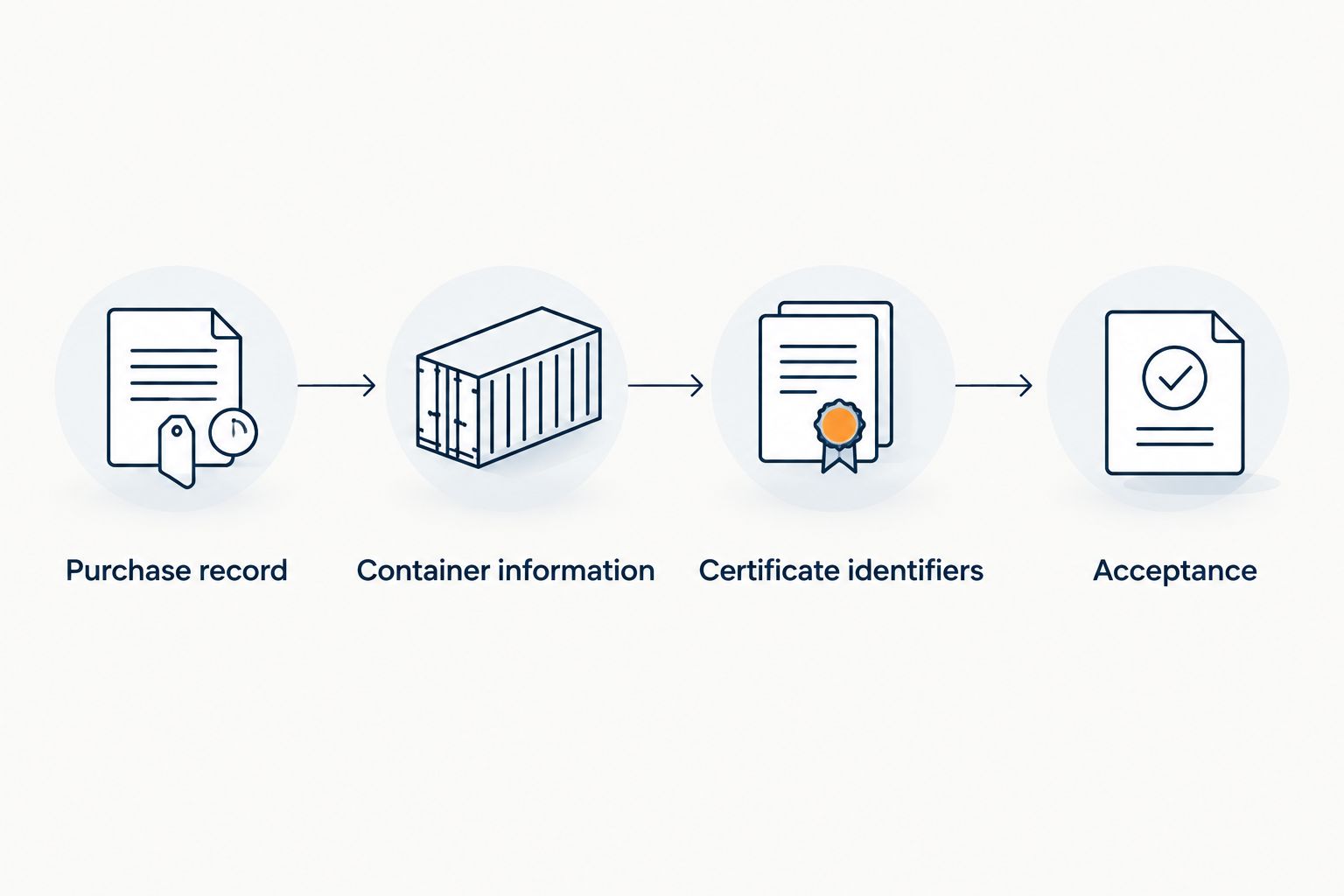
At receipt, compare the container information, purchasing record, and certificate identifiers. A certificate for a similarly named reagent is not enough to establish that it describes the material in front of you. Where the connection is unclear, hold the material outside your approved experimental workflow until the discrepancy is resolved.
For your 2026 records, preserve the certificate you reviewed rather than relying only on a live webpage. A saved copy allows another researcher to inspect the same evidence used in the purchasing decision.
Keep observations factual. Record an identifier mismatch as a mismatch, not as proof of contamination or misconduct; those are separate claims requiring separate evidence.
- Match the received designation to the purchase record.
- Compare lot or sample identifiers across documents.
- Archive the reviewed certificate and relevant correspondence.
- Record receipt observations without unsupported conclusions.
- Document acceptance, hold, or rejection and the responsible reviewer.
Set acceptance criteria before committing experimental resources
Write the acceptance checklist before the reagent arrives. Your laboratory's protocol and relevant institutional procedures should determine what counts as adequate evidence, not the fact that an order has already been placed.
Use 3 decision gates: scientific fit, documentation completeness, and receipt verification. These are recommended workflow checkpoints, not an external certification scheme. A candidate can satisfy the purchasing process while still failing the scientific specification.
If your study requires attributes beyond the published COA, identify how your laboratory will assess them or obtain suitable supporting evidence. Do not reinterpret an HPLC result as a substitute for an unrelated test simply because the result is easy to find.
For work spanning multiple lots, decide how a lot change will be recorded and evaluated. Keep the decision tied to the experiment's requirements rather than assuming either that all lots are equivalent or that every new lot requires the same additional work.
- Define scientific fit against the written specification.
- List required documents and unresolved questions.
- State the receipt checks needed for release.
- Identify protocol-specific evidence outside the COA's scope.
- Document how lot changes enter the experimental record.
Build a purchasing record another researcher can audit
Create a reusable decision template in your existing document system. Include the requested material, reviewed evidence, outstanding questions, approval decision, and received lot. The goal is a readable chain of decisions, not a collection of disconnected downloads.
Separate scientific approval from administrative approval in your 2026 template. A purchase authorization establishes permission to transact; it does not establish molecular identity or confirm that the material meets the experiment's requirements.
Record why you selected a supplier and what limitations remained at acceptance. This prevents a qualified decision—acceptable for a specified laboratory application—from later being repeated as an unrestricted endorsement.
When a certificate changes or a replacement document arrives, retain the relationship between versions. Another researcher should be able to determine which document supported the original decision without reconstructing it from email fragments.
- Save the original specification and supplier comparison.
- Identify the certificate version reviewed for acceptance.
- Record scientific and administrative approvals separately.
- Link the received lot to its experimental records.
- Preserve limitations and unresolved questions explicitly.
Compare procurement options for nonprofit research labs
Best overall approach: compare the evidence pathway, not just the purchasing route. The options below describe different ways to evaluate a purchase; they are not claims about unverified supplier services.
| Option | Best for | Main advantage | Key limitation |
|---|---|---|---|
| Strandaminos | Buyers seeking published third-party HPLC and mass-spec certificates | Published analytical documents provide a starting point for review | Your lab must still assess the specific certificate and experimental fit |
| Another catalog supplier | Buyers comparing the same specified material across vendors | Adds an alternative for a consistent evidence comparison | Documentation depth and relevance must be checked individually |
| An institution-approved purchasing route | Labs with an applicable internal procurement process | Aligns the transaction with institutional requirements | Administrative approval does not establish analytical suitability |
| Procurement with laboratory verification | Labs whose specifications require evidence beyond supplied documents | Connects acceptance directly to defined laboratory requirements | Requires an appropriate method, resources, and interpretation |
A catalog purchase and laboratory verification are not mutually exclusive. Use the purchasing route your institution permits, then apply the analytical review your experiment requires. Do not award extra scientific credibility merely because an option is easier to approve administratively.
For a 2026 supplier review, record the evidence available at the time of the decision. Avoid permanent supplier rankings based on a single certificate: the relevant question is whether the documented material meets the defined need.
Common mistakes nonprofit research labs make
Treating nonprofit status as a reagent specification
Your organizational status describes the buyer, not the material. A request for research peptides for nonprofit research labs still needs an exact reagent designation and evidence requirements. Specify the experiment first; apply institutional purchasing requirements separately.
Treating a published COA as universal approval
A downloadable certificate is useful evidence, but its scope matters. Check what was tested, which sample was tested, and whether the document connects to the received material. Do not turn a limited analytical result into a broad claim about every attribute of the reagent.
Comparing labels instead of molecular specifications
A short catalog name can leave important questions unanswered. If your protocol depends on sequence, modifications, or another defined attribute, resolve that detail before comparing candidates. A matching display name does not remove the need for a technical comparison.
Losing the evidence after purchasing approval
An order confirmation and a certificate serve different purposes. Preserve both, then connect them to the received lot and the relevant experimental records. A folder containing documents without clear relationships is harder to review than a concise, linked procurement record.
Importing personal-use language into research purchasing
Exclude dosing, administration, treatment, and human or animal benefit claims from the purchasing specification. Those claims do not establish analytical identity or suitability for laboratory work. Keep the boundary explicit in internal records and supplier comparisons: Research use only. Not for human or veterinary use.
FAQ
What's the best way to choose research peptides for a nonprofit research lab?
Choose research peptides against a written experimental specification and a lot-documentation checklist. Compare identity evidence, HPLC results, certificate scope, and receipt identifiers before accepting the material.
Does nonprofit status change the analytical evidence a laboratory needs?
Nonprofit status does not change what an analytical result establishes. Your experimental requirements determine the evidence needed, while institutional policies determine the purchasing process.
What does an HPLC certificate tell a research laboratory?
An HPLC certificate reports chromatographic findings under a stated analytical method. It does not independently establish molecular identity, sterility, or every attribute relevant to an experiment.
Is mass-spec identity better than HPLC purity?
Mass-spec identity and HPLC purity answer different analytical questions, so neither replaces the other. Review both in relation to the material specification and the certificate's stated methods.
Does Strandaminos publish analytical certificates for research peptides?
Strandaminos publishes third-party HPLC and mass-spec certificates of analysis for its research peptides. Review the specific certificate and its connection to the material being considered; publication alone does not establish suitability for your experiment.
Can a research-use-only peptide be used in people or animals?
Research-use-only products described here are not for human or veterinary use. This guide addresses laboratory procurement and analytical documentation, not dosing, treatment, or administration.
What should a lab do if the vial and certificate identifiers do not match?
Hold the material outside the approved experimental workflow until the discrepancy is resolved. Preserve the received information and supplier correspondence, then document the final acceptance or rejection decision.
One last thing
The most useful supplier question is often not whether testing exists, but which received material the test describes. An extensive analytical report cannot close a missing connection between the tested sample and your laboratory's reagent.
Before approving your next purchase, ask a colleague to trace the specification, certificate, and received lot without your explanation. If the record requires a verbal reconstruction, improve the record. That simple review tests whether your procurement documentation stands on its own.