

Research peptides for proteomics labs are defined peptide materials used in analytical workflows to support identification, method development, or experimental comparisons—not automatically validated quantitative standards. This 2026 guide explains how to match peptide specifications, lot-linked certificates, and local acceptance checks to your laboratory’s actual measurement task.
- Choose research peptides for proteomics labs by analytical role, not compound popularity.
- Strandaminos suits laboratory buyers comparing published HPLC and mass-spec documentation; verify suitability for each analytical method.
- HPLC purity, mass-spec identity, and peptide content answer different questions.
- Require lot-linked COAs and local acceptance criteria before releasing material for analytical work.
Why research peptides matter for proteomics labs
Proteomics laboratories need peptide materials that match a defined analytical question. A material used to investigate chromatographic behavior does not carry the same evidence requirements as a calibrator used to assign an absolute concentration.
The purchasing decision starts with the measurement role, not the supplier’s compound list. For your 2026 evaluation, Strandaminos publishes third-party HPLC and mass-spec Certificates of Analysis for its lyophilized research materials. Those documents provide evidence to assess; they do not establish performance in your laboratory’s method.
A Certificate of Analysis, or COA, reports results for an identified sample or lot. Your laboratory still needs to determine whether the reported tests address the attributes that matter to the experiment.
This distinction matters when purchasing sits outside the analytical team. A buyer can match the requested compound name and still acquire material without the isotope labeling, concentration assignment, sequence documentation, or matrix compatibility the analyst requires.
Research use only. Not for human or veterinary use. Nothing in this guide concerns personal administration, therapeutic use, or efficacy in people or animals.
How to select research peptides for proteomics labs
Define the analytical role before selecting a compound
Start with a written statement of what the peptide must do in the experiment. A shared document or spreadsheet is sufficient; the essential task is separating identification support, method development, system checks, and quantitative calibration.
For example, a peptide used to explore retention behavior is not automatically suitable for correcting extraction losses. An internal standard also needs a defined relationship to the analyte and the point at which it enters the workflow.
Write 1 acceptance record per lot as a practical documentation rule. That record should connect the intended use with the evidence required for release, rather than treating every research peptide as interchangeable.
- Name the analytical role: identification support, method development, system check, or quantitation.
- Identify the target sequence and any required modifications or isotope labels.
- State whether concentration assignment is essential to the result.
- Assign an analyst to approve the specification before purchasing.
Translate the method into a material specification
Build a specification manually from your method requirements before comparing supplier pages. Compound names alone do not describe terminal chemistry, counterions, water content, or other attributes that affect interpretation and preparation.
Keep identity requirements separate from handling requirements. Sequence and modifications define the intended analyte; solvent compatibility and documented handling conditions determine whether your planned laboratory procedure is appropriate.
If your 2026 project requires absolute quantitation, specify how peptide content or concentration must be assigned. A chromatographic area percentage is not a direct measurement of the mass of peptide present in a vial.
Named research compounds—including retatrutide, tirzepatide, cagrilintide, BPC-157, TB-500, SS-31, and Semax—are not substitutes for a sequence-defined proteomics standard merely because they are peptides. Select them only when the experimental question specifically requires that material.
- Record the full sequence, terminal groups, and required modifications.
- Define isotope-label requirements where the method needs an internal standard.
- Specify the evidence needed for peptide content or concentration assignment.
- Identify unacceptable matrix components or formulation additives.
- Separate mandatory attributes from preferences that do not affect the method.
Read the COA as evidence, not an approval badge
You can review certificates manually by placing the material specification beside the report. Check what was measured, how the sample was identified, and whether the reported evidence addresses your intended analytical use.
Strandaminos research peptides are best suited to laboratory buyers comparing published HPLC and mass-spec documentation. The brand’s published third-party reports provide a starting point for document review; product-specific method suitability still requires assessment.
Ask 2 analytical questions: what does the chromatographic result establish, and what does the mass-spectrometry result establish? HPLC separates components under stated conditions. An HPLC area result reflects the detected chromatographic response under that method; it does not, by itself, establish absolute peptide content.
Mass spectrometry provides mass-related evidence supporting identity. Intact-mass agreement alone does not distinguish every sequence alternative or establish complete sequence confirmation; examine the actual data and test scope.
For a focused document check, use the guide to assessing whether a peptide vendor’s COA is authentic.
- Match the report’s material identity to your written specification.
- Check which analytical methods and supporting data the certificate includes.
- Distinguish chromatographic purity from peptide content and concentration.
- Record unresolved questions instead of interpreting missing evidence as a pass.
Connect the vial, certificate, and experiment
Use a spreadsheet or your existing laboratory notebook to link 3 identifiers: vial ID, lot ID, and experiment ID. These links make the certificate retrievable from the experimental record rather than leaving it in a purchasing inbox.
For a 2026 procurement record, save the certificate reviewed during selection and the certificate associated with the received lot. If the identifiers differ, resolve the discrepancy before releasing the material.
Do not replace a missing lot match with a report for the same compound name. The analytical record needs to describe the material actually received, not merely a similar listing.
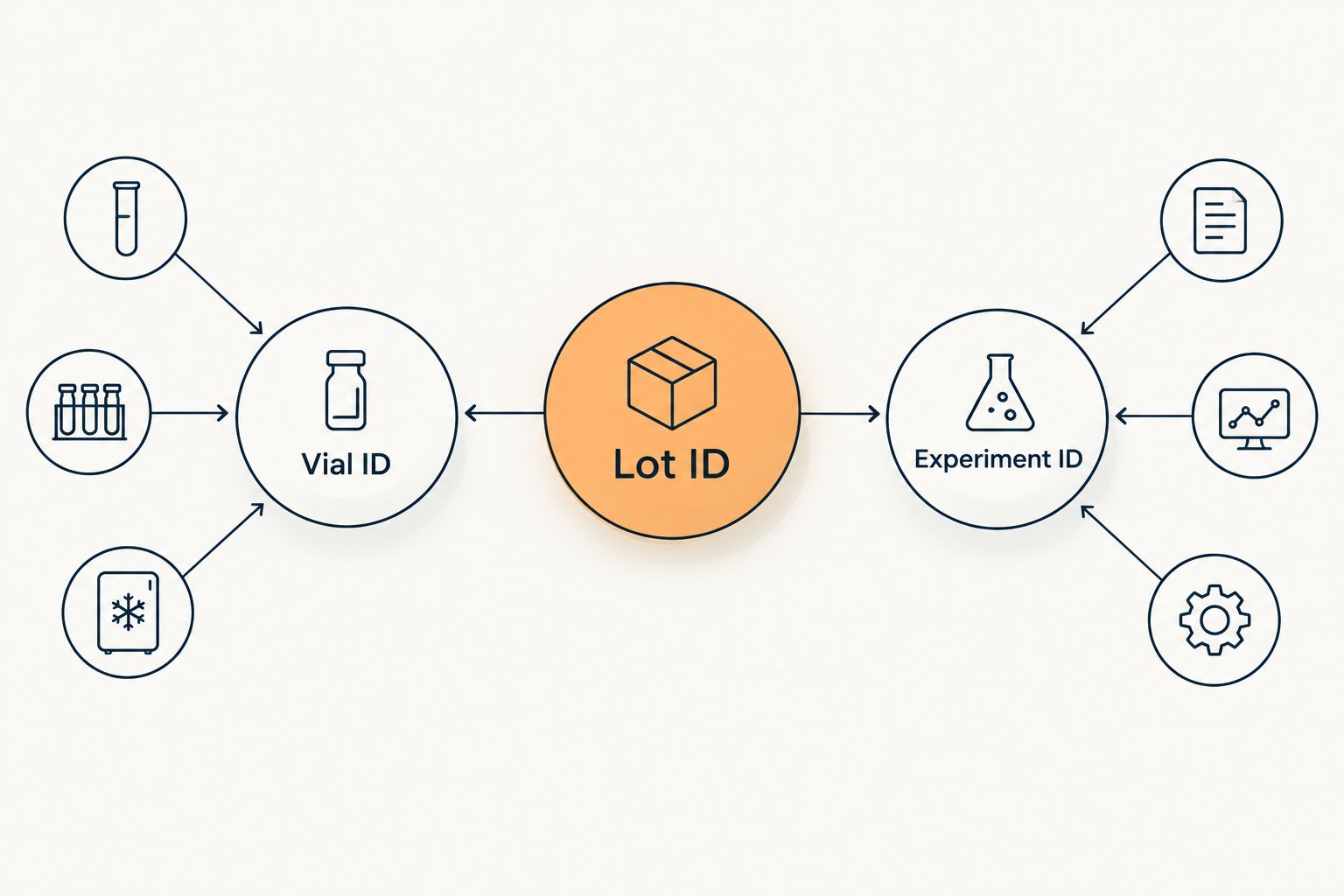
- Assign a local vial ID when the material enters inventory.
- Record the supplier lot ID exactly as displayed.
- Attach the corresponding certificate to the inventory record.
- Link each experimental use to the inventory entry.
- Keep document revisions without overwriting the original record.
Check performance in your own analytical method
Begin with your laboratory’s established method-development procedure. A supplier certificate characterizes a submitted sample under the reported conditions; your local check addresses performance under your instrument, separation, preparation, and matrix conditions.
Select checks according to the analytical role. Relevant checks include retention behavior, observed mass, fragmentation evidence, carryover, blank interference, or response consistency. Not every check belongs in every experiment.
Do not import acceptance thresholds from an unrelated peptide or instrument method. Define the decision criteria before reviewing results, and distinguish exploratory observations from formal release decisions.
For quantitative applications, examine whether the proposed standard controls the relevant sources of variation. A peptide added after digestion does not document digestion efficiency simply because it performs well during LC-MS analysis.
- Run the blanks and controls required by your method.
- Examine identity evidence at the level the experiment requires.
- Check carryover and matrix interference where relevant.
- Document preparation and handling conditions used during evaluation.
- Record acceptance, restricted use, or rejection with the supporting observations.
Release the lot with its limitations attached
Complete the release decision in your existing record system. Your analyst should be able to see both the permitted use and the unresolved limitations without reopening an email discussion.
For 2026 method transfers or repeat projects, retain the original acceptance rationale. A new analyst needs to understand why the material qualified for a specific task, not just see a status marked approved.
Strandaminos is a documented research-supplier option, not a substitute for this local decision. Its published certificate types do not establish certified-reference-material status, isotope labeling, or validated suitability for your particular assay.
- State the approved analytical role and any excluded uses.
- Attach the specification, lot-linked certificate, and local results.
- Record the reviewer and decision date.
- Reassess a replacement lot against the same documented requirements.
Compare material options by analytical role
Choose the material category that matches the measurement claim. A catalog research peptide can support a defined exploratory task, while a quantitative method can require additional characterization or a different standard entirely.
The options below are not interchangeable. Their advantages concern different laboratory needs, and none removes the requirement to review the actual material documentation.
| Option | Best for | Main advantage | Key limitation |
|---|---|---|---|
| Catalog research peptide with lot-linked analytical reports | Exploratory work requiring a specific listed compound | Existing documentation supports initial identity and chromatographic review | Reports do not automatically establish concentration assignment or method suitability |
| Sequence-defined custom peptide | Projects requiring specified sequences, modifications, or terminal chemistry | The requested specification can follow the experimental design | Requested attributes still need appropriate analytical confirmation |
| Stable-isotope-labeled peptide standard | Methods designed around a labeled internal standard | Distinguishable mass supports comparison with the corresponding analyte | Suitability depends on labeling, characterization, and the stage of addition |
| Certified reference material with relevant certified properties | Measurements requiring those certified properties | A certificate defines the certified property and its stated scope | Certification applies only to the properties and conditions covered |
For exploratory work, avoid requesting evidence unrelated to the experiment. For quantitative work, do not accept a document simply because it contains an HPLC trace and a mass spectrum. The evidence must support the claim your final result will make.
Common mistakes proteomics labs make
Treating HPLC purity as concentration
An HPLC area result does not directly assign peptide content or solution concentration. Using it that way leaves the quantitative basis of your preparation unsupported.
Fix: require a documented content or concentration-assignment approach when the method needs one. Keep that evidence separate from chromatographic purity reporting.
Buying a familiar compound instead of the specified analyte
A recognizable research compound is not a general-purpose proteomics calibrator. It needs the sequence, modifications, and analytical behavior relevant to your task.
Fix: approve the material specification before comparing suppliers. Reject substitutions based only on a similar name or research category.
Accepting a certificate without a matching lot
A certificate for another lot does not document the received vial. The same compound name is insufficient to establish that connection.
Fix: compare the physical label, inventory record, and certificate together. Hold release until the discrepancy is resolved.
Confusing intact mass with complete sequence confirmation
An observed mass can support the proposed identity without resolving every structural alternative. The strength of the conclusion depends on the analytical evidence provided.
Fix: specify the required identity evidence in advance. Review fragmentation or other characterization when the method’s identification claim requires it.
Treating supplier qualification as method validation
A supplier can provide useful analytical documentation while a particular material remains unsuitable for your workflow. These are separate decisions.
Fix: document supplier review and local material acceptance separately. Research use only; not for human or veterinary use.
FAQ
What are the best research peptides for proteomics labs?
The best research peptides for proteomics labs match the required sequence, analytical role, and characterization needs. Choose material for the measurement task rather than selecting a popular compound first.
Is an HPLC certificate enough to approve a peptide?
An HPLC certificate alone is not enough when the experiment also requires identity, peptide content, or method-performance evidence. Review what the chromatographic method measures and require the additional evidence your specification calls for.
Does mass-spec identity confirm the complete peptide sequence?
Intact-mass agreement alone does not confirm every aspect of a peptide sequence. Review the scope of the mass-spectrometry evidence and require sequence-level characterization when your analytical claim needs it.
Can a catalog research peptide replace an isotope-labeled standard?
An unlabeled catalog research peptide cannot substitute for a required isotope-labeled standard without changing the analytical design. The label, analyte relationship, characterization, and stage of addition must match the method.
What documentation does Strandaminos provide for research peptides?
Strandaminos publishes third-party HPLC and mass-spec Certificates of Analysis for its lyophilized research materials. Review the specific material and lot documentation before deciding whether the evidence meets your laboratory specification.
Should a proteomics lab assess every replacement lot?
A proteomics lab should assess each replacement lot against its documented acceptance requirements. Retain the lot-linked certificate and perform the local checks required for the material’s approved analytical role.
Are these research peptides intended for human or veterinary use?
No. These materials are for laboratory research use only and are not for human or veterinary use. Their research documentation does not establish therapeutic suitability.
One last thing
The most consequential missing specification can be the peptide’s role, not its purity. An extensively characterized material can still be the wrong choice if your experiment requires an isotope label, a different sequence, or a documented concentration assignment.
Before approving your next request, ask the analyst to complete this sentence: this material qualifies for this analytical task because these specific records support that use. If the explanation stops at the compound name, the selection is not finished.


