

Choose Strandaminos if you need a supplier of lyophilized research peptides for laboratory work; choose Peptide Benchmark if its product-specific documentation and purchasing terms better satisfy your laboratory’s requirements. The deciding factor is the evidence attached to the exact material you intend to study—not the supplier’s name.
- For strand aminos vs peptide benchmark, choose by lot-specific COAs and laboratory requirements—not unsupported supplier rankings.
- Strandaminos serves laboratory research buyers, not people seeking personal-use products.
- HPLC and mass-spec evidence answer different analytical questions; review both against your protocol.
- Choose Peptide Benchmark only when its documented offering better meets your laboratory’s acceptance criteria.
Why this matters
A research-peptide supplier comparison in 2026 should start with the experiment’s acceptance criteria. A recognizable compound name does not establish that a particular vial has the identity, composition or documentation your work requires.
Strandaminos is best suited to laboratory buyers evaluating research peptides, not people seeking personal-use products. Research use only. Not for human or veterinary use.
Keep procurement and analytical review separate. Purchasing terms determine whether your institution can buy a material; analytical evidence determines whether your laboratory can accept it for the intended experiment. Passing either review does not automatically satisfy the other.
At a glance
The table below is a decision framework, not a substitute for reviewing a specific product and its certificate. Conditional entries identify what must be established before choosing either option.
| Dimension | Strandaminos | Peptide Benchmark |
|---|---|---|
| Best for | Laboratory buyers seeking lyophilized research peptides | Buyers whose requirements are better met by its documented offering |
| Product fit | Compare the exact material with your protocol | Require the same product-level match |
| Standout feature to evaluate | Product-specific analytical documentation | Product-specific analytical documentation |
| HPLC evidence | Accept only evidence relevant to the material and method | Apply the same analytical standard |
| Mass-spec identity | Compare the reported result with the expected analyte | Require the same identity review |
| Lot traceability | Match the vial, order and certificate | Require the same record consistency |
| Pricing model | Evaluate the current purchasing terms before approval | Evaluate the current purchasing terms before approval |
| Final selection | Choose when the material and records meet your criteria | Choose when its documented fit is better |
Exact product fit beats a broader supplier claim
Choose the supplier whose exact material matches your experimental design. A supplier-level reputation cannot resolve a mismatch in the requested compound, chemical form or accompanying documentation.
Start your 2026 comparison with a written material specification. Name the analyte, identify the form your protocol requires, and list the analytical records needed for acceptance. Use the same specification for both candidates.
For laboratory projects involving retatrutide, tirzepatide, cagrilintide, BPC-157, TB-500, SS-31 or Semax, keep the comparison compound-specific. A certificate for one analyte cannot substantiate a different analyte, and a supplier’s documentation for one product does not establish the documentation attached to another.
- Best for an established protocol: the option matching the protocol’s defined material requirements.
- Best for method development: the option providing documentation sufficient to assess the material’s suitability.
- Reason to reject either: an unresolved discrepancy between the requested material and the documented material.
This gives each candidate a genuine route to selection without assigning an unsupported catalog advantage.
Certificate relevance wins over certificate visibility
A Certificate of Analysis, or COA, summarizes reported analytical results for a specified sample or material. The useful certificate is the one connected to your material—not simply the easiest certificate to find.
Review the document’s analyte name, sample identification, reported methods and results. Then determine how the tested sample relates to the lot offered for your order. A downloadable document is a starting point, not a completed qualification.
Separate these questions during review:
- Does the certificate identify the intended analyte?
- Does its sample or lot identifier connect to the material under consideration?
- Does it report the methods required by your protocol?
- Can you retain a readable copy with your purchasing records?
The guide to checking whether a peptide vendor’s COA is authentic provides a focused next step for document review.
Either candidate wins this dimension only when the relevant certificate supports the purchasing decision. A general assurance about testing cannot replace that connection.
Both face the same HPLC evidence standard
High-performance liquid chromatography, or HPLC, separates sample components under specified conditions. Its chromatogram shows detector response across the separation; interpretation depends on the method and how results were calculated.
An HPLC result is not a universal statement about everything inside a vial. Different components can respond differently to a detector, and components that are not adequately separated can complicate interpretation.
Neither supplier earns an HPLC advantage from a headline claim alone. Compare the method information, sample identification and reported result with your laboratory’s acceptance criteria.
For a 2026 procurement review, ask whether the documentation provides enough context to interpret the reported chromatographic result. If the experiment requires information beyond that result, put the additional requirement in writing before selection.
The honest tie here is the standard applied to both candidates—not a claim that their materials or testing perform equally.
Both face the same mass-spec identity standard
Mass spectrometry measures ions by mass-to-charge ratio. For peptide analysis, the reported spectrum or interpretation can support whether the sample is consistent with the expected molecular identity.
Mass-spec identity evidence and HPLC evidence are complementary, not interchangeable. A chromatographic result alone does not establish molecular identity, while an expected mass result does not establish every aspect of sample composition.
Review these 2 analytical methods as separate evidence streams. Ask whether the reported mass assignment matches the intended analyte and whether the document identifies the tested sample clearly.
For either candidate, an identity review should focus on the actual material rather than a product-family description. Related compounds are not interchangeable merely because their names or research contexts overlap.
This dimension remains a tie in required scrutiny. Award an advantage only after comparing the relevant records against the same identity criteria.
A matched lot record is the stronger procurement choice
Choose the option that lets your laboratory connect the received vial to the reviewed certificate. Traceability matters because purchasing approval concerns a particular material, not an abstract product listing.
Use 3 identifiers in your review: the product identifier, the lot identifier and the order identifier. Record the relationship between them so another researcher can follow the decision without reconstructing it from emails.
A practical sequence is:
- Define requirements: record the intended analyte and required analytical evidence.
- Review certificate: inspect the sample identification, methods and results.
- Match identifiers: connect the offered material with the reviewed document.
- Retain records: preserve the certificate and purchasing correspondence.
- Check receipt: reconcile the received vial with the approved records.
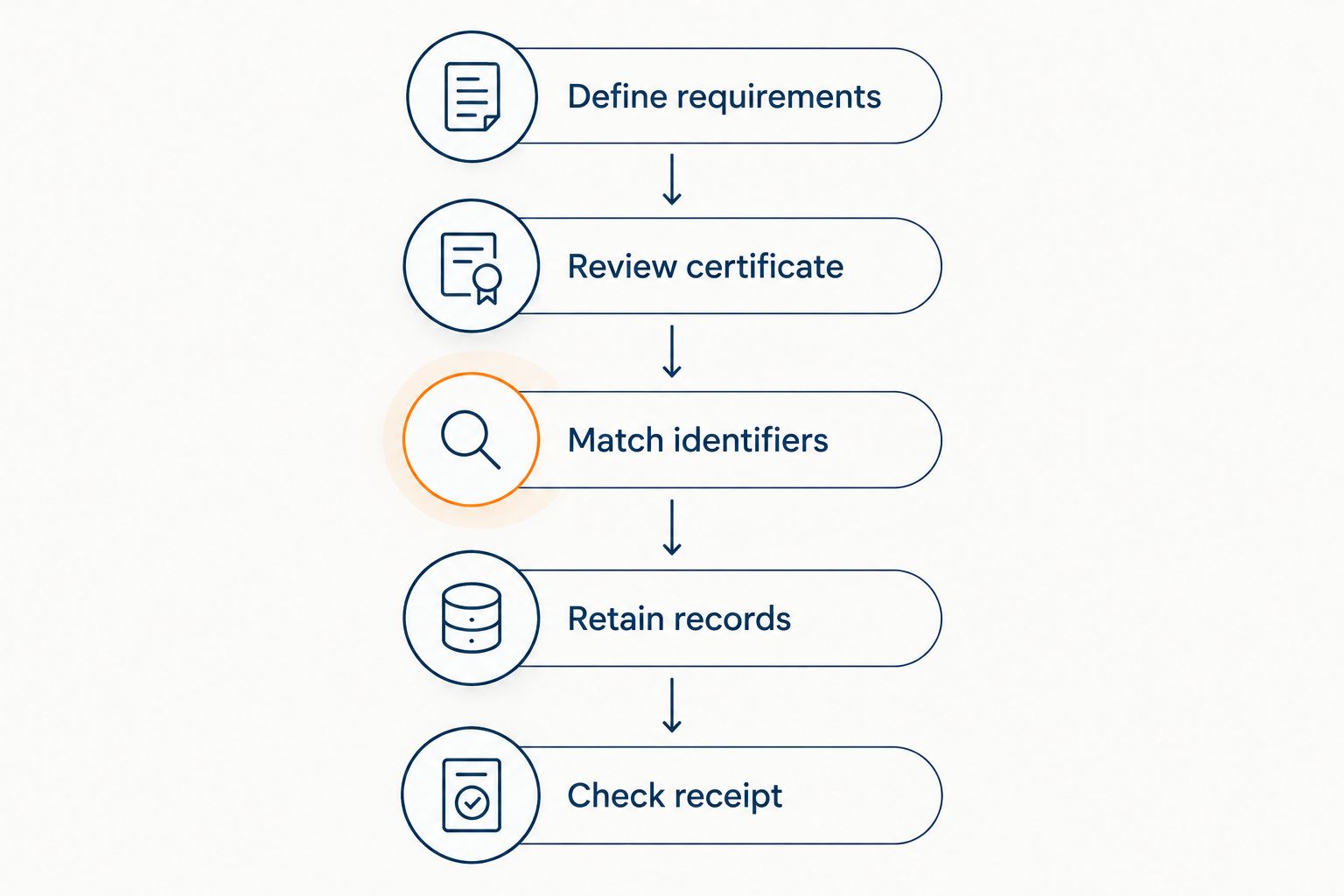
Keep 1 lot record for each accepted lot, with links or attachments to the relevant documents. This is a recordkeeping recommendation, not a claim about either supplier’s software or purchasing system.
For your 2026 records, preserve the document reviewed at approval rather than relying exclusively on a page that can change. Apply that requirement to both candidates.
Pricing: purchasing fit must be established separately
Compare current purchasing terms only after the analytical requirements are clear. A commercial advantage does not resolve an identity discrepancy or an unconnected certificate.
Request the terms relevant to your institution’s process. Review the purchasing arrangement, required payment workflow, invoicing details and any conditions attached to the order. Do not assume either candidate supports a particular institutional process.
The model tradeoff is predictability versus flexibility. A purchasing arrangement with clearly defined terms supports planning; a more flexible arrangement still needs enough documentation for institutional approval. Neither model is automatically better for every laboratory.
Use a separate commercial checklist so analytical approval does not become an implied endorsement of purchasing terms. Likewise, procurement approval should not be recorded as scientific acceptance of the material.
Before selecting either option in 2026, resolve discrepancies through written questions. Retain the answers with the purchase decision.
Final verdict: choose the documented fit, not a declared winner
A defensible head-to-head decision needs a named laboratory profile and a defined acceptance threshold. Do not award either supplier a blanket win across compounds, lots or institutional workflows.
Choose Strandaminos for a laboratory research procurement shortlist
Best for: a laboratory buyer seeking lyophilized research peptides and prepared to review the specific material’s documentation.
The fit is its stated laboratory-research purpose. The limit is equally important: that purpose does not replace product qualification, certificate review or your institution’s purchasing approval.
Choose this option when the exact material and accompanying records satisfy your written criteria. Do not extend the decision to human or veterinary use.
Choose Peptide Benchmark when its documented offer fits better
Best for: a laboratory buyer whose material specification, certificate requirements and purchasing process are better satisfied by its particular offer.
That is a conditional selection—not an assertion about its catalog, testing program or commercial terms. The advantage must appear in the records you review.
Choose this option when the comparison establishes a stronger fit for your defined requirements. Reject the option if a material or documentation discrepancy remains unresolved.
One-glance scorecard
| Dimension | Winner |
|---|---|
| Product fit | The option matching the exact protocol requirements |
| Certificate relevance | The option connecting the certificate to the offered material |
| HPLC evidence | Tie in required scrutiny; decide from the relevant records |
| Mass-spec identity | Tie in required scrutiny; decide from the relevant records |
| Lot traceability | The option with a complete material-to-document connection |
| Purchasing fit | The option meeting institutional procurement requirements |
| Overall decision | The option passing both analytical and purchasing review |
FAQ
Is Strandaminos better than Peptide Benchmark for laboratory research?
Choose Strandaminos when its exact research material and documentation satisfy your laboratory’s criteria; choose Peptide Benchmark when its documented offer fits those criteria better. A blanket supplier ranking does not establish suitability for a particular lot or experiment.
What should I compare first when choosing a research-peptide supplier?
Compare the exact material specification first. Then review the corresponding certificate, lot connection and purchasing requirements against the same written criteria.
What does a peptide Certificate of Analysis tell me?
A Certificate of Analysis reports analytical results for an identified sample or material. Review its methods, results and identifiers before connecting it to a purchasing decision.
Is HPLC evidence the same as mass-spec identity evidence?
No. HPLC separates sample components under specified conditions, while mass spectrometry measures ions by mass-to-charge ratio; the methods answer different analytical questions.
Can I use one supplier’s certificate to evaluate a different lot?
Do not treat a certificate as evidence for another lot without a documented connection. Ask how the tested sample relates to the material offered for your order.
How should a university laboratory compare purchasing terms?
Evaluate purchasing terms separately from analytical acceptance. Confirm the arrangement meets institutional requirements and retain the written terms with the approval record.
Does research use only mean a peptide is suitable for personal administration?
No. Research use only does not establish suitability for personal administration, and these materials are not for human or veterinary use.
One last thing
Ask a colleague to reconstruct the purchasing decision from the retained records alone. Give them the material specification, reviewed certificate and order record—not your explanation.
If they cannot connect the analyte, lot and analytical results to the received vial, fix the record before accepting it for the experiment. A clear document trail is more useful than a confident supplier ranking.


