

There is no single average vial strength for research peptides in 2026. Strength is set per product and per lot, and the only reliable source is the product listing cross-checked against the lot's Certificate of Analysis (COA). This page shows how to read it, how to compare it across peptides, and which numbers to leave alone. Research use only. Not for human or veterinary use.
- Vial strength by research peptide is not a fixed average: it varies by product, lot and supplier.
- Read strength from the product listing, then confirm it against the lot-matched COA.
- Compare peptides in molar terms, since a 15-residue and a 4-residue peptide differ in mass per mole.
- Strand Aminos pairs lyophilized vials with third-party HPLC and mass-spec certificates. Research use only.
Short answer: why this page has no average table
A benchmark table needs sourced numbers for every row. The inputs behind this page do not include a verified, dated vial-strength dataset across suppliers, so no averages are printed here. Inventing a "typical" figure for retatrutide or BPC-157 would give you a number nobody can audit.
The verdict: treat vial strength as a lot-level specification, not an industry constant. A figure quoted on a forum or a comparison site is a starting hypothesis. The COA for the lot in your freezer is the record.
Why this matters
Strength is the input to every downstream calculation a lab runs: stock concentration, aliquot planning, replicate budgets, cost per milligram. If the number is off by a labeling difference, every later figure inherits the error.
Two vendors can list the same peptide at different vial sizes. A third may list the same size but fill to a different net content. Comparing price per vial without comparing strength per vial is the most common mistake in supplier comparisons. For cost framing, see the GLP-1 research peptide cost per milligram breakdown.
What "vial strength" means on a listing
Vial strength is the labeled peptide content of one lyophilized vial, stated in mass (milligrams). Three related numbers get confused with it:
- Labeled content: the mass the supplier states for the vial.
- Net peptide content: the share of the lyophilized powder that is actually peptide, as opposed to counter-ions, water and residual salts.
- Chromatographic purity: the fraction of the peptide signal in an HPLC trace that belongs to the target compound.
These are three different measurements. Purity does not tell you content, and content does not tell you identity. Identity comes from mass spectrometry. The difference between HPLC and mass-spec verification is worth reading before you compare any two certificates.
Reference table: what to check by research peptide
This table lists the structural facts that change how you compare strength across compounds. It carries no strength averages by design.
| Peptide | Class (research context) | Why it affects strength comparison | Best for |
|---|---|---|---|
| Retatrutide | Triple GIP, GLP-1 and glucagon receptor agonist | Large molecule; compare in moles, not just milligrams | Incretin pathway studies |
| Tirzepatide | Dual GIP and GLP-1 receptor agonist | Large molecule; lot-specific content matters | Incretin pathway studies |
| Cagrilintide | Amylin analog | Different receptor family than the incretins; do not pool with them | Amylin signaling studies |
| BPC-157 | 15-residue pentadecapeptide | Small molecule; more moles per milligram | Tissue-repair models in vitro |
| TB-500 | Synthetic thymosin beta-4 fragment | Confirm which sequence the COA identifies | Cell migration assays |
| SS-31 | 4-residue mitochondria-targeted tetrapeptide | Very low mass per mole; milligram comparisons mislead | Mitochondrial research |
| Semax | 7-residue heptapeptide, ACTH(4-10) analog | Short sequence; check identity by mass spec | Neuroscience models |
Residue counts above are published sequence facts. Nothing in the table implies use in people or animals.
High and low commentary: where milligram comparisons break
The widest gap in this table is molecular size. SS-31, at four residues, carries far more molecules per milligram than the large incretin-class compounds. A vial of one and a vial of the other cannot be ranked by milligrams alone. Rank them in moles, or you are comparing different units.
BPC-157 and Semax sit in the middle: short enough that the same labeled mass gives noticeably more molecules than a tirzepatide vial. The practical rule is that the smaller the sequence, the more misleading a raw milligram comparison becomes.
Methodology and limitations
The table draws on published sequence and class information for each compound. It does not draw on a supplier survey, and it does not report purity, content or price figures. The main limitation: strength and net peptide content are lot-specific, so any cross-supplier average built from listings alone would hide lot-to-lot variation.
How to read strength from a COA
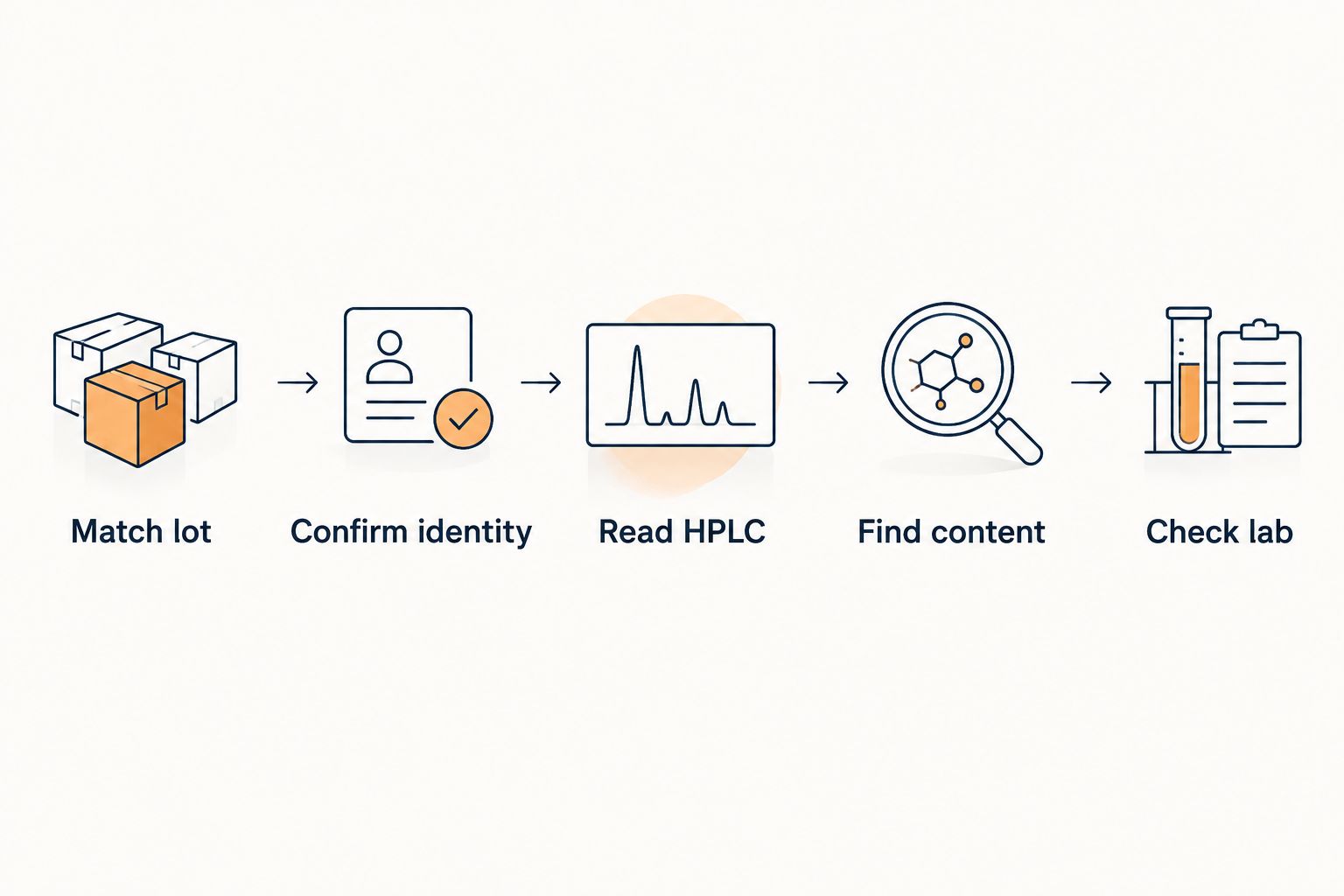
A COA is only useful if it matches your vial. Work through it in this order:
- Match the lot number on the vial label to the lot on the certificate. A mismatch ends the review.
- Confirm identity from the mass-spec section: the observed mass should correspond to the expected mass of the named sequence.
- Read the HPLC trace for the main peak and any secondary peaks. Check which method, column and detection wavelength the lab reports.
- Find the content statement. If the certificate reports only chromatographic purity and no content, the labeled vial strength is unverified by that document.
- Check the testing lab. A third-party lab name, date and signature give you something to audit. Authenticity checks are covered in how to tell whether a vendor's COA is authentic.
Strand Aminos publishes third-party HPLC and mass-spec certificates with its lyophilized research peptides, which gives you a lot-level document to run this checklist against. Read the specific certificate for the specific lot; do not assume one lot's certificate describes another.
How to use these comparisons
Four takeaways follow from the table and the checklist.
- Convert before you compare. Express strength in moles using the sequence's molecular weight, then compare price per mole across suppliers. The method is laid out in calculating peptide concentration from a COA.
- Compare within a class. Rank tirzepatide against retatrutide and cagrilintide against other amylin analogs. Cross-class strength comparisons say little.
- Log the lot, not the product. Record lot number, COA date and labeled strength in your tracking sheet so results trace back to a specific vial.
- Treat missing content data as a gap. If a listing gives only a vial size and no content measurement, plan for that uncertainty in your stock preparation.
For side-by-side supplier coverage of one compound, the retatrutide research peptide comparison applies the same logic to a single sequence.
Common mistakes in 2026 vial comparisons
- Treating the vial label as a measurement rather than a claim.
- Comparing purity percentages between suppliers that used different HPLC methods.
- Pooling peptides of very different sizes into one price-per-milligram chart.
- Reading a COA from a prior lot because the product name matches.
- Skipping the identity section because the purity section looked clean.
Each of these produces a number that looks precise and is not.
Ask about a specific lot
Questions on COA contents or vial specifications for research use.
FAQ
What is the average vial strength by research peptide in 2026?
No single average exists. Vial strength is set per product and per lot, so the reliable source is the listing plus the lot-matched COA.
Is vial strength the same as purity?
No. Strength is the labeled peptide content of the vial. Purity is the share of the HPLC signal belonging to the target compound. They are separate measurements.
Why can't I compare peptides by milligrams alone?
Sequence length changes mass per mole. A short peptide like SS-31 holds far more molecules per milligram than a large incretin-class compound, so compare in moles.
Where do I find vial strength on a COA?
Look for a content or assay statement. If the certificate reports only chromatographic purity and identity, the labeled strength is not verified by that document.
Does a COA for one lot apply to another lot?
No. Certificates are lot-specific. Match the lot number on the vial to the lot number on the certificate before relying on any figure.
What does mass spectrometry add to a COA?
It confirms identity: the observed mass should match the expected mass of the named sequence. HPLC alone does not establish identity.
Are these peptides for human or animal use?
No. Strand Aminos peptides are sold for laboratory research only. Research use only. Not for human or veterinary use.
One last thing
The most useful column in any supplier comparison is the one most listings leave out: the lot number on the certificate next to the lot number on the vial. If you build a 2026 tracking sheet around one habit, make it that match. Everything else, strength, purity and cost per mole, is only as good as that link. Start from the Strand Aminos catalog and read the certificate before you read the price.
Research use only. Not for human or veterinary use. 21+.


